Continuity and Change at The Retreat

Written by Jenny Mitcham, Digital Archivist, Borthwick Institute

Arranging a tour of the grounds of the Retreat for a morning in January was a bit of a risk. We were truly at the mercy of the elements! We were fortunate however to have picked a day when there was no snow or ice on the ground and nothing falling from the sky. Saying that, this was one of the coldest weeks for a while and the temperatures only just peaked at a chilly 1 degree celsius as we were shown around the extensive grounds of the hospital.

We have been lucky enough to receive funding from the Wellcome Library to digitise the archive of The Retreat (a psychiatric hospital that is situated right next to the University of York where the Borthwick is based). We are several months into the project now and are in the process of delivering the 3rd of 10 batches of digital images to Wellcome for ingest and processing before inclusion in their library catalogue.

Last week our in-house resident expert on the Retreat archive, Kath Webb took the project team around the grounds of the hospital and gave us a talk on its buildings, history and on some of the key figures involved with shaping the institution since it was opened in 1796.

It really is a fascinating place and has a key position not only in the history of mental health care, but in Quaker history and the history of York. It was great to see the full extents of the grounds, and hear how the land and its buildings have evolved and developed over time. Lots has changed but there was also a surprising level of continuity. Landscape features and plantings that are visible on early plans and images of the Retreat and are now being re-established. Some of the ‘newer’ additions to the archive held at the Borthwick Institute are a set of large 20th century plans of the Retreat grounds, showing planting and marking positions of trees, and allied to these there are some Retreat ‘tree books’ noting trees and plantings – a rich source of information for the modern gardeners.

Black and white photograph of a cricket match in progress
A cricket match in progress in the Retreat grounds in the early 20th century (reference RET 1/8/4/16/2)

We were taken to the sports fields at the back of the Retreat and later in the day were shown old black and white photographs of the staff cricket and hockey teams that played there. We went into the burial ground where local Quakers and Retreat residents had been buried. Very simple headstones stood in rows, but recognisable names from the archives were all around us.

The project team are used to the cold (working as they do in an archive where we try and maintain temperatures that will cause the least stress to the documents within our care) however by the end of the tour we were starting to lose feeling in our fingers and toes and were glad to get back to the office and get the kettle on. It was great to have some time out to understand and appreciate the character of the Retreat and put the work we are all doing on this project into context.

The Wellcome Library will be releasing the digital surrogates that we create on a rolling schedule as we deliver them. We are excited to be able to announce that the first small batch is already available via the Wellcome Library Catalogue.

Black and white photograph of the women's hockey team
The women’s staff hockey team in 1902 in the grounds of the Retreat (reference RET 1/8/4/15/1)

We are working through the Retreat archive in the order it appears within our catalogue so the first small test batch falls within the general administrative section and consists primarily of minute books from directors meetings from 1792 to 1928.

See for example the first item within the catalogue (archival reference RET 1/1/1/1), a minute book from 28 June 1792 to 24 June 1841. On the Wellcome Library catalogue we can see both the catalogue description of the item and the digital surrogates produced by our digitisation team and displayed within a viewer that allows you to move to the page of interest, zoom into the text and pan around the document.

The Wellcome Library viewer in 2015

This is just a taster of what is to come. We hope to highlight other interesting items from the archive as the project progresses so watch this space.

Slow and Steady Wins the Pace

Written by students from the University of York on a work experience placement.

The renowned ecclesiastical architects Pace and Sims were prolific. Both were involved in a wide range of projects, from restoring Castle Howard, to designing memorials at churches and cathedrals, and constructing imposing new buildings such as Keele University chapel. During our work experience project, we unfortunately did not see any of the plans for the new builds. However, we were lucky enough to get the opportunity to catalogue renovations and extensions, which showed their subtle skill in combining modernism with medievalism. Indeed, Durham University’s Palace Green library bears witness to this. Another aspect revealed through the archives is the careful, methodical way in which they worked; it often took many years for projects to be completed for they were known for working at a slow pace. In fact, George earned the nickname ‘Snail’s Pace’ for this very reason! 

The firm became one of Europe’s most productive ecclesiastical architecture practices, with over 700 churches and cathedrals being built, extended, and updated by Pace and Sims. This is certainly reflected in the Borthwick’s collection. Whilst they did work for larger and more famous churches such as Armagh and Newcastle cathedral, the majority of their work focussed upon the parish church, like St Mary’s, Beverley, St Giles’, Copmanthorpe, and St Mary’s, Northchurch. 

St Mary’s Northchurch has an ancient history; the church claims to be one of the oldest in Hertfordshire. It is believed that a Saxon church was on the site and some Saxon stonework can still be seen in the west and south walls. The majority of the building is related to the 13-15th century, which matches the parish church expansion pattern seen nationally, as well as some Victorian additions (a vestry, a porch and a new north aisle). Sims was involved in quite a radical alteration of the interior of the church: the choir stalls and organ were moved from the north transept to the west end of the church. This significantly altered worship as it affected the acoustics and the procession. However, the changes did not end here as a new nave altar was built underneath the crossing. The Victorian interior was thus heavily impacted upon by Sim’s efforts. The simple but robust style effortlessly blends into the sensitive Victorian-cum-Medieval décor. 

Copmanthorpe Church in York has a similarly extensive history with its Roman and Saxon roots. It began life as a Norman single cell church but slowly expanded over time; its plain outside does not continue inside as the elegant beamed roof adds a touch of symmetrical sophistication. St Giles’ church required some more modern features and hence, Sims was called upon. He designed a new vestry and kitchen. Whilst searching through the archive we discovered extensive sketches and photographs of what the interior was to look like as well as being treated to a photograph of the finished product. 

 In Beverley stands the beautiful church of St Mary’s, called by Sir Tatton Sykes in the 19th century, ‘Lovely St Mary’s, unequalled in England and almost without rival on the continent of Europe!’ It has undergone numerous building phases. Indeed, in the mediaeval period building work was almost continuous. This is reflected in a plan, from 1895, catalogued by us whilst on the placement, which dates each section of the church. Both Pace and Sims worked on the Beverley church but the archive contains plans from Leslie Moore and John Bilern too. Therefore, we were able to see the metamorphosis of the interior and exterior over a period of 100 years. The new roof for the south chapel in its rich blue effortlessly works alongside the stained glass and other decorated ceilings. 

The Pace and Sims archive therefore allows the transformation of churches to be investigated, illuminated, and inspected. By just briefly analysing three parish churches, it is possible to notice how much of an impact, whether subtle or sublime, both architects made upon the ecclesiastical fabric of England.  

Keeping Up the Pace (and Sims) at the Borthwick

Written by students from the University of York on a work experience placement. 

Death and Dairies at Castle Howard

Our week began with a brief introduction and tour of the Borthwick Institute’s archives and stores. The collection is massive and the works are housed in strong rooms which we were certain could survive the apocalypse! The collection varies from maps and photographs to books, wills, church registers and architectural plans which is what we focused on for the week. The Pace and Sims collection includes plans and sketches to English landmarks like Castle Howard. The works we were assigned are relatively contemporary, primarily dating between the 1960’s and the 1980’s with our most recent plan dating to 1999. The plans include designs for everything from entire buildings to notice boards and toilets. We even came across a full size sketch of a pillar in the Castle Howard Mausoleum which, at nine metres, stretched the length of the large Lifelong Learning Room!

The sketch was not very detailed and we believe this was because the architect may have been attempting to get a better idea of the height of the column.

The collection also included sketches of the Mausoleum on the grounds, originally designed by Nicholas Hawksmoor. These photos are copies of the original plans by Hawksmoor. These were interesting in that they included a stamp and address of where they were kept as well as, presumably, a signature from the person who kept or collected these plans. With these copies we were able to see the differences and similarities between older and more modern plans. Here, we observed likenesses in handwriting between eighteenth-century architects and twentieth-century architects. Most interesting was the stamp from the National Buildings Record Office in Swindon. This was interesting as we discovered that the office in Swindon housed records and archives from various collections that were thought to be at risk from bombing during the Second World War. 

Memorials and Mysteries at Newcastle Cathedral

Amongst mountains of architectural plans emerged designs in a language which we could not decipher….Danish! These were plans for the organisation of text for Danish memorials at St.Nicholas Cathedral in Newcastle at which Ronald Sims was Cathedral Architect for a time. In researching, we discovered that the memorials are still displayed at the cathedral in recognition of the Danish merchant navy which made Newcastle its home port during World War II.  We found these plans to be poignant as we were not expecting to handle documents for World War II memorials, especially to those outside of England.

The plans for Newcastle Cathedral also included sketches for a stolen noticeboard which was replaced in 1999. It was interesting to watch the progression of designs from the original board to the creation of a new board. This included many revisions which allowed us to experience the evolution of something that is seemingly insignificant.

A Canadian in England!

In the first roll of plans from Clifton Campville Church we found plans for memorials and various inscriptions for the Confederation Centre of the Arts in Prince Edward Island. We have tried to make a connection between Prince Edward Island, Canada and Clifton Church in Staffordshire (a tiny parish in English midlands) but have not been able to find its relevance. This was particularly significant for one member of our team as she is a Canadian. It was fun to come across something that was tied to Canadian heritage and history within mounds of rolls of English architecture.

This week has been particularly useful and full of surprises. Not only were we given the opportunity to handle and catalogue archival materials but also learned how to clean these sketches (rolls from the Atkinson Brierley drawings). We were given the opportunity to view and handle doodles, names and scribbles within the margins of these plans giving us insight into the personality of the architect and the day-to-day management of a major architectural firm.
Photograph of a male student unrolling an architectural plan on a table.
One of our volunteers in action!

The Borthwick Move 10 years on – Gazing back at St Anthony’s Hall

Written by Gary Brannan (Access Archivist and formerly Archives Trainee 2004-5)

I was just 21 (horrifically young, with a taste in fleeces and baggy cargo trousers – it was the early 2000’s, we did things differently there) when I arrived at the Borthwick Institute for Historical Research at the start of a warm September in 2004. 

I was the new Archives Trainee, and I was nervous. St. Anthony’s Hall on Peasholme Green, York, was somewhere where I had spent a few happy months researching my undergraduate dissertation the previous summer, and during that period something had got under my skin that had made me come back.

I knew that I was starting at a pivotal time in the Borthwick’s history. The Institute, as the sign on the door reminded me, was closed, about to move to brand new premises on the Heslington campus.

Photograph of door sign saying 'The Institute is Closed'
Well, that’s me told.

It’s strange to think that it’s just about 10 years today since the first documents were carried from the old building to the new. The moving process had started in early October with the move of a lot of furniture and library stock, but the 15th October 2004 was the last day for the collections at St. Anthony’s. Monday 18th was The Day the Documents Moved. And they didn’t stop moving for well over a month and a bit, to 2 miles of new shiny shelving.

I was there that day, with my tiny digital camera – a very small (but at the time, really quite cool) item– hence the quality (or lack of) of the images. The camera didn’t have a flash and had a ridiculously long exposure, so a steady hand – and subject – was required, especially when shooting in low light levels. Really, the lens and processing in the camera will now be beaten by the cheapest smartphone – but I’ll wager that they don’t come with a cool like LCD screen you can slide over the viewfinder! 

Obviously,  22-year-old-me was a bit snap happy, but the images below give a flavour of that heady time, of the old Borthwick, its creaking floors, draughty windows, beams soaked in history, and mysterious, untraceable footsteps in the distance.

Lots of people were taking photos at the time, so I’m sure over the next few months other photographs will emerge, but these images mean a lot to me. For once thing, they mark the start of my journey in this career.

10 years later I’m back as Access Archivist, and it’s really quite an odd experience – as an Archivist – looking back on the images. Day to day I’m dealing with our mediaeval collections dating back to the 11th century, but the images I made then remind me that we’re all making, shaping and recording our personal life stories and sometimes, it’s fun to look back – before looking forward.

The images below are only a small part of our story – you can find much more on our website

The York Lunatic Asylum Scandal

Written by Alexandra Medcalf

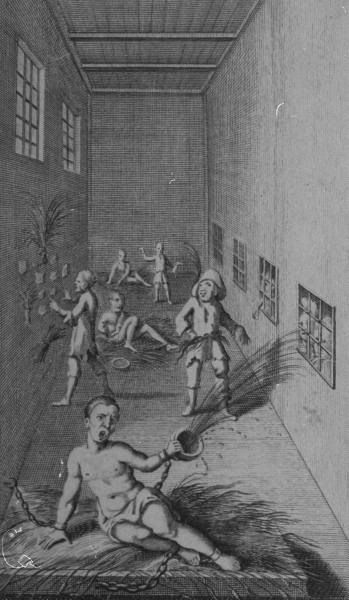
The York Lunatic Asylum opened in 1777, at a time when little was understood about mental illness. Without organised institutional care available, families were left to deal with the mentally ill at home as well as they could. It was usual to chain lunatics to the walls and to leave them naked (it was not thought possible for mentally ill people to feel cold) and alone. Madness turned people into animals.

Although there were grand ideals when it was first conceived of providing ‘relief to those unhappy sufferers who are the objects of terror and compassion to all around them’, York Lunatic Asylum soon fell onto a darker path. In 1790 a Quaker woman called Hannah Mills died at the York Asylum. No Friends had been allowed to see her during her six-week residence, to support her faith or to see the conditions in which she was being held. This led William Tuke to encourage the foundation of the Retreat in York, an institution built upon the Quaker idea that everyone should be treated kindly, and as an equal.

Concerns about the York Asylum continued to grow. After William Vickers was badly treated by the staff at the asylum, a Justice of the Peace for the West Riding called Godfrey Higgins interested himself in the case. Vickers had been released from the hospital bruised, lousy, dirty and so weak he could hardly stand. Other poorly-treated patients were discovered: Reverend Schorey who had been kicked down the stairs by his keeper, and Martha Kidd whose hip was dislocated during her stay. A meeting was called to examine Higgins’ accusations and nearly 40 local gentlemen (including members of the Tuke family and a number of their friends) took advantage of an old rule and paid £20 in order to qualify as governors of the asylum and effect change.

Investigations discovered that the number of patients at the Asylum had been growing, but poor financial management meant that the institution was struggling and conditions for the patients were poor. This should have caused a higher death rate but the figures published in the Asylum’s annual reports did not reflect this. Closer examination of the steward’s books made it clear that deaths had been concealed. In addition, it was discovered that the physicians at the Asylum had misappropriated significant sums of money from the institution. Before further assessments could be made, a fire began which destroyed one wing of the asylum and all of its early records. Four patients died. Rumours said it had been set by the steward deliberately to conceal the truth but this was never proven. Dr Best was never charged for his fraud but was forced to resign due to ill health.

Affluent patients at the Asylum were generally well treated. It was the poor who suffered. On a surprise inspection in March 1814, Godfrey Higgins insisted that the staff opened locked doors near the kitchen. When the key could not be found he threatened to break open the doors with a poker. Finally he gained entrance and found ‘a number of secret cells in a state of filth, horrible beyond description’, full of female patients, ‘the most miserable objects I ever beheld’. Elsewhere, ‘you might see more than 100 poor creatures shut up together, unattended and uninspected by anyone’.

 In August 1814 at the governors’ annual court, new rules were made and the officers of the asylum were all dismissed. The staff were replaced with help from the Retreat Hospital.

In the aftermath, there was a full parliamentary enquiry to which Godfrey Higgins, Samuel Tuke and others contributed. The report was published in 1815 and can be read for free via GoogleBooks. 

New website reveals the story of the lost Aero Girls (and boys)

Written by Kerstin Doble, Project Curator: Who Were the Aero Girls?

Nearly a year after the search for the real life Rowntree Aero Girls began, I am delighted to announce the launch of a website dedicated to the remarkable stories of the women and men behind this collection of postwar paintings.

As many as 40 Aero Girls portraits appeared in Rowntree Aero chocolate advertising between 1950 and 1957, in British newspapers, magazines and early ITV commercials. An accompanying slogan proclaimed, “For her – AERO – the milk-chocolate that’s different!”

These representations of modern young women formed part of a successful campaign to relaunch the Aero bar onto the UK market following a break in production during the Second World War. Since the early 1990s, 20 of the portraits have been stored in the Rowntree & Co. Ltd Archive, with little known about the artists or the sitters. While the advertisers J. Walter Thompson wanted the portraits to stand out as being ‘different’ – like the chocolate itself – they kept the female sitters anonymous, and the product firmly in the foreground.

THE SEARCH

After launching a public appeal for information and hosting a landmark exhibition at York Mansion House in October 2013, we were contacted by our first living ‘Aero Girl’, Pamela Synge. Synge, now in her 90s, is a visual artist, performer and writer. Her portrait was also the only Aero painting to feature in a television advert, on the newly-launched ITV in 1955. 

Another of our early successes was tracing the last living Aero artist, Arnhem veteran Frederick Deane, whose recollections provided the names of two more Aero Girls, former JWT Art Department employee Rhona Lanzon and the Vogue model Myrtle Crawford. Then, in March 2014, we discovered that the renowned contemporary painter (and soon to be winner of the John Moores Painting Prize 2014) Rose Wylie had been an Aero Girl. Wylie reflects that she was a “rebellious art student” at the time, adding that her true image was “more punk than Mills & Boon cover.” In fact, many of the other Aero Girl sitters also worked in the creative industries, as painters, lithographers, film directors and dancers.

Relatives of the Aero Girls and Aero painters have been tireless in helping us to piece together countless fascinating stories behind the paintings, which lead from the battlefields of the Second World War, through polite society in post-war London, to present-day celebrity, touching on art, social history, fashion, the changing role of women and even the Profumo Affair.

A new website gathers together archive images, footage, biographies and first-hand accounts about the Aero Girls collection for the very first time and you can explore it all at York Digital Library. 

Graphic saying STOP PRESS

Over the last few days we have been contacted by another Aero Girl, the subject of Anthony Devas’ Art Student (c.1950). Painter and former art teacher Barbara Pitt was aged 17 and studying at Goldsmiths College of Art, London, when Devas painted her portrait. She moved to South Africa in 1965, and contacted us from her home in Cape Town with some colourful reminiscences of bohemian London and invaluable material from her own archive.

We would love to continue adding information to our online resource. If you would like to contribute to the ‘Who Were the Aero Girls?’ project please contact us at borthwick-institute@york.ac.uk

Dishing the Dirt on the Atkinson Brierley Conservation Project

Written by Ruth Mather, Volunteer on the Atkinson Brierley Conservation Project

Archivists might baulk at the old stereotype of the ‘dusty archive’, but it is an image that rings true for some of the items in the Atkinson Brierley collection. When the collection was assessed in 2011/2012 of the 6414 architectural plans there were only 99 that did not require cleaning. This is where we volunteers come in. Thanks to generous funding from the Shepherd Charitable Trust, we meet every Wednesday morning under the supervision of the Borthwick’s conservation technician, Tracy Wilcockson.  There are four regular members of our team – our longstanding volunteers, Catherine and Dave, and more recent (August 2013) arrivals, Kate and myself. We also occasionally have additional students or volunteers who want to find out more about conservation. At the start of the project we received training in handling the plans and in careful cleaning with special brushes and smoke sponges, and since then we have cleaned architectural plans of all shapes and sizes and in various degrees of disrepair. We get through about 1.5 smoke sponges per two-hour session and, as of June 2014, have now cleaned 25% of the plans identified for attention.

It might seem like a fairly mundane task, but cleaning the plans is a really important part of ensuring the Atkinson Brierley collection remains accessible to the public. Even when the plans don’t look particularly dirty, they can carry ingrained dust and grime which then rubs off on archive user’s hands and can be transferred onto other documents. Over time, the dirt will cause the document to deteriorate, so it’s really important that we clean as many of the plans as possible. Doing so means that people can continue to visit the Borthwick and use this fascinating collection, which includes plans of many of the public buildings in and around York, providing a wonderful source for local and family historians as well as those interested in architectural history from the Georgian period onwards. The collection includes documents as well as plans, and covers schools, churches, war memorials and country houses, not only in Yorkshire but as far afield as Ypres in Belgium.

As for us, the volunteers, we’ve gained a vital insight into what goes on behind the scenes in an archive. Every week, we handle a number of interesting documents and learn more about how they are cared for. We’ve also had talks on more intensive conservation procedures from the team, and learned about a digitisation project which used some of the plans we had cleaned to create an exhibition about the war memorials designed by the architectural firm. Last but not least, there is always good conversation during our sessions, and even occasionally cake and a coffee once the plans are safely back in storage! Our current list of plans to clean stands at 4618 documents, and we are hoping to secure funding to continue with the project after our current grant expires in October. The best thing about working on the project is the sense of helping to preserve a collection so that it can continue to be enjoyed for a long time to come, and possibly be digitised for even wider use.

We’d love to hear from others who’ve used the collection – what do you love about the plans and why?

George Isaac Sidebottom: Spot the Cat

Written by Alexandra Medcalf

Like most archives, although most of our holdings are manuscripts on parchment or paper, bound into volumes and loose leaf, we do have other objects in our strong-rooms.

This painting shows people in the grounds of the Retreat, York, in the late nineteenth century. The Retreat was, and is, a psychiatric hospital run by the Society of Friends. It was established in the late eighteenth century and pioneered moral treatment for the mentally ill. The hospital saw its patients as no less human because of their illness, and emphasised that they should be cared for just like other people. This certainly does not sound unreasonable today but at the time it was extraordinary – standard Georgian treatments for mental patients included chaining to walls, leaving them naked in bare cells and sound beatings.

By the time of this painting, moral treatment was standard and you can see here that the patients were occupied with a variety of sports and activities including golf, cricket, tennis, croquet and football. Some figures in the background are riding bicycles. A slightly surreal element is provided by a patient lying under the tree in a bed. Painting was another pass-time. We know this because the artist who painted this picture was a Retreat patient at the time.

George Isaac Sidebottom was a resident at the Retreat from 1894 until 1912. He had been a merchant in the north-west of England and was a non-conformist. He suffered from moral and religious delusions and had been ill, and in care, for some years before his admission. A letter from the transferring doctor called him “a very good fellow indeed it would be hard to find a more agreeable man. He can paint watercolours very decently, sings a little… and can accompany himself fairly well.” In his case-notes, George is described as occupying himself in painting, reading, walking (including walking into town) and singing. He even played the piano, and there is correspondence to show that he was allowed to acquire a piano for his room.

He had a keen interest in games at the Retreat, and played cards, billiards, chess, croquet, cricket, hockey and tennis; he even skated in January 1895. He attended the Retreat’s ‘entertainments’ and ‘amusements’ (which vary from picnics to dances to amateur dramatics) and had holidays in Scarborough at the Retreat’s branch house.

References to paintings are made throughout although unfortunately this particular painting was not mentioned specifically. In January 1896 he ‘painted a scene for the Lady’s party at the beginning of the month’ and in October that year ‘he occupied himself with painting in oils and gives great attention to his work’. In December 1900 he was ‘busy on a scene for the Xmas party’. Towards the end of his life, George painted ‘peculiar’ caricature portraits, which gave him much satisfaction. He continued painting virtually up to his death at the Retreat in early 1912.

This painting provides us an interesting glimpse of life inside a Victorian mental hospital from the patient’s point of view which is all too rare among psychiatric archives. But, since this post is in honour of World Cat Day I also have to ask… Can you spot the cat? Comment below when you spot him (and no peeking until you do!)

Conservation and the Science of Light

Written by Catherine Firth, Conservator.

The Conservation Department has recently been involved in the installation of two new exhibitions: ‘The Architecture of War Memorials’, which can be found on the third floor of the Raymond Burton Library, and ‘The Pity of War’, which is on display along the ground floor main corridor in the Harry Fairhurst. We decided that this would be a good opportunity to set up some environmental monitoring, so that we could investigate the environmental conditions within the display cases for the duration of an exhibition. We positioned data loggers in various cases to record temperature and relative humidity, hiding the loggers under exhibits and behind stands. We also agreed that we would conduct some light monitoring for the exhibition areas.

It is difficult to be discreet about our light monitoring – the blue wool sample cards that we have positioned in the cases need to be in direct light to give an honest indication of light exposure in the cases. You should be able to spot two sample cards in each exhibition.

The principles behind the blue wool scale were originally developed for the textile industry in the early eighteenth century. French chemist Dufay was appointed to be Inspector of Dyeworks in 1729, and instructed to develop regulations to control the operations of the dyers.[1] He carried out systematic comparative testing on dyes, by exposing test materials alongside standard samples of graded fastness. Although there have been various developments in the materials, this method of using dyes of known light-fastness is still widely used today.

The blue wool scale tests for light fastness. The sample card we use today is made up of eight swatches of blue wool, which are dyed so that each consecutive dyestuff has an increased resistance to fading when they are exposed to light. Standard 2 takes twice as much exposure to fade to the same level as standard 1, and standard 3 takes twice as much exposure to fade as standard 2 and so on up to standard 8. The sample cards are used in a variety of industries that need to test their products for light-fastness. This could include testing the dyes in clothes, the colour in wallpaper or watercolour paints used by artists. A standard test will expose the blue wool card to light alongside a sample of the dye. Half of the blue wool sample is covered (as you can see in the sample in our exhibition cases) and half of the dye sample is also covered. After a pre-determined amount of light exposure both the blue wool sample and the dye sample are uncovered and compared, and the dye will be awarded the standard on the blue wool scale that has faded the closest amount.

Conservators monitor light exposure so that we can limit damage to the materials that we care for. Light is energy, and energy is damaging to organic materials. I read a comparison of light and heat damage recently that I thought very expressive. Garry Thomson suggested that we imagine organic molecules as people on a commuter train.[2] People are jostled, but this causes minimal physical damage, just as a steady, cool temperature causes minimal chemical damage to our archives. If the temperature on the train is raised, this jostling can get out of hand, and this is when chemical reactions to our molecules also become increasingly likely.

Now, Thomson associates light energy with projectiles fired at the commuters by a riot control squad. The damage that the projectiles cause is dependent on the type of projectile: a ping-pong ball or a pebble might only cause minimal damage, whereas a rocket or a hand grenade would cause considerably more. Light travels in waves, with the shortest wave-lengths in the visible spectrum at the violet end, and the longest at the red end. Ultraviolet (UV) light lies beyond the visible at the violet end, and infrared (IR) at the red end. The shorter the wavelength, the more energy delivered; and the more energy delivered, the greater the damage. As a result the violet waves of light are more dangerous than the longer red waves; and the UV waves are the most dangerous of them all, equivalent to the hand grenades thrown by the riot control squad. During my research, I was amazed to discover that to get a supply of useable energy from heat comparable to the energy delivered by light in the UV range one would have to heat up to 200°C.[3] This demonstrates how powerful light energy can be.

In our exhibition cases we are not testing individual specimens, but have chosen to use the samples to give us an overall indication of light exposure over a fixed period of time. We also take light measurements with a handheld monitor in our exhibition areas, which give us ‘lux’ and UV values. These tell us how much visible light and how much ultraviolet light can be detected. To reduce light exposure in our Borthwick exhibition area there are blinds on the windows. A shaft of light that once escaped from between the blinds was measured to be 1767 lux, whereas the next highest reading from the cases next to the windows with the blinds down has been 582 lux. Direct sunlight can be very intense, and the blinds significantly reduce this exposure.

The glass of windows and exhibition cases also reduce the amount of light that reaches our archives. UV light is reduced, and only between 80 and 90% of visible light is transmitted.[4] As UV is the most damaging type of light, we aim to reduce this as much as possible, and so we also use UV filtered glass for our exhibition cases. The graphs shown here relate to the display cases in the Harry Fairhurst, and demonstrate how much visible light is blocked by the glass as well as how much UV light is filtered by the glass.

We calculate light exposure by multiplying the time by the intensity of exposure. We aim to limit the ‘light hours’ that our archives receive by restricting the length of time we have them on exhibition. Some more light sensitive materials, such as photographs or watercolours, are given even shorter exhibition periods, and are frequently substituted with surrogate images. We also alternate between exhibitions of original items with those full of surrogate material, so that we can continue to raise awareness of the collections we hold at the Borthwick without putting any items at risk from regular display.

Although our exposure calculations are necessary, we are excited to see the results of our blue wool samples at the end of these exhibitions. Our calculations convey some numerical sense of light exposure, but the sample cards will be a significant visual indication of deterioration.


References

Forrester, Stanley. ‘The fast and the fugitive: light fastness testing of dyed textiles up to the 1870s’, Journal of the Society of Dyers and Colourists, 91 (July, 1975), 217-223.

 Guthrie, J., N. Tayan and L. Wilson, ‘A novel approach to light-fastness testing’, Journal of the Society of Dyers and Colourists, 111 (July/August, 1995), 220-222.

 Pugh, Samantha and James Guthrie. ‘The development of light fastness testing and light fastness standards’, Review of Progress in Coloration and Related Topics, 31 (2001), 42-56.

 Thomson, Garry. The Museum Environment, Second Edition, London: Butterworth-Heinemann, 1986

With thanks to Tracy Wilcockson for the photographs and light monitoring statistics.

Keeping Pace: Dr Jones and the Raiders of the Lost Archive

Written by Dr Amanda Jones

In your day-to-day life you’ve probably walked past one of George Pace’s buildings before and not realised it. Pace (1915-1975) was a York-based architect who is famous for his contributions to modernist ecclesiastical architecture. Perhaps his strict religious upbringing was the reason behind his career. Upon the death of his associate, Ronald Sims, the Pace and Sims documentation was gifted to the Borthwick. Today, more than 250 rolls of plans, drawings and correspondence lie uncatalogued in storage: it was our job to begin this exciting quest.

Photograph of a pencil sketch design for a war memorial
Design for a war memorial

As work experience students from the University of York – under the guidance of Dr. Amanda Jones – we immediately got our teeth stuck in (not literally!). Armagh Cathedral was the first building we unrolled. Seventy-seven architectural drawings took us on a virtual tour of the Royal Irish Fusiliers Chapel. The Dean of York personally recommended Pace for this project; this is the foundation of Pace’s illustrious career. Some of the most interesting drawings from this roll related to the war memorial design. We saw many designed for such memorials; it served as a powerful and poignant reminder of the lasting impact of the World Wars.

Another part of our project was to help conserve some of the Atkinson Brierley archives. This involved cleaning the documents using specialised tools. Alex was swept away by, “the cleaning experience. I couldn’t believe the amount of dirt that has accumulated on the documents!” Through this, we learnt how important conservation is for the preservation of these valuable documents. We enjoyed working with the conservation staff and current volunteers and through their help and knowledge, we gained a new set of skills in basic conservation.

Photograph of work experience students seated around a table, each cleaning an architectural plan with a smoke sponge
This was Guy’s favourite part,” I am currently working on a Masters dissertation on Brierley so the chance to contribute to the preservation of these wonderful documents was really rather special.”

In three days, we managed to catalogue 347 documents. This process was one in which the past was unrolled before our very eyes. From memorials to dossals, radiator covers to electrical installations, and candlesticks to altars, we saw the extensive work and skill behind being an architect. Joy particularly enjoyed the data collecting. “It is wonderful to think that my work is contributing to the preservation of ‘the past in the present for the future’. Through the database, these documents can now be brought to light again and truly appreciated.”

Photograph of a student entering data on a laptop
“I built on my communication and team skills through the data inputting. Also, the project gave me the chance to further my palaeographical skills. This week has been really fun and insightful.” Caitlin.
Photograph of students gathered round an architecture plan as they examine it
“Analysing the documents was very interesting. I normally study 19th century architecture, so getting the chance to see 20th century work was fascinating.” Rebecca.
Photograph of a student holding a rolled architectural plan
This is how Joy rolls.

What made the experience truly worthwhile is the fact we have made a lasting contribution to the archives. Before we began this placement, we did not truly appreciate the important work of archivists and the volume of information stored. A career in archives is one that should be respected as archivists are making a remarkable effort to preserve our heritage. In fact, we are all interested in pursuing a job in this field. Aoife found that, “all the staff were friendly and helpful, and their career advice was really useful.”

Group photograph of the students smiling
“A fun and fascinating week with a great group of people.” Mark