

By Karen Coales PhD, Mental Health and Addictions Research Group, Department of Health Sciences, University of York

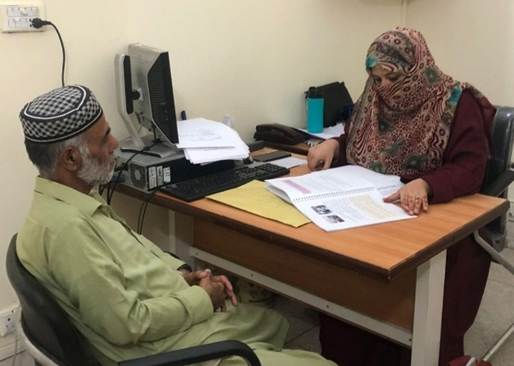
Figure 1:A Pakistani female community health worker wearing a shawl covering her hair and lower face seated at a desk facing an older Pakistani male wearing a kurta and kufi head covering. They are looking at a workbook together.
As low- and middle-income countries (LMIC) work to meet the growing demand for healthcare, many face a fundamental barrier: a critical shortage of specialist health workers (SHW). This deficit has only been exacerbated by increasing disease burdens and population growth. Task shifting—redistributing tasks from specialist to non-specialist health workers—has emerged as a widely endorsed strategy to expand access to care and make more efficient use of limited resources.
From a policy perspective, task shifting is appealing. Evidence supports its clinical safety and cost-effectiveness, particularly when accompanied by appropriate training and supervision. It has been successfully applied across a wide range of conditions—from maternal and child health to HIV care and non-communicable diseases. Yet for all its technical promise, there remains a crucial blind spot in the literature and in global development practice: the lived experiences of the health workers asked to adopt these expanded roles.
Our qualitative evidence synthesis (QES) addresses this gap. Drawing together data from 54 peer-reviewed studies conducted in LMICs and capturing the views of over 800 health workers, the study offers a synthesis of the perspectives of those actually implementing task shifting. The findings provide an essential lens for understanding why some task shifting initiatives succeed—and why others fail.
Published in Global Health Action in July 2023, the review emphasises that health workers’ perceptions of task shifting are not formed in a vacuum. Rather, they emerge from a complex interplay of cultural, organisational, and personal factors. This has clear implications for policymakers, researchers, and practitioners working at the intersection of health and development.
What Influences Health Workers’ Perspectives? Three Key Dimensions
The review’s thematic analysis highlights three overarching factors that shape how health workers perceive task shifting:
- The cultural environment in which task shifting is implemented
- Access to resources—training, supervision, materials, and remuneration
- Alignment with personal values, self-efficacy, and emotional resilience
Each of these themes reflects not only technical and managerial realities, but also the deep interconnection between health systems and social context—an area where interdisciplinary development research is particularly well placed to contribute.
Culture and Power in the Workplace and Community
One of the clearest findings of the synthesis is that the success or failure of task shifting often depends on the cultural environment within healthcare settings and local communities.
In supportive workplaces where teamwork, communication, and respect for roles are embedded, task shifting was viewed positively. Non-specialist health workers (NSHW)—including community health workers and lay counsellors—reported feeling empowered and respected. Where task shifting was understood as a collaborative approach, it fostered professional development and job satisfaction.
However, in environments lacking clear communication or mutual trust, tension and resistance emerged. Some SHW expressed concern that delegating key clinical responsibilities could erode their professional status and job security or pose risks to patient safety. Meanwhile, NSHW often encountered stigmatisation or dismissal, particularly when their roles were not fully recognised by clinical colleagues.
At the community level, cultural values and expectations also played a powerful role. In many contexts, the authority of healthcare providers was traditionally linked to formal qualifications. Patients often expected to be treated by a doctor, and were sometimes reluctant to accept care from lay workers—even when they were highly trained for specific interventions. However, NSHW who shared language, religion, or background with patients often reported higher levels of community trust and access.
The synthesis also highlighted a tension between proximity and professionalism. In sensitive areas such as mental health or HIV care, lay and community health workers sometimes struggled to maintain boundaries and gain the trust of those in their care, especially when patients and their families feared community stigma.
Resources, Supervision, and Recognition: Necessary Foundations
The second critical dimension shaping perceptions of task shifting was access to training, supervision, resources, and remuneration.
Health workers who received structured, skills-based training tailored to their task-shifted roles generally felt more confident and effective. This was particularly true when training addressed both clinical knowledge and interpersonal skills. However, in many cases, workers reported receiving only cursory or “on-the-job” training—often informal and inconsistent. In such cases, task shifting was experienced as overwhelming, with health workers feeling underprepared and unsupported.
Supervision was another major theme. Workers valued supervisors who were accessible, empathetic, and knowledgeable. Effective supervision not only supported quality care but also provided emotional reassurance and professional development. However, in overstretched systems, supervision was often unavailable, sporadic, or focused purely on monitoring rather than support.
Material resources also mattered. A lack of clinic space, medications, transport, or equipment directly undermined the ability of health workers to deliver task-shifted care. When basic needs were unmet, even the most motivated workers expressed disillusionment.
Lastly, remuneration—or lack thereof—was a recurrent concern. Many NSHW were asked to take on additional responsibilities without additional pay. This created a sense of injustice and sometimes resentment towards better-paid colleagues. Recognition, whether financial or symbolic (e.g. titles, uniforms, or certificates), was found to be a critical enabler of motivation and retention.
The Personal Dimension: Identity, Motivation, and Resilience
Beyond systemic factors, the synthesis also reveals the deeply personal ways in which health workers interpret task shifting. For many, the experience of learning new skills, helping patients, and being recognised in their communities was profoundly meaningful. Lay health workers described pride in being called “doctor” by patients, even when they clarified their actual role. Others spoke of improved self-care and emotional wellbeing resulting from their training.
Altruism was a particularly powerful motivator. Workers from the same communities they served expressed a desire to improve health access not only for individuals, but for the community as a whole.
However, when task shifting conflicted with personal values—such as being pressured to perform tasks outside their training—or when systemic support was lacking, workers reported emotional exhaustion and stress. Some struggled with the ethical burden of trying to meet expectations with insufficient resources. Those without strong emotional resilience or coping mechanisms were at greater risk of burnout.
This raises important questions about the psychosocial sustainability of task shifting. Development strategies must recognise that emotional resilience is not a substitute for organisational support.
Implications for Global Development and Health System Strengthening
This synthesis holds important lessons for global development actors. As the world strives toward universal health coverage and equitable access to care, task shifting will likely remain a central strategy in LMIC. However, for it to be effective and ethical, we must move beyond top-down implementation.
Key recommendations include:
- Co-designing initiatives with health workers from the start to ensure that roles, expectations, and support mechanisms are clearly defined.
- Investing in comprehensive training that goes beyond technical skills to include condition knowledge, communication, and ethical practice.
- Establishing robust, supportive supervision systems with clear governance frameworks.
- Ensuring fair compensation and recognition, especially for lay workers and NSHW.
- Understanding local cultural dynamics that influence community acceptance and workplace relationships.
Perhaps most critically, the study calls for listening to the voices of health workers as central stakeholders in health system reform. Task shifting is not simply about reallocating labour—it is about reshaping healthcare delivery in ways that are contextually grounded, socially legitimate, and emotionally sustainable.
Conclusion: From Evidence to Action
This research underscores the need for integrated, participatory approaches to development. It also highlights the power of qualitative synthesis as a tool for centering lived experience in global health and development planning.
In our view, health workers’ perspectives are not ancillary—they are central. Understanding how task shifting is experienced by those delivering care can inform more equitable, effective, and resilient health systems.
This is not just good practice; it is essential development thinking.
Reference:
Coales, K., Jennings, H., Afaq, S., Arsh, A., Bhatti, M., Siddiqui, F., & Siddiqi, N. (2023). Perspectives of health workers engaging in task shifting to deliver health care in low-and-middle-income countries: a qualitative evidence synthesis. Global Health Action, 16(1), 2228112. https://doi.org/10.1080/16549716.2023.2228112