

IGDC member, Dr Paul Hudson (Environment and Geography) tells us about a recent workshop aimed at understanding evidence cultures in coastal policymaking in Thailand as a part of a British Academy funded project.
Policymaking is a complex process of trying to navigate multiple policy objectives and priorities that are not always aligned with and can clash with each other. The politics of policymaking and implementation are not always easy to overcome. One of the earlier posited ways of doing so was through ‘evidence-based policy’. The idea being relatively straightforward in that someone would identify a problem, gather the best objective scientific data, design a policy based on that data, and implement it.
However, this relatively straight forward idea is a much cleaner process than reality often allows for. This is because while ‘evidence-based policy’ aims to provide objective answers to policy answers, evidence is never truly objective, simply because of the human systems that surround how evidence is generated, seen, used, interpreted, or even just asked for. For this reason, we have seen that ‘evidence-based policymaking’ has become replaced by ‘evidence-informed policymaking’ (EIPM). The difference between the two is that EIPM treats evidence as one of many inputs, integrating it alongside a range of practical factors, e.g., like political feasibility, stakeholder input, and cultural values. This puts a stronger emphasis on how evidence, knowledge, and information is used to craft policy as rather than always aiming for the ‘first best’ solution of evidence-based policy that won’t be implemented. We can often accept the ‘second best’ solution, as it can be implemented.
Therefore, to understand how evidence is used as part of how policy is identified, designed, and implemented, we must understand the processes of how knowledge is used. A recent review of different frameworks by Sambé et al. (2025) summarises the different avenues through which evidence is used and processed in the policy process.

Figure 1: Evidence-informed policymaking framework as presented in Sambé et al. (2025)
While there are many different avenues to explore, in this blog we will explore the idea of evidence cultures. Evidence culture relates to the supportive values, beliefs, and norms that shape how evidence is perceived, understood, and used in policy contexts. This includes developing a shared understanding of what can be considered as ‘good evidence’, as well as being supportive of changing policy design and processes when new evidence comes to light. This entails encouraging critical thinking and questioning assumptions rather than assuming our processes are correct. Evidence cultures as such are a fundamentally normative and social process, as different people can approach the same issue with different perspectives on what counts as good evidence or their willingness to be challenged.
Understanding the distinct evidence cultures of the three main players in the policy ecosystem — policymakers, intermediaries, and beneficiaries — is an important prerequisite for designing and implementing policies that work well because we account for the different ‘ways of knowing’ that govern the behaviour of the actors within the policy ecosystem.
This was the crux of the British Academy funded project ‘Shifting Shores’ (a collaboration between The University of York with Mahidol University) In this project we aimed to understand the multiple evidence cultures of coastal stakeholders in Krabi Province in Thailand. Coastal problems are complex because they exist at the intersection between marine and terrestrial problems, and in Krabi they are compounded by a large tourism industry that has rapidly expanded, putting pressure on the existing infrastructure. We aimed to help understand whether and to what extent key actors across the policy ecosystem in Krabi have similar priorities and perspectives over the policy cycle, i.e., from identifying when policy is needed to how policy is designed to how policy is implemented and then evaluated. To this end, we held a workshop in Krabi to help discuss and identify these different perspectives.

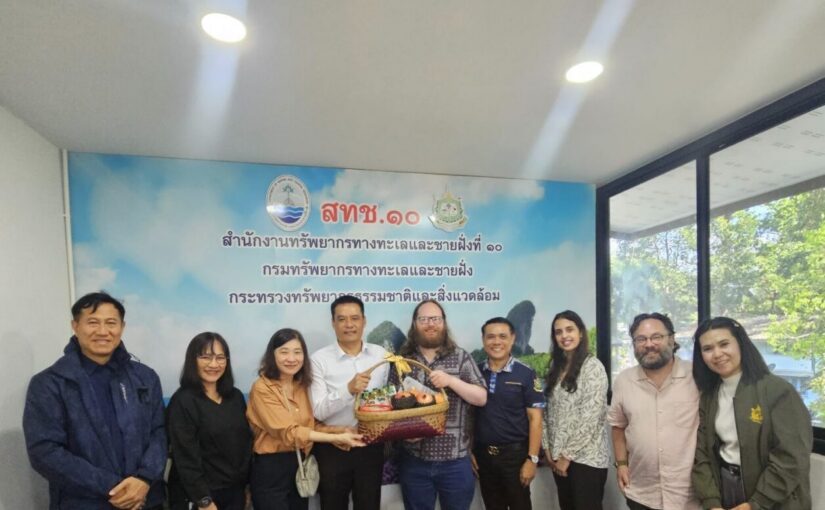
Figure 2: Project team from the University of York (Dr Paul Hudson, Dr Joshua Kirshner and Dr Saba Joshi) and Mahidol University (Prof. Suvaluck Satumanatpan, Dr Kamalaporn Kanongdate and Dr Kampanag Bhaktikul) with the Marine coastal resilience team in Krabi, Thailand
The analysis of this workshop is still ongoing as we are following up with the groups who could not attend our workshop through additional interviews to depend on our understanding. However, at there are distinctions between the evidence cultures between the local policymaking community and the beneficiaries. They all agree on the same issues when asked to rank them (with priority given to addressing the loss of seagrass, which is an important nurse habitat for fisheries, and coastal erosion, meaning coastal land is lost to the sea). However, their evidence cultures clash in terms of processes. We seem to see an indication that the bottom-up process of getting information from local communities to the policymakers and implementers is perceived to work well by both groups and they have close established networks.
However, this is the point at which they diverge. The local policymakers saw these established networks and linked them positively to their own internal processes, with a belief that the structures and expectations of the ‘system’ set out by national laws and regulations is what establishes ‘good evidence’ and reflective processes for how that evidence should be used in the implementation and prioritisation of policy action to the best ends. The beneficiary communities, on the other hand, disagreed with this assessment, as they felt they could identify issues and raise them with the relevant policymakers, but at this point they become disengaged from the process and didn’t trust it to work through in a way that would benefit them in the long-run as compared to sporadic action. The norms on what seems to be ‘good evidence’ seem to be similar, but the norms and trust in the expectations of how evidence is used and implemented is policy are not aligned.
There was one area of commonality between the two groups, which was the role of gender in evidence generation and policy engagement. Both groups indicated that they didn’t perceive this to be a major issue because they had balanced gender representation in meetings and processes. However, when examined more deeply, the focus was purely on representation and not gendered differences in implementation and action. For example, both groups accepted that tasks would be gendered and that this would filter out into practical roles. Therefore, the full range of power dynamics that what this means for how policy impacts people on the ground could be neglected as gender and social equality is considered to be addressed by representation, even though one of the participants communicated that while she represents her group in stakeholder consultations and this was an example of gender equality being achieved, she still needed a male representative to advocate for her points in order for them to move forwards.
There will be more to come when we finish the project in June.
Dr Paul Hudson, Senior Lecturer in Environment and Geography and the Principal Investigator of “Shifting shores: evidence for gender-inclusive coastal resilience policy in Thailand” funded by the British Academy.