


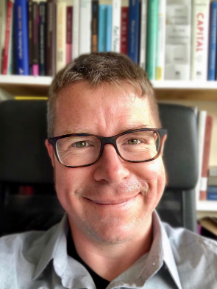
Martin O’Neill, Professor of Political Philosophy, University of York
Last week saw the launch in York of the report of the Community Wealth Building Commission for York and North Yorkshire. At a moment when Andy Burnham is promising a radical decentralisation of economic power from Downing Street, the report offers a timely example of what such a programme could look like in practice.
These are momentous days in British politics, and we are now in the first days of a new Prime Minister, with Andy Burnham taking his place in 10 Downing Street as the culmination of his unopposed run to the Labour leadership. A central theme of Burnham’s pitch both to the Labour Party and the wider country has been the need for a radical change of direction. His vision, as laid out in his speech last month at the People’s History Museum in Manchester, was not heavy on details, but involves at its core a set of commitments including placing key economic sectors under public control, supporting reindustrialisation, and significantly increasing council housebuilding.
The new prime minister presents this not just as a minor change of direction after the disappointments and frustrations of the Starmer premiership, but as a major course correction that seeks to undo many of the harms that have been wrought to British society by pursuit of ‘neoliberal’ economic policies since the Thatcher administration. This vision is intrinsically linked to a commitment to radical decentralisation, with more political power and resources for the regions, including plans for a “Number 10 of the North”. Burnham’s emphasis on democratic renewal and “good growth in every postcode” raises the question of what a new political and economic settlement could look like in Britain – one that genuinely distributes economic power to the country’s cities, towns and regions, and which pushes back against the sense that influence and opportunity are too often concentrated around London and the South-East.
The launch on Wednesday 15 July 2026 in York of the report of the Community Wealth Building commission for York and North Yorkshire provides a practical example of the kind of policies that will be needed if Burnham’s vision is to turn from theory into reality. The commission was initially launched by Mayor David Skaith in September 2025 as a way of thinking about how policy in York and North Yorkshire could be directed in an ambitious way towards transforming the regional economy to make it work better for everyone. The Mayor had been impressed by the successes that have been achieved by a Community Wealth Building approach, from examples such as Cleveland, Ohio and Preston, Lancashire, to more recent developments in London, Amsterdam, Scotland and elsewhere, where policymakers had found new ways to reconfigure local economies to make them more democratic and inclusive, and to share economic benefits more widely.
The Community Wealth Building approach starts from a simple proposition: economic development should strengthen the power of communities and people to shape their own economic future. It is a broad-based economic development strategy that transforms local economies based on those communities having greater direct ownership and control of their assets. Community Wealth Building (CWB) expands democratic forms of ownership and control, supports municipal enterprises, uses the purchasing power of public institutions to strengthen local businesses and supply chains, collaborates with and supports community-based organizations, retains wealth within communities, and creates better jobs. In doing so, it advances democratic renewal as well as economic growth.
As someone who has written about the promise of this approach in my book The Case for Community Wealth Building, co-authored with Joe Guinan of US “think-and-do tank” The Democracy Collaborative, it was both a great honour and a pleasure to have the opportunity to participate as a commissioner in the York & North Yorkshire CWB commission. Part of the strength of the commission was the diversity of experience and expertise that was brought by its members, who included commissioners with backgrounds in business, trade unions, community development, local government, and social enterprise, as well as those such as my University of York colleague Professor Kate Pickett and me, who had researched alternative economic approaches as they have been developed and deployed in different parts of the world. We were also extremely fortunate to be able to call on the expertise of Councillor Matthew Brown, leader of Preston City Council, who has done more than anyone to advance the CWB approach in this country.
I learned a huge amount from our discussions, and from lively debates in which we could work together to test our ideas and develop a shared agenda. It is greatly to the credit of commission chair Sam Leach, the co-founder and development director of Spark CIC in York, that he managed to bring this wide variety of voices and perspectives together with such skill.
The final report of our commission, drafted with the able support of the Centre for Local Economies, makes a range of ambitious proposals for how the economy of York and North Yorkshire can be rewired to make it work better for local people. These proposals include a shift towards ‘social value’ procurement and commissioning that will aid the development of local small businesses, cooperatives and social enterprises; support for community ownership of land and assets, with the development of a land commission for the region; the convening of an ‘anchor institution’ network to bring together a number of significant local institutions to coordinate around shared aims; the re-direction of more investment from sources such as local authority pension funds towards long-run local assets such as housing and renewable energy; and a more integrated approach to transport planning across York and North Yorkshire.
The commission report is of course not the final word on how to transform the economy of York and North Yorkshire, but it provides a strong direction of travel for what a more equal, inclusive and democratic local economy would look like. Significantly, it sees the achievement of these goals as not just a job for the combined authority, but as a goal for cooperation with City of York Council, North Yorkshire Council, and local ‘anchor institutions’, including our two local universities, York St John University and the University of York, the local NHS trust, and others. Where Community Wealth Building has been successful in other places, it has been through bringing together the power and influence of a set of local institutions, and building a shared commitment between them to act together for the broader public good. By taking this kind of ambitious and strategic long-run institutional approach, much more can be achieved than by local government acting alone.
I look forward to the report being widely read and discussed; when taken together, its recommendations have the potential to be deeply transformative for the quality of life of people in York and North Yorkshire. To see it implemented will require political will from those in local government, and a parallel commitment from the other local institutions which have a role to play in the work ahead. But to have a plan is already to have made a good start, and the commission report provides a practical guide for how the aspiration to devolve economic power and to spread economic rewards more widely – the very goals that Andy Burnham has articulated– can be turned from rhetoric into reality.
The report of the York and North Yorkshire Community Wealth Building Commission can be read here.
The views, thoughts, and opinions expressed in this blog are solely those of the author and do not necessarily reflect the policies or views of the University of York