
As a small team working to spread accessible digital practice far and wide, we’re always collaborating with colleagues across the university (and beyond!). We’re delighted to share a post from a guest, Katie Vernon, Graduate Engagement Lead for Open Research and Postgraduate Researcher in the Centre for Medieval Studies, outlining how open research and digital accessibility have shared aims of breaking down barriers that individuals face when accessing and engaging with research.
Definitions
The ideal for open research is to make as many parts of the research cycle as open as possible or, in other words, to make research free and easy to access to anyone using the internet. The Open Research Toolkit provides an overview of practices and principles which can be applied to projects across all disciplines and at different stages, including:
- Pre-project: sharing aims and questions through open access protocols, preregistration and registered reports.
- During research: participatory research collaborating with communities, or an open notebook and open data to share the project’s materials and activities.
- Post-project: publishing academic work openly, sharing code, and engaging with open peer review.
Digital Accessibility aims for digital content, on and off-line, to be easily viewed, used and understood by everyone. Everyone’s accessibility needs are different and can change over their lifetime. However, there are principles and guides to making content accessible and these should be considered from a project’s inception. For instance:
- Webpages need structuring with a clear pattern to the information displayed, including formatting with headers, content sections, and weblinks.
- Content needs to be navigable by assistive technologies. Screen-readers are commonly used by people with vision impairment or with specific learning disabilities like dyslexia and so documents need to be clear and in a machine readable format.
Benefits:
Breaking down societal barriers
As open research is freely available to all, without paywalled access, communities and individuals who do not have academic institutional access are able to read research. Disabled people may be more likely to take breaks from their studies, but open scholarship means that journals and monographs are available during breaks from education.
The first principle of Open Research is accessibility, and to be equitable, accessibility should not just mean available online. As digital outputs, open research can be quickly and easily made accessible, formatted for a variety of readers. Digital accessibility: a Practical Guide offers guidance on how to format work with many users in mind.
Impact and reach
Making open research digitally accessible allows for work to be shared quickly and with a wider audience. It can reduce workloads, as staff are unlikely to need to make changes to documents for teaching or research purposes, as such open and digitally accessible research may receive more citations.
Open source software and open educational resources provide free tools which support education and research. Assistive technology through Disabled Students Allowance or Access to Work can take time to be arranged, be expensive and time-limited if subscription models are provided by funders. As such, open tools and resources may be a better option when it comes to supporting researchers and educators, although users need to be aware that these tools may not be formally recommended by the University – see Accessibility tools and support: Unsupported digital tools. An exception is Non-Visual Desktop Access (NVDA), an open source screen reader supported by the University.
Open educational resources can be used for impact and public engagement. In her Open Research in Practice case study describing the Romans at Home project, Eleanor Drew, former Digital Heritage MSc student, described how she created open educational resources to help bring archaeological research to those who are unable to visit museums. Romans at Home was a collaborative outreach project with York Archaeological Trust (YAT) which used a multi-sensory approach, using readily available materials like sage or olive oil, to explore aspects of Roman life in York with people living with dementia.
Equitable Research
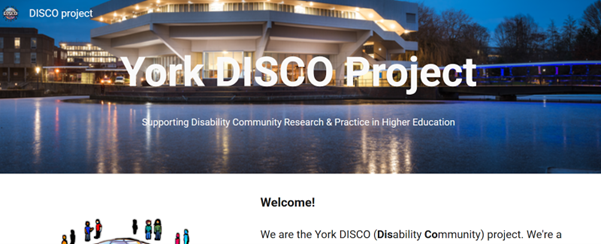
Using participatory methods and collaborating means research can be more equitable and representative. The DISCO (Disability Community) Project offers guidance on including disabled people in research and building community for disabled students. It provides a toolkit for including disabled people in research and guidance on creating inclusive events. Working with communities allows those who are impacted by or have an interest in specific research to access information and be involved in the processes.
In her Open Research in Practice case study, doctoral student Elizabeth Richards describes how she supported students with Special Educational Needs and Disabilities (SEND) through collaborative practice. Embedding open research principles into each stage of the project, Elizabeth created a study involving local schools. Elizabeth’s case study also speaks to some of the challenges of open research when working with sensitive data.
Compliance
Funders, for example UKRI, require certain publications to be freely and immediately available under a suitable open access licence. Open research allows publicly funded research to be accessible to the wider public. However, digital accessibility would ensure that these works can be accessed and used by a wider public. Digital accessibly may also be required by many potential collaborators, such as public bodies or EU funded projects. The 2025 European Accessibility Act means that if digital work is to be shared, and especially sold, to members of the EU then it must comply with certain standards. Meeting these requirements is increasingly important within and outside of academia and ensuring research is digitally accessible means that it will be more likely to be usable without changes to the work in future.
Inclusive digital practice sends the positive message that your organisation values everyone it engages with.
UKRI details its strategy for equality, diversity and inclusion.
A Boydell and Brewer blog on their changes to publishing due to the accessibility act. They are a signatory of the Accessible Books Consortium’s Charter for Accessible Publishing.
The National Lottery Fund has a guide to online accessibility, which is especially tailored to heritage organisations. While not all elements of digital accessibility are required, as they state: “people recognise good accessibility, sites with poor accessibility will stand out. They will appear unprofessional and will reduce your organisation’s potential audience and support base.”

Practical steps:
Take time to reflect
Consider the audience of your research, their needs and representation:
- Those with specific learning disabilities might need clarity and structure in academic feedback processes. Open Peer review provides an opportunity for more transparency between researcher and reviewer.
- Public engagement can connect with marginalised communities and provide representation of researchers with disabilities and projects which speak to disabled people’s experiences.
Keep it simple
Use software which is familiar to a wide range of users:
- Many types of software now have inbuilt accessibility features, such as voiceover on Mac or PDF annotation on Edge.
- Try not to use proprietary file formats, which might require a subscription and have fewer in-built or compatible accessibility tools.
- PDFs are a popular format with a range of free compatible tools and so many users will be able to access and navigate them on and off line. However, older PDFs may not be digitally accessible, with difficult to read serif fonts or blurry scans, so, in teaching, use modern high-quality versions.
- Powerpoint and Google Slides are both potentially accessible and easily converted.
Format your work
Take responsibility for ensuring that research outputs are accessible:
- Include formatting like alt-text, colour contrast and title headings. These features are commonly missing from publications but are a quick addition for an author to make.
- Ensure that the whole document is formatted correctly, including appendixes and tables. Postgraduate researchers should make their thesis accessible in line with formatting guidelines.
- Screen readers struggle with mathematical equations on documents like PDFs, so convert work to LaTex, a template of open source code for which is offered by the University’s Digital Education Team.
- Be aware that screen readers can also struggle with texts that use multiple languages, manual language tags can help with this.
- Use free templates available for making accessible Google websites on Google Workspace: a Practical Guide. A website should be able to be navigated with a keyboard or using speech recognition software.
- Research guidance, use checklists and undertake training, all of which are available on the university webpage Digital Accessibility: A Practical Guide.
Publish accessible work openly
Use a repository with built-in accessibility controls:
- Ensure that your deposited work is an accessible copy.
- White Rose Research Online has a guide on its accessibility options, but this is currently being reviewed and updated. As it notes, their PDFs, especially older files, are not always in the scope of accessibility regulations because the site hosts user generated content.
Contribute to future change
Think about which publishers you submit research to and work with:
- Consider if the publisher has open access policies. The library hosts a searchable database of journals which notes open access agreements. Or contact the Open Research Team to discuss further options.
- Consider if the publisher provides digitally accessible as standard.
- If you are an editor, ensure that submission guidelines include accessibility requirements, as research shows that this is rarely outlined. Such guidelines may reduce later workloads and attract submissions from a more diverse range of researchers.
Conclusion
Open research and digital accessibility are both a means of making information available and understandable to a range of audiences, especially those who might face institutional and societal barriers. When practicing open research it is important to consider digital accessibility from the inception of the project through to the completed work.