

By Nicola Burgess, Nick Downham and Amar Shah
In a recent email exchange with a colleague from another international health system, it was mentioned that we had recently completed a rapid evaluation of a single, unified approach to shaping the conditions for a systematic approach to improvement across the English NHS.
Their response was: “That’s an interesting idea! I hope it worked, I suspect it failed…”
This initial scepticism, though understandable, highlights a common reductionist approach to improvement efforts: seeing success or failure as simply black or white. However, our quick evaluation shows a more detailed picture, confirming that learning—the foundation of bettering any process or system—relies heavily on recognising this complexity.
In this blog, the first of a four-part series, we present the findings of our rapid evaluation, outlining five ways in which a single, unified approach to improvement is influencing strategy and practice across the NHS.
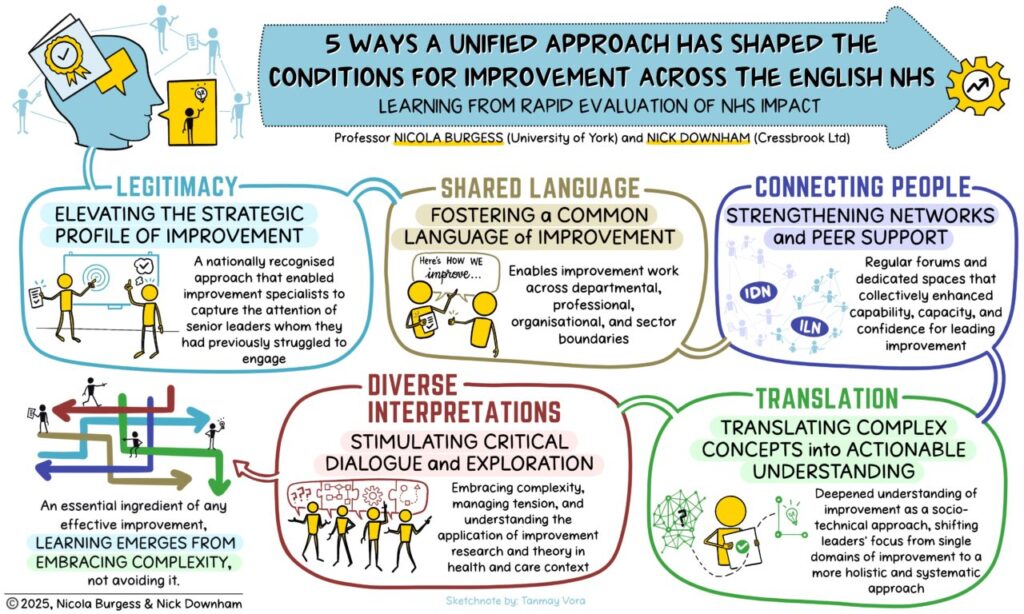
Before we proceed further, let us begin with a brief overview of this unified approach to improvement, known as NHS IMPACT.
What is NHS IMPACT
Launched in April 2023 by NHS England, NHS IMPACT is a unified framework comprising five interconnected components. Described as “a single improvement approach to shaping strategy,” it aims to help NHS organisations foster a sustainable, system-wide improvement culture. These five components are:
• Building a shared purpose and vision
• Investing in people and culture
• Developing leadership behaviours
• Building improvement capability and capacity
• Embedding improvement into management systems and processes
We direct the reader to explore further details on each component and supporting resources via the NHS IMPACT website (www.england.nhs.uk/nhsimpact).
Beyond “Success or Failure”: Five Ways a Single Approach to Improvement has been shaping Improvement in the English NHS
Our rapid evaluation involved interviews with 40 individuals from 40 diverse NHS organisations, spanning acute hospital trusts, community health and specialist care providers, as well as integrated care providers and integrated care boards (ICBs). These conversations, coupled with our analysis, reveal critical insights into how individuals and organisations were utilising NHS IMPACT to foster a systematic approach to improvement. We’ve identified five interrelated themes that illuminate how NHS IMPACT has shaped the conditions for improvement across the English NHS:
1. Elevating Improvement’s Strategic Profile (Legitimacy)
NHS IMPACT was frequently described as a valuable lever for elevating the strategic profile of improvement within NHS organisations and instigating discussions about improvement with senior leaders and executive boards. These findings were consistent across all types of NHS provider organisations:
“I think it’s helpful that its badged NHS England because of the way it’s talked about: ‘this is what we are going to do together this is our way of working’ …whether it’s a financial problem, a patient problem, a pathway, this is the way it’s going to work. I think that’s powerful ”
(Chief Clinical Improvement Officer, ICB)
Our data also indicated the significance of a lever at the individual level, allowing improvement specialists to capture the attention of senior leaders in ways they had previously struggled to achieve:
“It gives me a framework that is nationally recognised to be able to support the points I’ve been trying to make for a long time, but hadn’t had the gravitas or the reference model”
(Director of Improvement, Hospital Trust)
From a meta-level perspective, respondents compared the existence of a unified improvement approach to “an ideology and narrative that this is a national imperative” (Respondent, Mental Health Provider). This perception of NHS IMPACT as a national directive underscores its role in framing improvement as a core organisational mandate rather than a peripheral activity.
Finally, respondents were keen to illustrate NHS IMPACT as the mechanism through which they instigated structured conversations about improvement with members of the executive board:
“I hang everything on it. So, any board report, I’ll always reference it, and that’s helpful because it gives you the legitimacy in your organisation to say we’ve got to do this. If we didn’t have that, it would be, ‘Do we do it?’ and ‘We’re all right. We’re already doing it’ … Whereas I can push people a bit more and say no. No, we’re not doing enough. This [framework] describes what it should be … I think that has helped because the chief exec’s certainly paid attention. Because of that national focus.”
(Associate Director for Quality Improvement, Community Health Trust)
2. Fostering a Common Language of Improvement (Shared Language)
As a method-agnostic framework, NHS IMPACT facilitated a common language of improvement that transcends differences in improvement methodologies, organisations, and organisational types. The emergence of a shared language was a highly significant aspect of NHS IMPACT’s influence, as highlighted by participants:
“The framework has given us a common language to talk about, ‘How do you build capability’ and ‘What is your management system?’ You can ask these questions because you’re coming from a common framework irrespective of what methodology you are using”
(Associate Director of Improvement, Hospital Trust)
The loyalty of some organisational leaders to specific improvement methods is an intriguing dynamic that becomes especially problematic as organisations increasingly adopt collaborative structures, such as shared leadership, groups, and other forms of partnership, to achieve greater efficiency and integration. Improvement leaders told us how NHS IMPACT enabled them to effectively transcend these differences during times of transition to focus on what matters:
“When things got fraught, I used NHS IMPACT a lot to say that this isn’t a question about ‘is it Model for Improvement or is it not’, or ‘is it Patient First or not’. I said the better question to ask is ‘as an enlarged organisation, how do we deliver on the key principles of NHS IMPACT’. It has been so useful to me. I kept dragging people back to that. I said, ‘Let’s not get hung up on what we’re trying to defend, let’s focus on the destination instead.”
(Director of Improvement, Hospital Group)
This sentiment, echoed across all organisational types, was particularly relevant for ICBs liaising with multiple types of health and care providers across an expanded geography, and encouraging them to work together in a more centralised way:
“Providers have a very strong identity of what they are and what they want to be, and often a well-developed infrastructure for improvement, but it was then a big leap to consider what they contribute to the system …[and] get to the greater good, especially when the benefit lands outside of their particular silo”
(Clinical Improvement Officer, ICB)
One respondent noted the benefit of a single improvement approach for the patient. Through the example of a rehabilitative care pathway for stroke patients, the responded told us how the shared language of NHS IMPACT helped them feel part of the same network when moving between different:
“We found NHS IMPACT’s approach helpful to kind of have that common set of standards and common language so that the patient recognises that they’re still in the network and they’re not going from the [specialist centre] to our extended rehab and seeing it as an entirely different part of the journey”
(Improvement Specialist, Community Health Trust)
3. Strengthening Networks and Peer Support (Connecting People)
A significant facet of NHS IMPACT’s influence has been the administration and monthly gatherings of two national, dedicated improvement networks: the Improvement Directors Network (IDN) and the Improvement Learning Network (ILN). These networks were consistently highlighted as highly valued features, providing a dedicated space for knowledge sharing, fostering peer support, and collectively enhancing the capability and capacity for leading improvements within member organisations.
As one Head of Improvement (Community Health Trust) noted:
“When you’ve got that passion for improvement, it’s nice to know what people are doing and probably within that hour of a period of reflection and learning as well, so that’s what’s good for me.”
This sentiment reflects the critical role these networks play in sustaining motivation and providing a necessary avenue for professional development.
Leading systemic change invariably requires considerable energy and persistence, and some participants frankly acknowledged the solitary nature of leading improvement efforts. The IDN and ILN networks emerged as vital sources of support and resilience in this challenging context. A Director of Improvement from a Hospital Group powerfully articulated this, stating:
“I couldn’t be without the IDN. They’re like my life source, because it’s lonely.”
Beyond virtual engagement, the connections, shared learning, and peer support facilitated by these networks also inspired tangible ‘go-see’ visits, allowing participants to observe exemplary improvement implementations firsthand. “If I’m struggling with something conceptually,” shared one Improvement Director (Hospital Trust), “I just get on a train or get in the car and go and see someone who’s doing it well and I can bring that back to the [organisation].”
This practical application of shared learning underscores the depth of engagement fostered by these networks.
While the value of these networks was broadly affirmed, a notable concern emerged regarding the wider proliferation of similar networks across the NHS. These often operate with overlapping objectives, leading to competition for finite resources, particularly time and operational space, within an already severely constrained environment. Furthermore, some perspectives suggested that this fragmented landscape might inadvertently dilute the potential for NHS IMPACT to catalyse a more unified social movement for systemic change across the NHS. This led one participant to pose a critical question: “Is there a way NHS IMPACT can build on existing infrastructure and networks?”
The challenge of reconciling the organic characteristics of a social movement with a framework initiated by a bureaucratic entity like NHS England remains a complex organisational dilemma.
4. Translating Complex Concepts into Actionable Understanding (Translation)
NHS IMPACT fostered a shared understanding of what a systematic and holistic approach to improvement should entail. As with any socio-technical approach to change, knowing where to start, what to include, and what good looks like is complex and challenging due to the range of research, arguments, case studies, literature, and perspectives. NHS IMPACT has facilitated the translation of what good looks like in a trusted, method-agnostic manner, providing flexibility for future development and local interpretation, regardless of context, experience, or history.
“I would describe NHS IMPACT as a template for how you should approach developing an improvement culture that delivers in your organisation”
(Director of Improvement, Hospital Trust)
Many participants informed us that NHS IMPACT had contributed to a deeper understanding of improvement as a holistic, socio-technical approach to change. This has shifted senior leaders’ perception of improvement from the belief that it solely pertains to training staff or merely applying commonly associated tools, to recognising the socio-cultural aspects of change and considering how to foster the system conditions necessary for improvement to occur.
“The idea of [improvement] being part of an actual organisational management system until recently, has never really been said…It’s like because our whole approach to improvement in the NHS has been, this is great – just do it, go on, just get inspired, find something, improve it… What NHS IMPACT does is it says [improvement] is not separate, it has to be part of how you operate.”
(Quality Improvement Lead, Community Trust)
5. Stimulating Critical Dialogue and exploration (Diverse Interpretations)
NHS IMPACT stimulated healthy dialogue on emerging topics within systematic improvement approaches and their application in healthcare. Of note was the level of discussion surrounding management systems and what they entail in practice. While this lack of clarity was uncomfortable for some, the dialogue, discussion and exploration that it stimulated was ultimately viewed as a positive step.
“Until NHS IMPACT came along, no one was talking about management systems. We’re just doing improvement. So I think it’s really prompted the agenda to be more thoughtful, more thorough, about how do we change in the organisation, not how do I just deliver improvement.”
(Director of Improvement, Hospital Trust)
While recognising the value of dialogue on complex improvement topics, some participants cited a pressure to be decisive and ‘know how to do things’ even when dealing with new concepts – they noted this was at odds with making sense of the range of perspectives around the how of developing a quality management system:
“There’s a drive and an urgency and sometimes, from both the centre and providers, to know what this thing is and know I’m doing it. But if you read the research, there are lots of different ways of having a look at this – all these things are at play.”
(Director of Improvement, Hospital Trust)
In Summary
We set out to conduct a rapid evaluation of the impact of NHS IMPACT. In this blog, we present five interrelated themes that demonstrate how NHS IMPACT has successfully shaped the conditions for a more systemic approach to improvement, aligned to a single, unified framework, within and across many NHS provider organisations. Of course, it wasn’t all success. There are many matters identified by the respondents and through our own reflection, that require addressing and resolution. Below we highlight three key issues:
1. The Heterogeneity of Organisational Context
We must recognise the crucial role of context in shaping efficacy. Financial position, access to funding, population inequities, and other contextual factors play a significant role in an organisation’s ability, motivation and opportunity to invest in the five pillars of NHS IMPACT. Many NHS Trusts are facing severe financial constraints and calls to make substantial financial savings – and many interviewees were of the view this burden in not uniform across trusts. While a robust and systematic improvement culture can and should be part of the solution, it is challenging to achieve in organisations where an improvement culture is yet to embed. As one participant told us: “we’ve got no resources whatsoever”.
2. Positioning
Overall, the data suggested a positive association between NHS England and the legitimacy of the approach. However, in a climate that promises further reorganisation, including the potential abolition of NHS England, careful attention should be paid to ensuring NHS IMPACT retains its perceived legitimacy as a national movement, as it represents an essential lever to raise the profile of improvement and give it parity with other strategic priorities.
Conversely, some participants expressed concern that the NHS England branding, while lending legitimacy, might inadvertently limit NHS IMPACT’s potential to evolve into a genuine social movement. This concern stems from a perceived allegiance to the ‘policy machine,’ potentially reinforcing a top-down approach rather than organically building upon existing networks and diverse voices.
3. Longevity
Extending our point above about the critical role of legitimacy and the NHS England branding in gaining traction and catalysing conversations with senior leaders and executive boards, participants informed us that the most crucial next step for NHS IMPACT is to “keep it going!” Ultimately, the feedback from our respondents on how to sustain the wide-scale improvement effort in the long term was to ‘hold your nerve’.
“[We have to] hold our nerve on this stuff. It’s all the right stuff in the right order. Don’t be swayed into, you know, there’s all the talk about the money now, the productivity agenda. The Senate may be changing again and any number of restructures. You’ve just got to hold your nerve”
(Associate Director, Hospital)
Want to dive deeper into our findings? Check out the report here and look out for our next blogs in this four-part series (to be adapted):
· NHS IMPACT challenges and possibilities (forthcoming)
· A response from the National Director of Improvement, Amar Shah
· Mechanisms and artefacts that support social and technical aspects of change (forthcoming).