Meet the student curator: Hello, I’m Angharad, a third year integrated masters Biology student. I am Disabled, and since coming to University I have really enjoyed carving out a queer, Disabled, neurodivergent community for myself. I hope that my curation, which will include interactive elements, furthers a sense of belonging within the York Disabled community. I aim to highlight art, literature, film, and media made about us, and for us, focusing on joy and liberation to uplift Disabled voices, which are so often left out of the conversation. I also want to encourage non-disabled staff and students to engage with art and media made by Disabled people, and challenge any preconceived notions they may have.
Reframing the conversation I believe focusing on Disabled joy and community is increasingly important in the wake of recent events. Changes to Personal Independence Payment (PIP) by the government are dehumanizing and ignorant at best, with the Department for Work and Pensions stating PIP fraud is 0.0%, resulting in Disabled people being used as political football. This has emboldened think pieces and hate on social media, with people questioning the validity of random strangers’ disabilities, and framing a person’s worth by whether they can work in a broken, ableist, capitalist system. On the other hand, more ‘positive’ Disability representation is often from the angle of inspiration and ‘overcoming’ their disability, focusing on Disabled people for non-disabled people to marvel at. Crip Kinship by Shayda Kafai tells the story of Sins Invalid, a disability justice and art activism performance project. Reading this was incredibly inspiring to me; it stresses Disabled, queer, nonbinary, bodyminds of colour existing in a space for themselves is radical in and of itself. Our joy is a form of resistance. Reading how members of Sins Invalid support and accommodate each other was joyful, and my aim with my curation is to evoke that emotion in the community here in York.
The importance of Disabled visibility and joy Those who aren’t white, cis, or straight have an undeniably different experience of Disability to those who are, and are often at the forefront of the Disabled joy and radical acceptance movement. Platforming voices often marginalised and underrepresented is incredibly important, and something I aim to do with my curation. Only a few weeks into my curation, I have found so many examples of Disabled joy which I am excited to share. I already feel more part of the community, and empathise with Alice Wong in her book Disability Visibility, talking about how she collected stories of Disabled people in clippings in newspapers; “In surrounding myself with these stories, I found and developed my own voice.” Alice founded the Disability Visibility Project, an oral history collection of Disabled people. She writes that the stories she collected do not seek to explain, inspire, or provoke empathy, but to just show Disabled people existing, including with joy.
This encapsulates just how important it is to see Disabled people existing unapologetically and demanding accommodations, rather than fitting into uncomfortably abled boxes. With this curation, I hope to amplify Disabled joy, and foster a sense of Disabled community within the University.
In the meantime, I hope that you find some Disabled and neurodivergent joy in these titles, which are already available in the library, and will feature in my curation once it is published.
Care Work by Leah Lakshmi Piepzna Samarasinha. A celebration of Disabled community, highlighting radical love, power, and resilience of Disabled queer people of colour. Currently available in the library as an ebook
Disability Visibility edited by Alice Wong. A curation of essays celebrating Disabled culture. Focusing on hope and love, this book highlights the everyday lives, passions, and talents of those in the community. Available in the library as a hard copy
Hello, I am Lola! I am a third-year English Literature student born in Sheffield and raised in San Francisco. I am deeply passionate about how narratives are cultivated: how and what information is curated, canonised, or omitted entirely. I am invigorated by the opportunity to burgeon a wider class consciousness at the university and its facilities through the lives and narratives of working-class women from the 20th century to present, placing imperative emphasis on intersectionality.
During my study at the University of York, the need for greater working-class visibility in academic spaces has become apparent. These observations have shaped my desire to help foster a library environment that acknowledges and honours the complex, intersectional identities within the working class.
As someone from a working-class background, shaped by generations of strong working-class women, this curation encapsulates a desire to represent and honour the lives and stories that have informed my own. With the curation topic’s persistent relevance, I wish to amplify the narratives, complexities, communities, and resistance of working-class women through literature, art, and media. During this process, I will be curating an array of materials from the University Library, with additional diverse media beyond traditional literary forms. By including theatre, oral histories, protest ephemera, songs and chants, community engagement, and museum exhibitions, this curation will embrace forms that diverge from traditional academic boundaries. These stories act not singularly as records, but also as abundant sources of cultural, intellectual, and emotional insight.
A badge held at The Feminist Library
Why Read Working-Class Narratives?
In discussions of power and representation, those who get to tell their story, and those who do not, are central to this curation’s visibility efforts. Today, contemporary working-class authors are flourishing, so to platform their narratives during such cultural momentum is both necessary and appropriate.
Literature offers an intimate encounter between reader and narrative voice, highlighting an essential element of visibility for, in this context, working-class women. There is a unique accessibility granted by diverse narrative mediums, enabling marginalised voices to be understood and heard with depth and personality. Working-class women have been at the forefront of resistance, creativity, and survival, yet with minimal opportunity to infiltrate dominant literary and academic discourses, their stories are often overlooked. By engaging with such narratives, the reader is able to interact with alternative societal perspectives, ones that consider the politics of labour, domesticity, migration, poverty, motherhood, and resistance. These narratives challenge structural oppressors, and reveal much about the material conditions of daily life and the lived realities for many.
Why Now?
In an era of fraught economic conditions and ever-expanding inequality, the voices of working-class women provide tremendous insight and lived truths. Amid cost of living crises, reductions of public services, housing instability, and amplified class divides, such narratives expose the impact of systemic intricacies along the intersecting lines of class, gender identity, race, and ability. I wish to emphasise individuals, their narratives, their voices of resistance, with such engagement serving as an act of recognition and political engagement, essential in the plight for visibility. This curation acts both on behalf of platforming underrepresented voices, but also as a deep admiration for the transformative nature inherent in the works. In centring working-class women’s narratives, this project will attempt to reaffirm their cultural and political significance; and contribute to an increasing representation, and diversification of the library’s presented material.
An Enduring Curation:
I aspire to curate a project that foregrounds a class-conscious, intersectional perspective within feminism that highlights narratives and existences often overlooked in media and literary discourse. I aim to assemble a thoughtful, transformative body of work that reflects the lived experiences of working-class intersectional marginalisation. I understand there are limitations, but such ignites an extended invitation to my peers, with hopes of an ongoing student engagement. I aim to create a curation that may begin with me here at the university library, but lives on through reinterpretation and further development to establish a dynamic, democratic collection for students in the future. Curation, to me, is a political and creative act, one that has the power to disrupt dominant narratives and empower those who resonate, and those who are allied in the cause. I want my internship project to exemplify this ethos while honouring the trust placed in me as its curator. I hope that the curated material presented will at the very least scratch the surface of such robust narratives, with the aim of introducing you to ideas, people, and experiences you may have not encountered yet. In granting this visibility, I encourage my peers to continue this exploration, championing engagement with working-class narratives of all kinds.
Ruth Elder (Collections Management Specialist) outlines how the Library has developed a methodology to promote University of York research theses to a global audience through the use of Wikidata.
Wikidata and White Rose eTheses Online logos
Wikidata is part of the Wikimedia family and acts as a central store for the shared data of Wikimedia projects, including Wikipedia. Wikidata can be read and edited by both humans and machines, can be interlinked with other open data sets on the linked data web, and (in part) populates Google knowledge graphs, digital assistants and Wikipedia information boxes with information harvested from Wikidata. University of York doctoral dissertations reflect the original, independent research of the institution, and are available digitally through White Rose eTheses Online (WREO.)
By creating entries on Wikidata with unique identifiers for each thesis title, author and associated doctoral supervisor(s) this information becomes available as part of the linked open data ecosystem. Links are created between individual entries to express relationships and connections, and the author and title entries signpost directly to the WREO digital entry.
In addition to displaying the “internal” relationships, the data within Wikidata is available to inform a range of external knowledge systems. One example of this is Scholia, a tool based on Wikidata information which creates visual scholarly profiles for topics, people and organizations using bibliographic and other information sources from Wikidata (example: Matthew Collins Q17386345).
A second example is EntiTree with the tagline – “bringing the data closer to the users.” This is as an “academic family tree”, visualising the relationships between generations of doctoral supervisors and students (example: Richard F Paige Q102303862).
Screenshot of results for query “which University of York theses have been cited by others?”
Of course the information has to be listed in Wikidata to be included in the result. Over 3,611 doctoral theses awarded between 1966 – 2025 are currently listed on Wikidata and the total is increasing all the time. Analysis indicates that the addition of doctoral information to Wikidata is resulting in directing users to WREO, supporting the library objective of making our content as open as possible, and supporting the commitment of the University of York as an institution for the public good.
For more information about this project, contact Ruth Elder
Faculty Engagement Manager Ned Potter offers ten tips for academics getting started on the Bluesky social network
Many academics and researchers have chosen to leave Twitter / X due to recent events, and one of the places they’re sharing ideas instead is Bluesky. For those not familiar with this platform, it is extremely Twitter-like in look and feel but with exponentially less toxicity – and it has recently doubled its number of users in a very short period of time, in fact adding more than 1 million users in the last week alone.
There is a growing University of York community on Bluesky (more on how to find this community below), and if you’d like to be part of it read on: this guide is for you. It’s worth noting that the official word from the University is that staff are welcome to set up and maintain personal social media accounts related to their work, provided that their use conforms with the University’s social media policy – best to ensure you have read the policy before setting up a new Bluesky account.
Throughout this guide I’ve quoted various York academics, and it seems appropriate to start with this advice from Dr Richard Carter (School of ACT):
Don’t be afraid of starting out again. If you have a sizeable following on Twitter-X, the prospect of shifting to a significantly smaller audience on BlueSky might appear very discouraging. Nevertheless… rebuilding on a fresher, far less toxic platform offers us a chance to reconnect with the core audience of professionals that we always intended to reach and be in dialogue with.
Here, then, are ten top tips for those ready to rebuild.
1. Fill out your profile BEFORE you start following people
A trap many ‘Newsky’ people fall into is looking up their peers and friends and following them on the platform, before setting up their own profile: picture, bio, link etc. The issue is that accounts with generic avatars and no biography or introductory text are often perceived as likely to be bots, so users not only eschew following them back but they may even automatically block – meaning the chance to engage in dialogue is gone.
Put in a bio of some sort, and an avatar: it doesn’t have to be a picture of you. As Dr Jeremy Moulton (Department of Politics and International Relations) says: “…immediately write your bio and then post an ‘I’m here!’ post that sets out your interests and what’s brought you onto the app. For me, it was to say I was interested in environmental politics and the Scholarship of Teaching and Learning, for example.”
2. Adapt for – and enjoy – the lack of algorithm
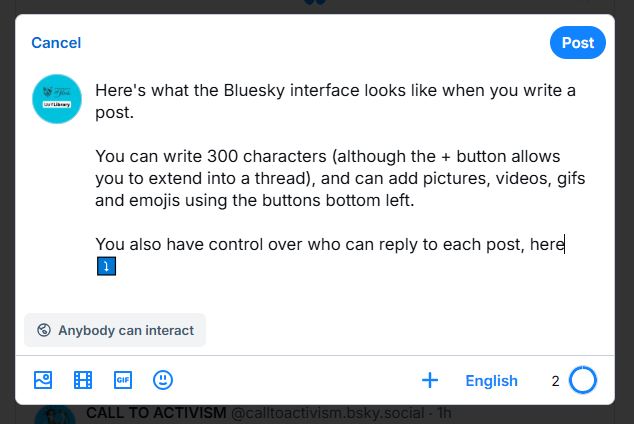
Bluesky is very Twitter-like in lots of functional ways: you can post up to 300 characters at a time, you can repost, you can Like, and so on.
The Bluesky interface
The crucial difference is the lack of algorithm – the lack of endlessly auto-refreshing content, showing you things you didn’t ask to be shown. Bluesky’s default ‘Following’ feed is simply the posts from the people you follow, in reverse chronological order. That’s it.
It takes some time to readjust to proactively seeking out posts and people to engage with, but it’s well worth doing. When you’re new, if you don’t get out there and follow a bunch of people, your feed will be completely dead; with that in mind, as Dr Lucy Grigoryan (Department of Psychology) says: “It’s worth following a lot of people – more so than on twitter, it really changes the whole experience” – so how do you find people to follow?
There are several ways but let’s start with the most York-specific.
3. Follow the University of York Bluesky Starter Pack
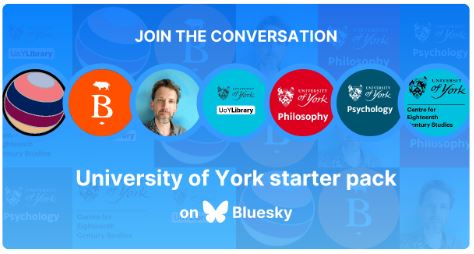
Consisting primarily of academics at York, along with some professional services staff and departments who have created presences on the platform, this pack is the easiest way to connect with colleagues from the off. Two things are worth noting here: you can follow the whole pack and then unfollow / weed as you go along (you’re not obliged to follow all of the accounts, forever), and if you would like to be added to this pack please let us know! The easiest ways to get added is to ask the library on Bluesky itself (@uoylibrary.bsky.social) or send me an email (ned.potter) if you’d prefer.
4. Find other useful starter packs
“One of the best things you can do when starting out on BlueSky is to curate your experience from the get-go: look up different feeds of interest, follow those you’re interested in, follow anyone interesting ‘they’ are following, and take advantage of the new starter packs to rapidly follow the activities of people in related areas of interest / work. It will take a little while to organise, but it’s worth it,” says Richard Carter.
As well as the York starter pack there’s an entire Directory of Starter Packs available, allowing you to search by keyword to see if your discipline is represented. If you’re still looking for people to follow after searching the directory and taking all of Richard’s advice above, you can use Skyfollower bridge to follow the same people on Bluesky you used to follow on Twitter if you wish to.
5. Get up to speed with custom feeds
Whilst a Starter Pack is a useful tool, it is also a fairly blunt one – you follow a group of users united under some sort of thematic umbrella, but you see all of their posts (about any subject). A slightly more subtle device, well worth getting on board with, is the Custom Feed: a curated set of posts on a theme, rather than merely a set of users, which you can view whether you follow the people posting to the Feed or not.
Posters can use emojis or hashtags to tag posts to appear in the feed, depending on how the feed is set up; usually you will need to ask the creator of the feed to add you to the list of eligible posters if you wish to actively participate, but anyone can view and follow a custom feed.
Prof Colin Beale (Department of Biology) says “Finding, following and requesting being added to feeds that are relevant to your research and then tagging posts for those feeds appropriately is very helpful” and in fact using custom feeds was the most often cited piece of advice amongst the academics I spoke to about Bluesky, with Dr Emilie Murphy and Professor Jennie Batchelor among others flagging it.
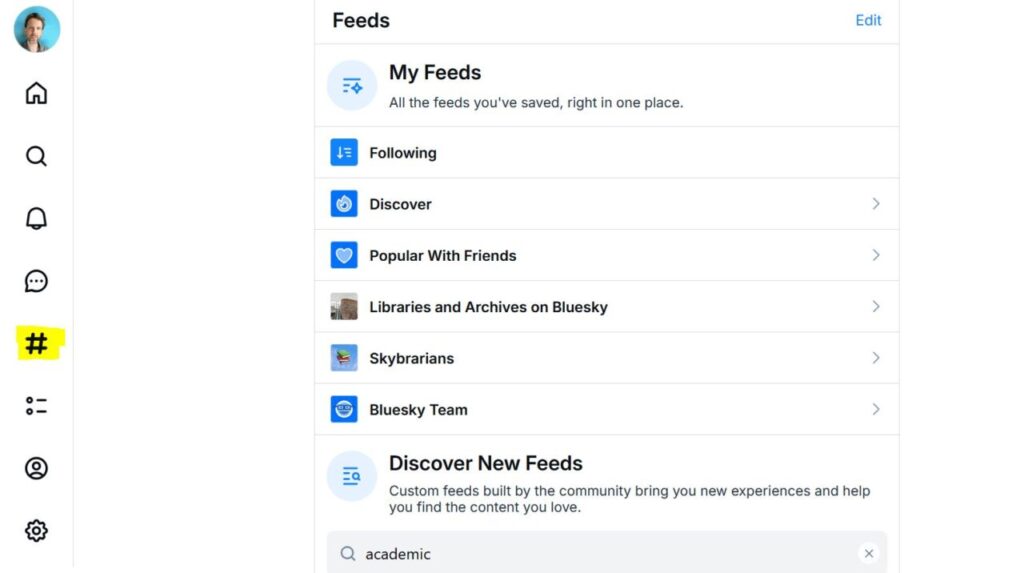
Pavlos Vasilopoulos (Department of Politics) specifically recommends the polisky feed for those interested in political science; there’s an AcademicSky feed for general HE chatter, a PhDSky feed for and by PhD Students, and so on. Search for feeds in Bluesky via the Feeds menu (hit the # button down the left-hand side of the home screen on desktop, or top right of the home tab on the mobile app) and you’ll see any feeds you already follow, plus a search box under ‘Discover New Feeds’.
The Feeds tab
6. Be proactive. Like, reply, engage
All those clichés about how you get out what you put in really apply here. You have to go beyond broadcasting and truly engage: reply to other people’s posts, join in conversations, cultivate discussion. One the tips from Dr Terry Hathaway (Norwegian Study Centre) is simply “…engaging in conversations rather than focusing on posting some branded message out into the void.”
Dr. Sophie Coulombeau advocates a mix of the professional and the personal if you feel able: “…blend self-promotion (‘Thrilled to announce…’) with other stuff around hobbies, interests, and boosting the work of others, if you feel comfortable doing so.”
7. Don’t just post links to your articles, post mini-threads highlighting your findings
More than one academic I spoke to advocates using Bluesky to discuss research papers rather than merely linking to them. Here’s how Colin Beale puts it: “As a general rule posts that just say “We’ve got a great new paper here, read it” don’t really work – but explaining in a short thread the key findings is a much more effective way of engaging.”
8. The follower numbers are lower but the engagement is higher
Several users who maintain presences on both X and Bluesky report that engagement is much higher on the latter: in fact a comparison by Andrew Dressler found engagement was 10 times greater on Bluesky:
as an experiment, I posted the same post to twitter and bluesky. here is the time series of engagements (sum of comments, reposts, likes) from the two platforms.Note that I have 39K followers on twitter and 7K here, so engagement per follower here is more than 10 times higher here on bluesky.
Furthermore Katharine Hayhoe reported that not only was the level of engagement considerably higher on Bluesky, the nature of the responses was much more positive too.
There was an even bigger difference in the comments received. All on Threads and all but one here were positive, constructive, or neutral (one person was just being a jerk, not a troll). Only 18% on X were positive or neutral. The rest were negative, many highly so.
In short, don’t be put off by the idea of starting again with a smaller network.
9. Make the most of Bluesky’s powerful moderation tools
Good moderation and the ability to control who you interact with has been baked into Bluesky from the start, and it makes such a difference. Dr Sabine Clarke (Department of History) says “I do a lot of pre-emptive blocking. When people follow me now who appear to have no interests in common, or seem a bit random, I just block them.”
When you block someone they are gone completely: if they leave a comment on your post and you block them, you won’t see the comment and no one else will see the comment either. If someone Quote posts you and you don’t like it, you can detach your post from theirs so they’re no longer associated. Not only that, you can subscribe to blocklists (e.g. this one) which really do starve problematic groups of the oxygen they need. It’s basically the opposite of Twitter.
As well as the nuclear block option, you can also use the mute function to moderate your own experience of the platform. Richard Carter says, “…if there are topics and discourses that you could very much do without seeing regularly, it can be an invaluable tool. I’ve compiled a veritable ‘devil’s dictionary’ of words to help bring a sense of personalised calm to my various feeds.”
10. Bluesky can be better than Twitter, but give it time
Bluesky is often seen as a Twitter replacement but it doesn’t have to be only that – it can take the good things from that platform and leave some of the bad things behind to make something better. In particular, engaging the trolls and quote-posting the terrible takes – all of that is not necessary on Bluesky, especially when the Block button is so effective.
The accessibility is better too: I’d recommend accessing Settings, find the Accessibility section, and toggle the switch marked ‘Require alt-text before posting’ and you can create accessible content every time. You can also add alt-text (and indeed captions) to videos – finally a social network which offers this… Here’s a great resource on how to write alt-text descriptions, if you want to brush up.
As we’ve seen above the engagement rate is already higher than Twitter – and the academic and Higher Education communities are really starting to build up on the platform. A strong York presence will only enhance that. You may not get instant results on Bluesky, but it’s worth putting in the time. And remember, if you do end up joining the platform after reading this, let us know so we can add you to the York starter pack… Join us!
Bonus tip for departments: speak to Central Communications before you start!
If you are considering creating a new Bluesky account to represent a School, Department or other University Service or subsidiary, please get in touch with the University’s Central Communications team before you get started at communications-support@york.ac.uk. There’s more information on what the Communications team will cover with you on the University’s Social Media For Staff page, including account ownership and security.
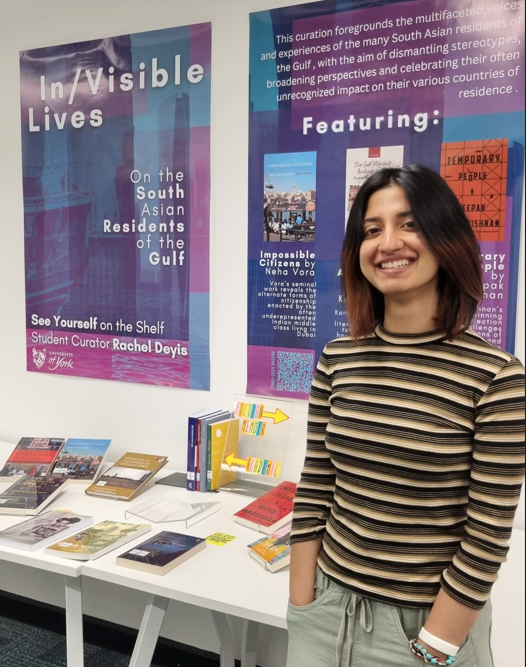
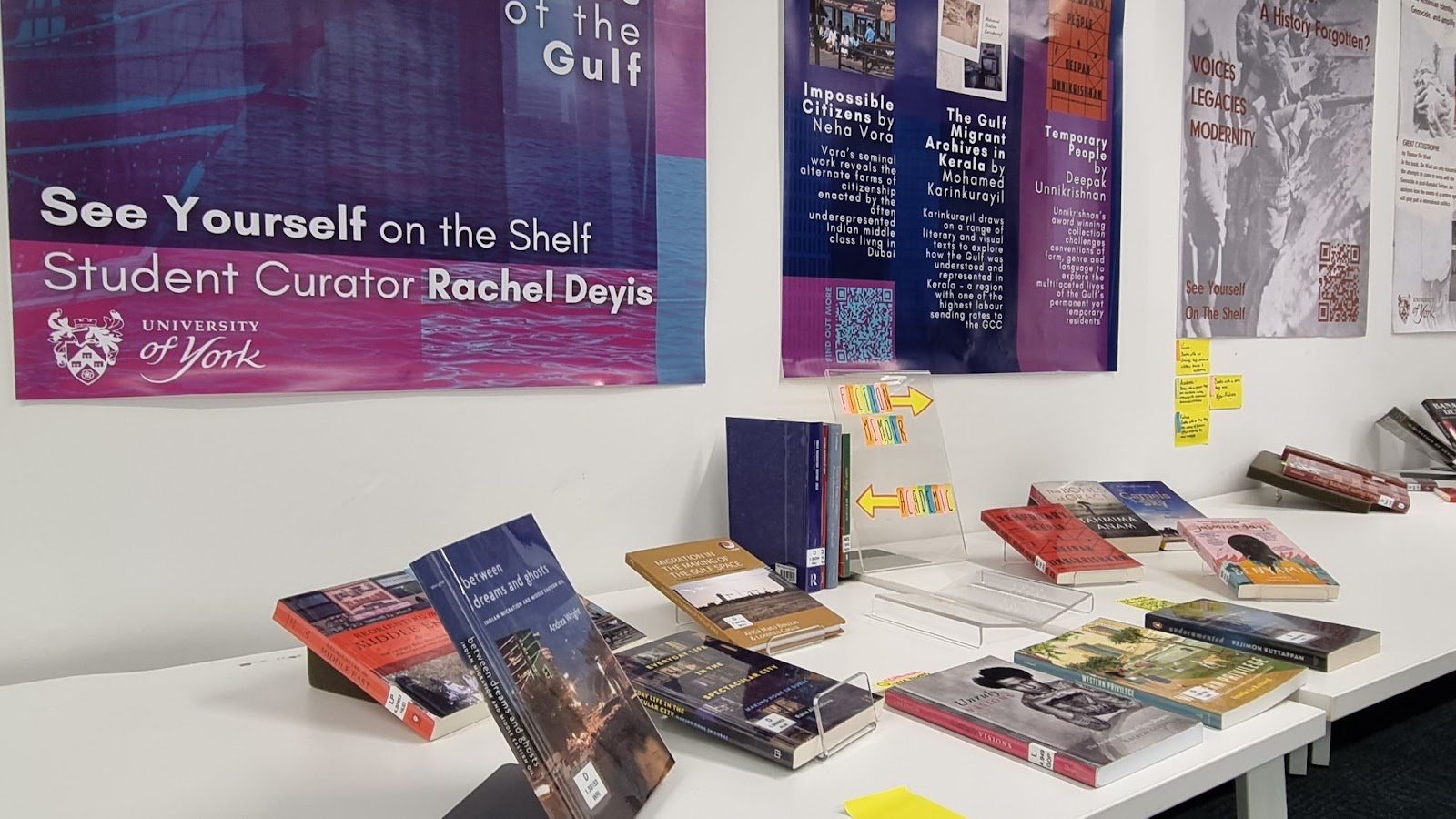
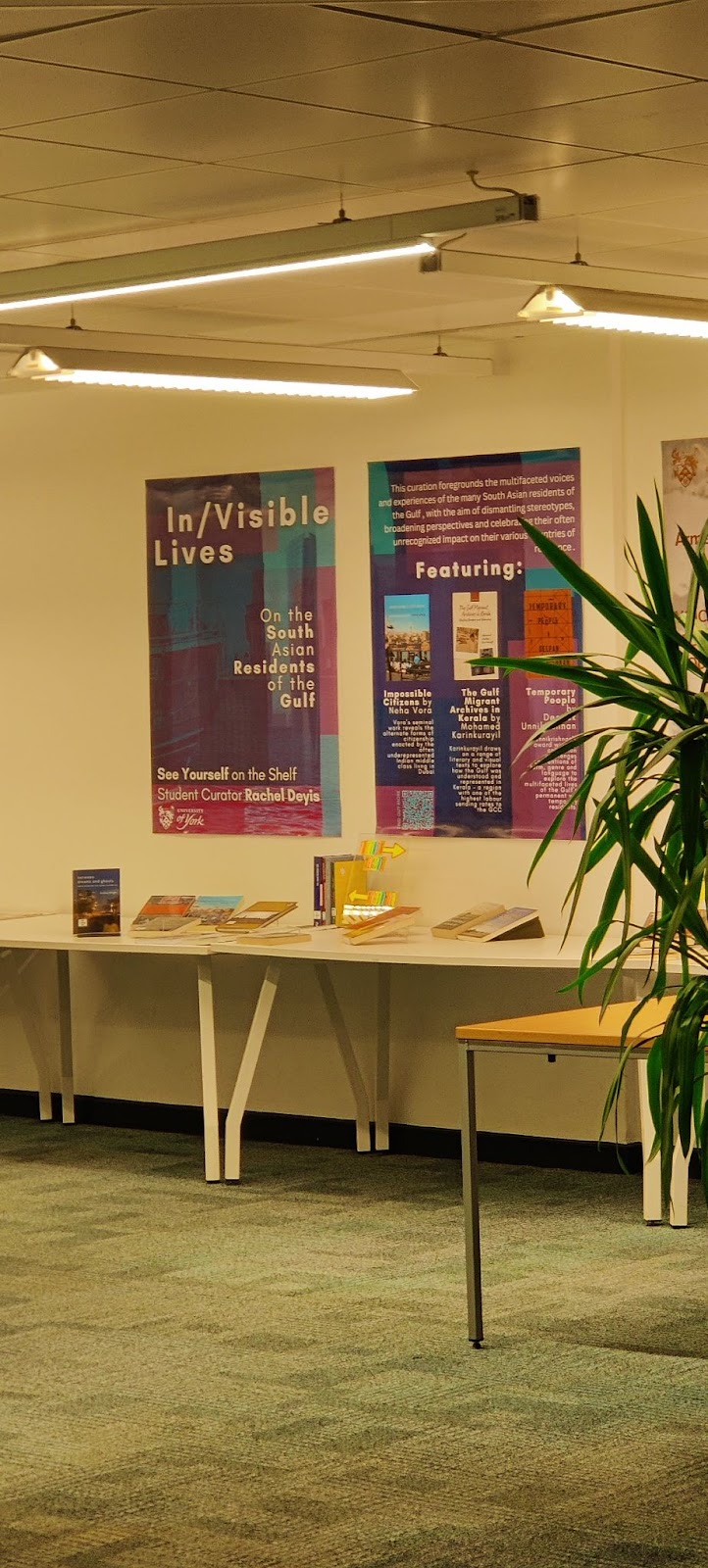
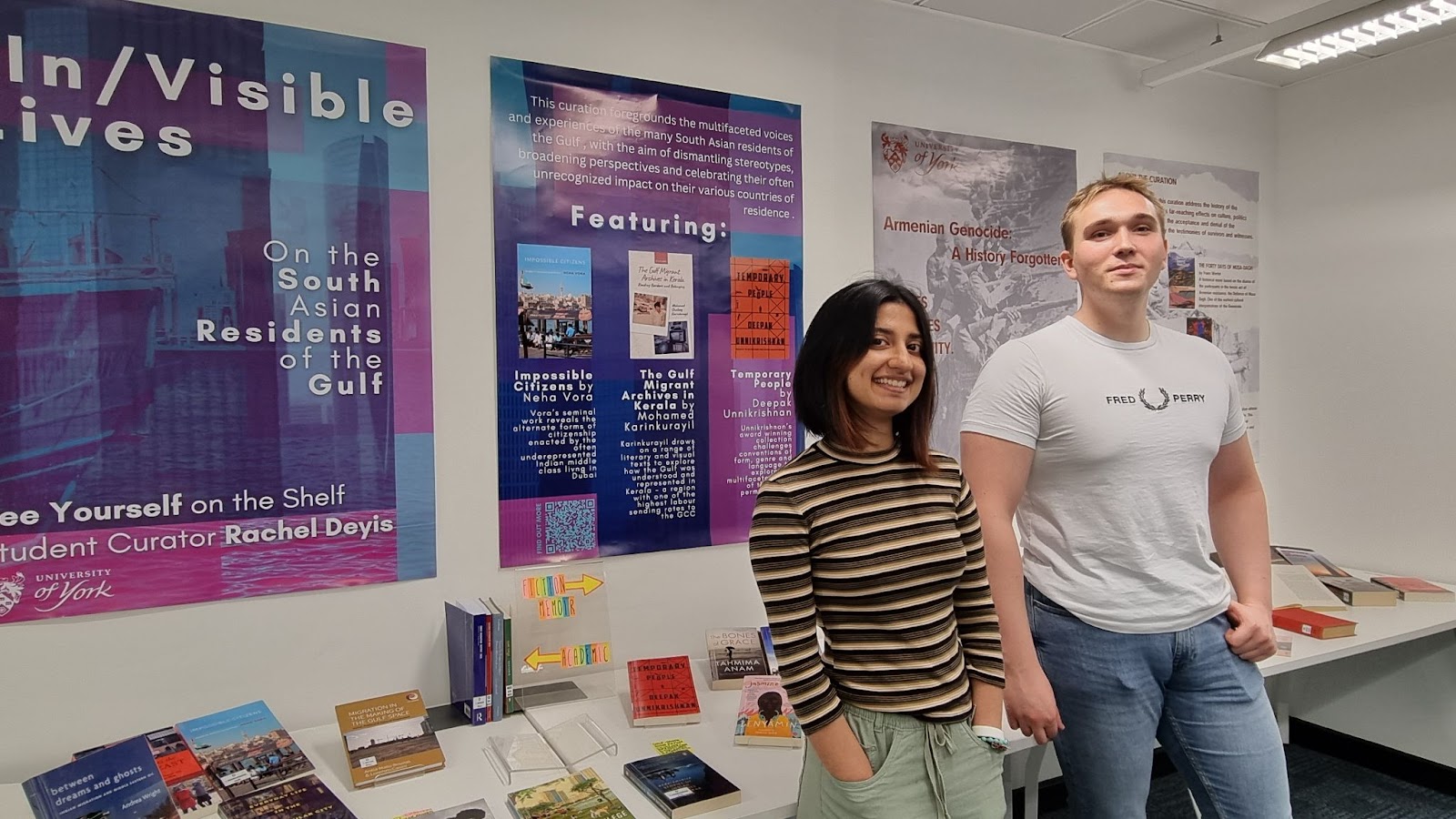
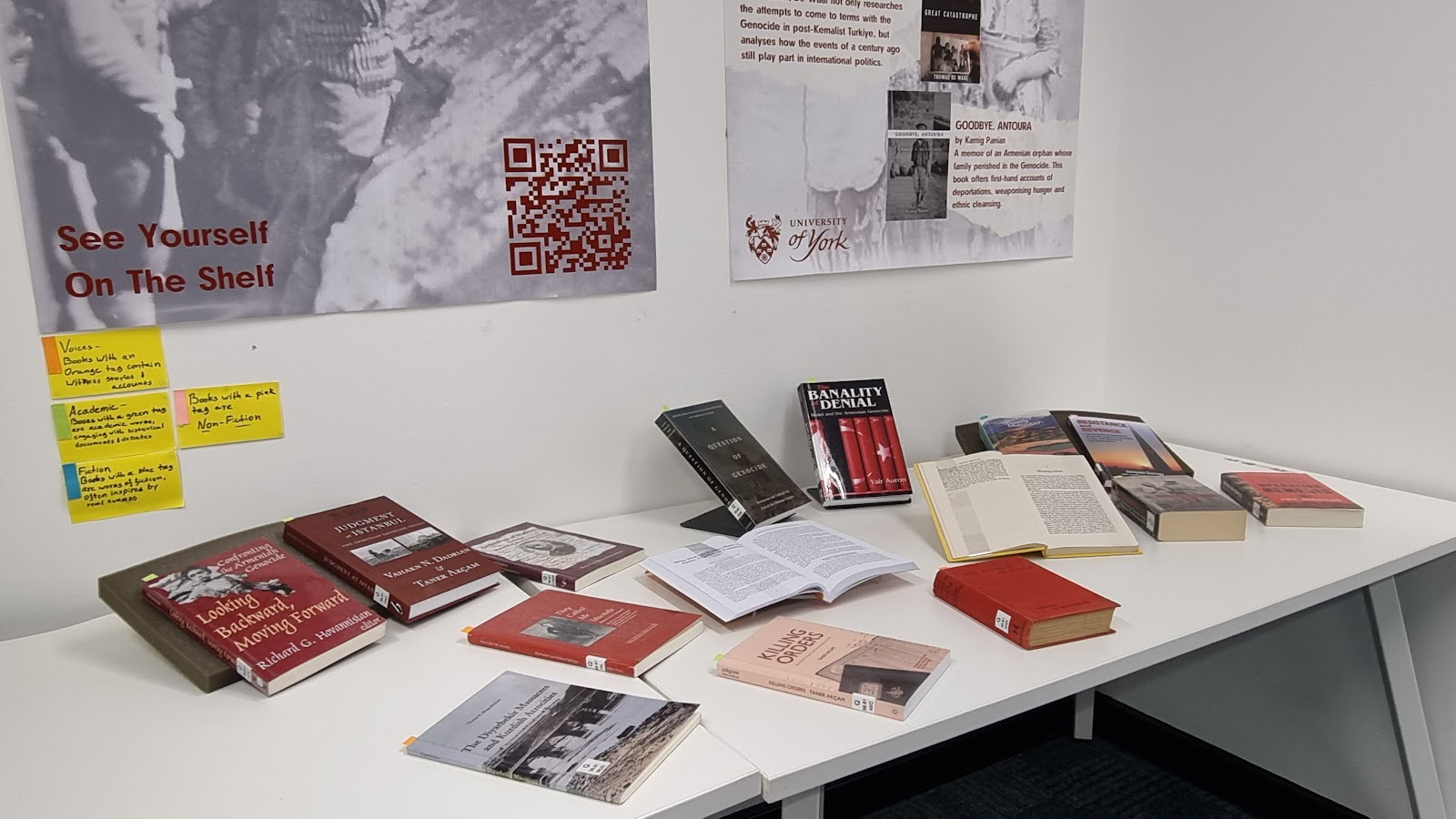
Rachel Deyis reflects about her curation ‘In/Visible Lives: On the South Asian Residents of the Gulf’ project, which is now available on the See Yourself on the Shelf webpage. Its accompanying exhibition is located in the University of York’s JB Morrel library, to the right of the entry-way help desk.
It’s both a mildly terrifying and thrilling feeling to look back at the curation I’ve worked on over the last summer and think about it existing physically in the library and also somewhere on the web, accessible to anyone. As a project I am rather attached to, I find it hard to let go of the curation—a part of me wants to do just a little more research, add just another item to the reading list, in case there’s more to include. Of course, there is inevitably more I could have included: more research, more writing, more art. It would be incredibly reductive to suggest that a single curation could somehow encompass the expansive histories, lives and perspectives of South Asians in the Gulf. However, I do hope the curation works as an important starting point, as an introduction to the largest resident demographic in the Gulf, and a way of making space, both physically and metaphorically, for our experiences.
I have stated in my introductory blog post that the curation’s aims have been to foreground, celebrate, question and facilitate engagement with the often neglected and misrepresented experiences of South Asians in the Gulf, embracing the complexity and diversity of our experiences. The process has been accompanied by its own set of challenges and rewards. When it came to the curation’s title, I found myself struggling to find something that fit. As Mohammed Karinkurayil notes, the Gulf is often narrated through the “poetics of secrecy” and the “idiom of revelation”, so it was important to me that the curation didn’t present the Gulf or the South Asian presence in it as a secret to be revealed. Positioning the curation as something that unveiled the Gulf or certain facts of Gulf life as a South Asian, felt dishonest. Consequently, the question of who I was curating for is one that persisted in the back of my head; I wanted the curation to be a resource for students, researchers and anyone else who was curious about the place and its people, but also for others like like me, who had grown up in the Gulf and for whom the South Asian presence in the Gulf was a fact of daily life, but also rarely encountered in academic, literary or artistic narratives. It is in light of this that I settled on the title, In/Visible Lives. The title’s hyphenation attends to the simultaneous underrepresentation and exclusion of South Asians from spaces, stories and discourses in and about the Gulf, and at the same time our paradoxical visibility, and also hypervisibility in humanitarian narratives.
I found the work of compiling a reading list for the curation incredibly enjoyable, allowing me to immerse myself in both academic and artistic work around the Gulf. Although scholarship in the fields of economics and development have studied the Indian-Gulf migration complex quite extensively, new and innovative anthropological, sociological and historical studies fill in gaps and offer alternative perspectives to mainstream narratives that have viewed South Asian-Gulf migration from a largely economic lens. Neha Vora’s Impossible Citizens, for example attends to the alternative forms of citizenship enacted by middle-class Indians in the Gulf while Mohamed Karinkurayil’s The Gulf Migrant Archives in Kerala, published only earlier this year, draws on a range of visual and textual media to illustrate out how the Gulf has been understood and represented in Kerala. Texts in the history section, presenting the long Indian Ocean histories of the Gulf that predate oil, evince the transcultural dynamics that are and have always been present in the Gulf.
It was important to me that the curation also address the often unspoken gendered and sexual contexts of migration to the Gulf, including underrepresented queer and female perspectives. Pardis Mahdavi’s Crossing the Gulf: Love and Family in Migrant Lives provides insight into the intimate lives of migrant workers, challenging the human trafficking frameworks that reduce these workers, often women, to their labour. The ‘Queer’ section of the curation features fictional texts like Deepak Unnirkishnan’s genre defying collection of short stories, Temporary People and some academic work like Ryan Centner’s Peril and Privilege, which, although it focuses on Western, gay men in Dubai, reveals how classed, racial and gendered hierarchies of access to queer spaces in the city exclude South Asians, especially low-wage workers. Other works, like Gayatri Gopinath’s Unruly Visions suggest the vibrant queer socialities formed even under conditions of duress, asking for example, “what forms of homosocial/homerotic desire and relationality emerge in the all-male labour camps themselves”.
Having written my dissertation on South Asian migrant workers in the Gulf, I was somewhat aware of academic work around the topic but more doubtful about finding much creative work. However, I have been both humbled and thrilled to discover a rich, if emerging variety of artistic and literary works, from memoirs to film to music videos, finding creative work in unconventional forms and unexpected places. One of my favourite discoveries were the community-built Instagram archives like @gulfsouthasia and @humans.abudhabi that have emerged in the absence of ‘formal’ archives documenting the South Asian presence in the Gulf. Publications like ALA and Postscript magazine, and art foundations like Art Jameel also reveal a vibrant, emerging art scene, featuring the work of South Asian creatives like Vamika Sinha, Aathma Nirmala Dious, Vikram Divecha and Bhoomika Ghaghada.
Importantly, there is no single narrative the texts in this curation follow; some celebrate the South Asian presence in the Gulf, others draw attention to important humanitarian issues around labour rights, still others analyse the impact of the South Asian presence on the economies, societies and cultures of the Gulf and South Asian home countries they return to after retirement. I have had to make challenging decisions about which works I wanted to include, afraid that some would prop up exactly those narratives which reduced South Asian workers to their experiences of labour and hardship. However, it was important that those experiences weren’t erased either. The texts featured in the curation aren’t intended to stand in isolation—viewed collectively, they reflect the varied experiences and outputs of South Asians in the Gulf and the evolving narratives through which the South Asian presence in the Gulf has been perceived, understood and written about. Ultimately it has been my intention that the range of mediums and voices featured in this curation resist simplistic binaries or singular narratives and refuse to homogenise a multiplicitous and unendingly diverse group of people.
As I state on my curation page, this curation, as much as it has been my own project, is also the result of many people. I am very grateful to Dr Nadeen Dakkak and Professor Neha Vora for their help and recommendations. Beyond this, I am indebted to the assistance I received from the Library team who have been incredibly warm and supportive throughout the entire process. I have Antonio, Ilka, Dave and Kirsty, to thank for their wonderful advice in our meetings (and also for answering my many, many questions about copyright), to Kenny and the rest of the purchasing team for helping the curation take physical form, to Ned for help with social media promotion and to Steph for patiently guiding my not-very-tech-savvy self through the process of setting up the curation’s libguides page (and for rescuing it from being eaten up when I forgot to close my code).
The ‘See Yourself on the Shelf’ initiative has been a wonderful way to allow students to create spaces within the library collections that reflect our experiences and I am very grateful for this opportunity. Looking to the future I’m excited about the impact of the curation. Aside from a few articles like Jadaliyya’s, Losing Oneself in Gulf-Migrant fiction,I have yet to encounter any collections about South Asians in the Gulf, so I hope the curation plays an important role in dismantling stereotypes and promoting understanding about the Gulf and the South Asian residents it has long been home to—while also making it a little easier for others from the Gulf to find works that reflect on and celebrate their own lives and experiences. In the face of increasingly hostile immigration policies across the globe, this curation hopes to promote greater empathy and understanding of the complex and varied experiences of migration, celebrate the transcultural societies it creates and encourage readers to engage deeply, caringly and continually with migration narratives.
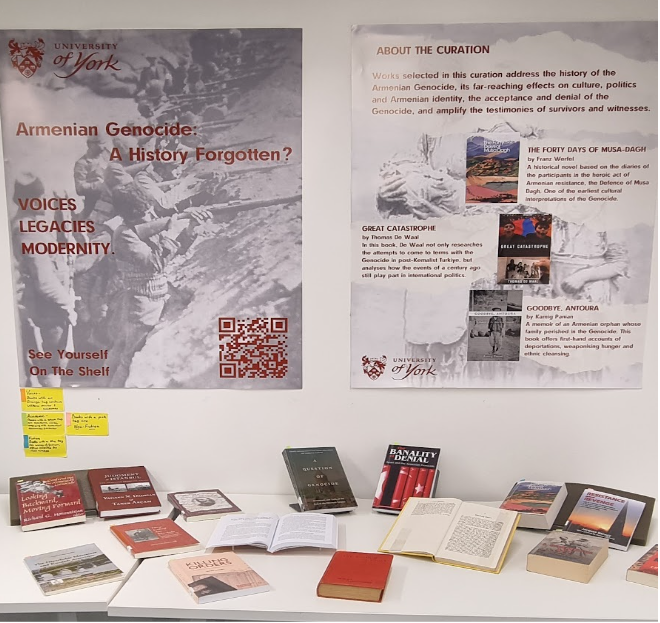
Fedor reflects about his ‘Armenian Genocide: A History Forgotten’ project, which is now available on the See Yourself on the Shelf webpage. Its accompanying exhibition is located in the University of York’s JB Morrel library, to the right of the entry-way help desk.
When I began the curation, I had no clue about the way the university library was organised, and I was hoping to maybe order a few new books, specifically ones that I could not find when writing that one essay a year ago – what made me think about applying for this internship in the first place. Now, several months later and coming out of the internship, I know not only how the process of ordering books works, but I learned some HTML coding (something I feared, something I never even touched before). Not only have I had the opportunity to expand the library collections and set up an exhibition of my own, but I now know so much about what goes on behind the scenes of the reading lists that all (humanities, at least) students know and love.
In the beginning of the curation, I had a relatively vague idea of what to add into the collections – as a history student, and as is evident from my history-heavy introduction, I started with locating books that provided a wide overview of the history of the Armenian Genocide, but as the project develped, my research took several tangents.
On one hand, I kept the guide I created with history in mind, and modelled the reading list structure off some of the reading lists that I encountered throughout my Bachelors and Masters history degrees. On the other hand, I did not shy away from including creations of culture that surround the theme of Genocide, and, towards the end of the curation, I incorporated materials that tie the events of 1915-1923 to today, culturally, politically, physically.
I have included works that invoke the role of the Genocide in modern day politics and international relations between Turkey and Armenia, both on state levels, and on personal levels, for the citizens of both states. Particularly interesting I found the topic of Crypto-Armenians, a phenomenon that is not too widely known in the western world – the descendants of those Armenians, who survived the genocide by assimilating into Turkey, sacrificing their names and identities. A book of testimonies of modern crypto-Armenians, who research their family histories and find inconsistencies with the lives that they lived in and discovering the dramatic truth of their real ancestry, finally realising why their grandparents had no cousins or brothers is an important centrepiece of my exhibition, highlighting events of over a century ago impact the lives of those alive today.
Amplifying the voices of the witnesses of the Genocide, whether of armenian descent or witnesses of other nations was one of the key goals of the curation, and I am very happy with the results. I managed to locate and order several books that have never been published in the UK before, and several books that have only been translated to English in recent years, like Karnig Panian’s “Goodbye Antoura,”a harrowing account of the survival of an Armenian orphan. Quite notably, one of the first autobiographical sources on the Genocide, Aurora Mardiganian’s “Auction of Souls” was already available in the library collections, and so it took its rightful place next to the newly published voices.
When assembling the LibGuide for the curation, I faced several challenges stemming from the sensitivity of the topic. Because I was working with a genocide, a lot, if not most, sources contained metions of unspeakable violence and brutality, including sexual, and including women, men and children. As such, a simple trigger warning at the top of the guide was not enough, and some of the entries in the reading list had to be equipped with further warnings. Same was true about the use of photographs. While most photographic evidence available from the Armenian Genocide have long been public domain, so copyright was not really an issue to me, the contents of the photographs presented an ethical challenge. When using pre-Genocide photographs of Armenian families and their peaceful life in the Ottoman empire, I had to bear in mind, that the majority of people from these images met a grizzly end. While I refrained from using pictures of dead bodies in my LibGuide directly, to make it slightly less distressing, some of the links that I have included lead to the collections of photographs that include photos of human remains and executions. While I think that using images of violence for shock value is not a good tone, these photographs are relevant historical testimonies.
Another challenge came during the discussion of the denial of the Armenian Genocide, that is still a state policy in some countries in the world. Addressing this theme, I included academic works by Turkish and Armenian academics alike, including a work on the denial of the Genocide by the State of Israel, a truly fascinating read. In the LibGuide itself I chose to add a document created by the Turkish Ministry of Foreign affairs that denies the genocide, instead presenting a different interpretations of the events of 1915, invoking the violence of Armenian population against the Turkish population, and calling the numbers of victims “doctored.” While platforming a source that denies the genocide may be a controversial idea, I think that the viewers of the LibGuide and anyone who stumbles across it need an example of what the denial can look like, and make up their mind about it themselves.
If I had to work on a similar project again, I would probably spend more time working on obtaining more physical books and utilising the budget. Given the limited funding of the project and the relative expensiveness of the books that are available on the topic of the Genocide, I feel like I had to make very difficult choices at times, selecting several books instead of one that would be very relevant and needed, but would not fit into the budget.
Overall, I think my work has been a success, enriching the library collections with many books, fictional and non-fictional, academic and eyewitness accounts, and making sure that the history of the Armenian Genocide does become forgotten, at least in the University of York.
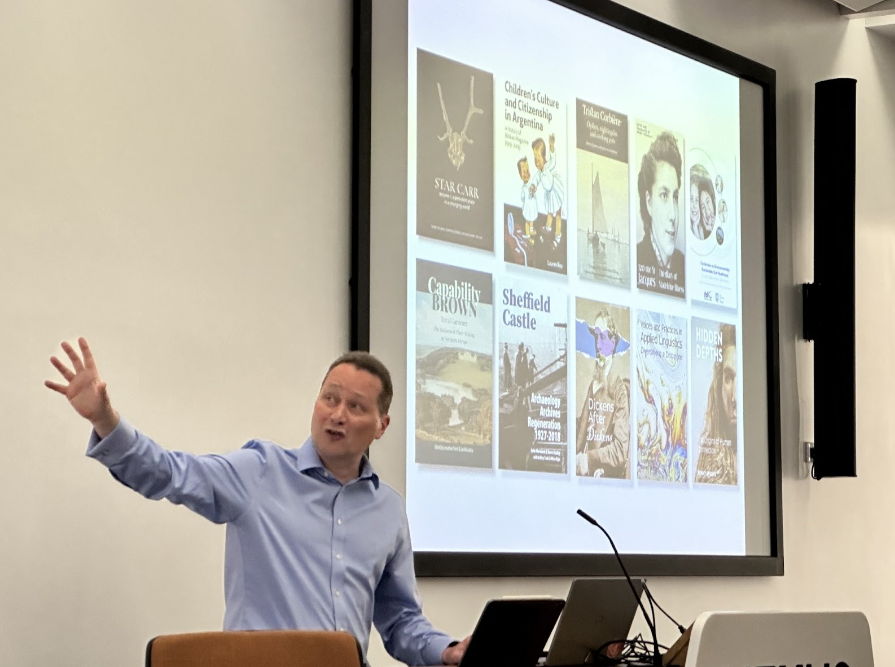
The universities of Leeds, Sheffield and York have all hosted events across 2024 to showcase White Rose University Press (WRUP). This series of advocacy events aimed to further raise awareness of WRUP and its focus on ensuring academic quality, promoting open access, and driving innovation in publishing. With authors sharing their experiences of open publishing with WRUP, and through an academic-led panel discussion on the value and challenges of open access, these events also sought to increase the awareness of, and engagement with, open access book publication. The events reinforced WRUP’s identity as the open access academic publisher for Leeds, Sheffield, and York, and reinforced its mission to support scholarly communication and barrier-free access to scholarship.
Engagement from the Academic Community
Each event was opened by an academic from the host institution, a key advocate for open access and for WRUP. Professor John Flint, Deputy Vice-President for Research at Sheffield highlighted the innovative publishing practices of WRUP and how these have helped catalyse the OA publishing sector towards a more equitable, ethical, and sustainable model. Professor Tom Stoneham, Head of the Department of Philosophy at York and outgoing Chair of the WRUP Editorial Board, emphasised WRUP’s core values and its openness to proposals from across the wider academy. Professor Nick Plant, Deputy Vice-Chancellor for Research and Innovation at Leeds and the next Chair of the WRUP Editorial Board, stressed WRUP’s commitment to knowledge equity and highlighted the societal benefits of a digital-first publisher.
Professor Nick Plant delivering his talk. Photo courtesy of Masud Khokhar.
These perspectives from experienced academic leaders set the scene for relevant and timely discussions on how WRUP can serve its parent institutions with support for open access publishing.
Author Experiences
Authors who have published with WRUP also shared their experiences during the sessions, providing valuable insights into the open access publishing process. Their testimonials highlighted the benefits of choosing an open access model, including greater visibility, wider dissemination, and the increased impact of their work.
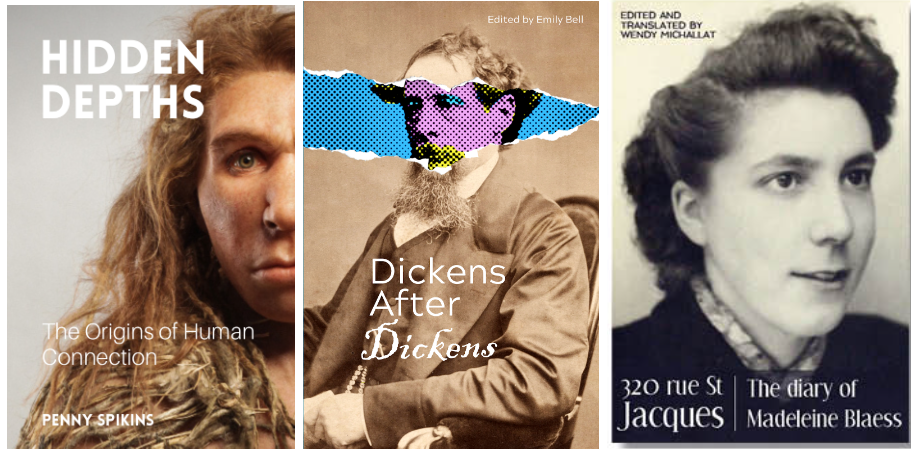
Experiences of publishing with WRUP were shared by three experienced academic authors. Dr Wendy Michallat from the School of Languages and Cultures at Sheffield, the editor and translator of 320 rue St Jacques: The Diary of Madeleine Blaess (2018), praised the bespoke editorial service WRUP offers. She emphasised the support and guidance she received, and spoke about how this helped her realise her vision for her monograph as an unabridged scholarly resource with interdisciplinary reach. The book is at the heart of a suite of openly licensed resources that can be shared and reused to support learning across disciplines and academic levels.
Professor Penny Spikins from the Department of Archaeology at York shared her experience of publishing Hidden Depths: The Origins of Human Connection with WRUP. She highlighted the benefits of publishing open access books for researchers, including greater exposure for her research and subsequent opportunities to further engage with the wider public through other routes. Penny also noted that open access publishing addresses issues around equality of access to research by making high quality publications available to read without financial barriers.
Dr Emily Bell from the School of English at Leeds discussed her positive experience in publishing the volume Dickens after Dickens open access with WRUP. Again, making the publication available as widely as possible was important, but Dr Bell also stressed the responsiveness and service levels a smaller press could offer.
Recent WRUP publications
As well as advocating for open access publishing, both Dr Bell and Dr Michallat have shown continued support for WRUP, with both bringing a second publication to the press. Dr Bell and her associates are working on Digital Dickens, which will further showcase the digital capabilities of open access publishing, and Dr Michallat is working on additional translations of the letters of Madeleine Blaess in a volume that will complement her first WRUP publication. These researchers’ further collaboration with WRUP serves as a testament to the positive experience they had working with the Press.
Panel Discussion on Open Access Publishing
A significant portion of each event was dedicated to a panel discussion that explored the value and challenges of open access publishing. Facilitated by Michael Fake, the panel at each event was composed of academics, open access specialists, and colleagues supporting the wider scholarly communications area. The discussions explored the benefits and perceived challenges of open access book publishing. Attendees to the events were invited to submit questions in advance and could also actively participate in the session, creating a lively interaction between the panellists and the audience.
Image by art designer at PLoS, modified by Wikipedia users Nina, Beao, and JakobVoss
Key Themes and Insights
The Benefits of Open Access:
Open access helps authors reach the widest possible audience with their work as it is freely accessible to and beyond the global academy, regardless of financial or institutional barriers.
This enhanced availability and visibility increases the reach and citation of an author’s work, increasing the impact of their scholarly contribution.
The academic community benefits from this growing pool of open content, with research outputs licensed to make sharing and reuse a default position.
Challenges in Open Access:
The perception of open access publishing as in some way significantly different to traditional publishing persists. There are concerns about how open licensing works, how to use third-party owned content, and how authors’ rights are protected. In practice, these are issues that impact on open access publishing in much the same way as in traditional publishing, but the impression of greater challenges remains.
The complexities of funding models, availability of funding across different disciplines, and the sustainability of open access initiatives were keenly debated, as was the crucial need for strong institutional support to overcome these challenges.
The Future of Academic Publishing:
Academic publishing and university presses were thought to have a key role in fostering innovation.
University presses, especially those with a non-profit approach, can adapt to the changing landscape of scholarly communication, potentially leading the development of new open access models that balance the demand for quality with the need for sustainability.
Many new university presses are library-led, positioning libraries as both creators and consumers of open content. This dual role provides greater insight into the needs and challenges faced by both authors and readers, allowing for the prioritisation of non-commercial considerations.
Diverse Perspectives and Unique Insights
All three events brought a different perspective to the open access debate. Discussions took different trajectories, offering fresh and engaging insights into the opportunities and challenges that open access publishing brings. The range of viewpoints enriched the overall conversation, contributing to a more nuanced discussion of the issues at hand. Feedback indicates that attendees learned a great deal about OA publishing and about WRUP, and that this gives a platform to further build upon.
Next steps
These advocacy events were a significant step forwards in emphasising the WRUP’s role as the university press for the Universities of Leeds, Sheffield and York. As well as offering a viable and proven route to high-quality and innovative open access publishing, WRUP provides an important aspect of the three libraries’ broader support for open access, being able to help academics from a position of practical experience. These events were the first step in a concerted drive to promote WRUP as an example of supportive open publishing that can help authors navigate the challenges, and enjoy the benefits of open access publishing. It is hoped this will foster a deeper understanding and appreciation of open access within the academic communities of Leeds, Sheffield, and York, and generate increased interest in WRUP as a publishing route. The events also generated ideas for further advocacy, both internal and external to the three parent universities, with the goal of continuing to raise WRUP’s profile and increase the numbers of internal and external submissions.
This is a guest post authored by Lucy Cook, White Rose University Press Publishing and Communication Assistant. If you’d like more information, please get in touch with the WRUP team: universitypress@whiterose.ac.uk.
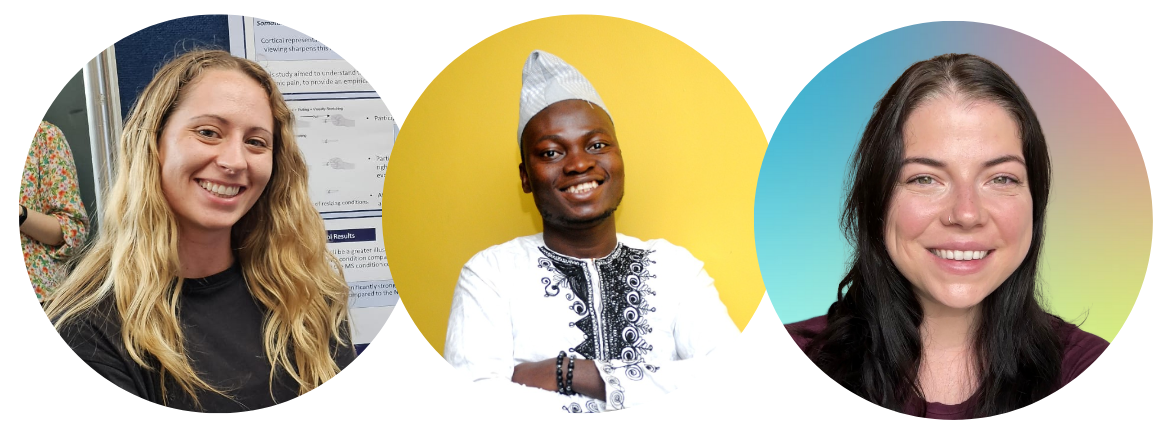
In August 2023 the Open Research team welcomed three postgraduate researchers, Kirralise Hansford (Psychology), Luqman Muraina (Interdisciplinary Global Development) and Melissa Kays (Archaeology), as Graduate Engagement Leads for Open Research in each of our academic faculties. The purpose of their roles was to work with the Library, staff and students across departments and schools developing open research training, advocacy and community-building initiatives. Kirralise, Luqman and Melissa wrote about their early successes and plans in a previous post, Next steps for the open research community at York. In this post we’ll summarise their achievements over the past twelve months and highlight some areas where work is still to be done.
L-R: Kirralise Hansford, Luqman Muraina and Melissa Kays
Funding for the Graduate Engagement Lead posts was secured through an Enhancing Research Culture grant from Research England, and the role description and expectations have been closely aligned with the University’s Research Culture commitments. There was no precedent for a role such as this at York, and the first task for the Engagement Leads was to agree upon a set of achievable objectives and working patterns – hybrid and flexible – to make the most of their time working with us alongside completing their PhD.
A key priority has been to formulate training and advocacy activities based on the needs and expectations of our research community. The Engagement Leads soon got to work developing an evidence-gathering survey for staff and students which was launched in the middle of semester one. The survey was tailored to each faculty and shared widely at both University and departmental level, making the most of our Engagement Leads’ knowledge of local contacts such as email and WhatsApp groups. We received over 300 responses from a wide range of disciplines and roles which have provided valuable insights and helped to inform a comprehensive set of recommendations in our survey report. The team benefitted especially from Kirralise’s skill in designing the survey instrument and analysing the data to allow for reproduction of figures and statistics, and further exploration of the responses. The survey report has been shared openly with the accompanying data and R analysis script on our Open Science Framework (OSF) project site.
In terms of new resources for training and advocacy, three Open Research in Practice case studies have been created to highlight researcher perspectives into open research-engaged projects from the departments of Archaeology, Psychology and School for Business and Society. Further case studies have been lined up from a variety of departments based on submissions to this year’s Open Research Awards scheme, which were co-organised and judged by the Engagement Leads in partnership with Dr Nathalie Noret (Education). Melissa used her skills in research communication to create case study posters and launch a new Instagram account, helping us reach a broader audience and create a more visual narrative around open research at York activities. We also created an internal Open Research Newsletter which has been published every two months to provide timely updates and researcher perspectives. The audiences for these new communication channels are relatively small – around 100 followers and subscribers each – but we aim to continue developing these and review our use of social media as we assess the long-term sustainability of X/Twitter and possibility of migrating to other platforms.
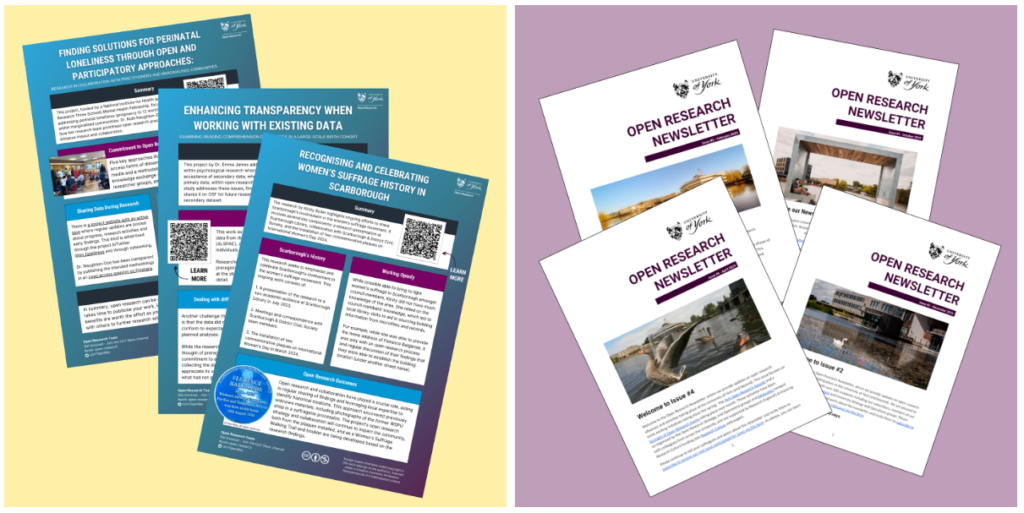
Open Research at York case studies and newsletter issues
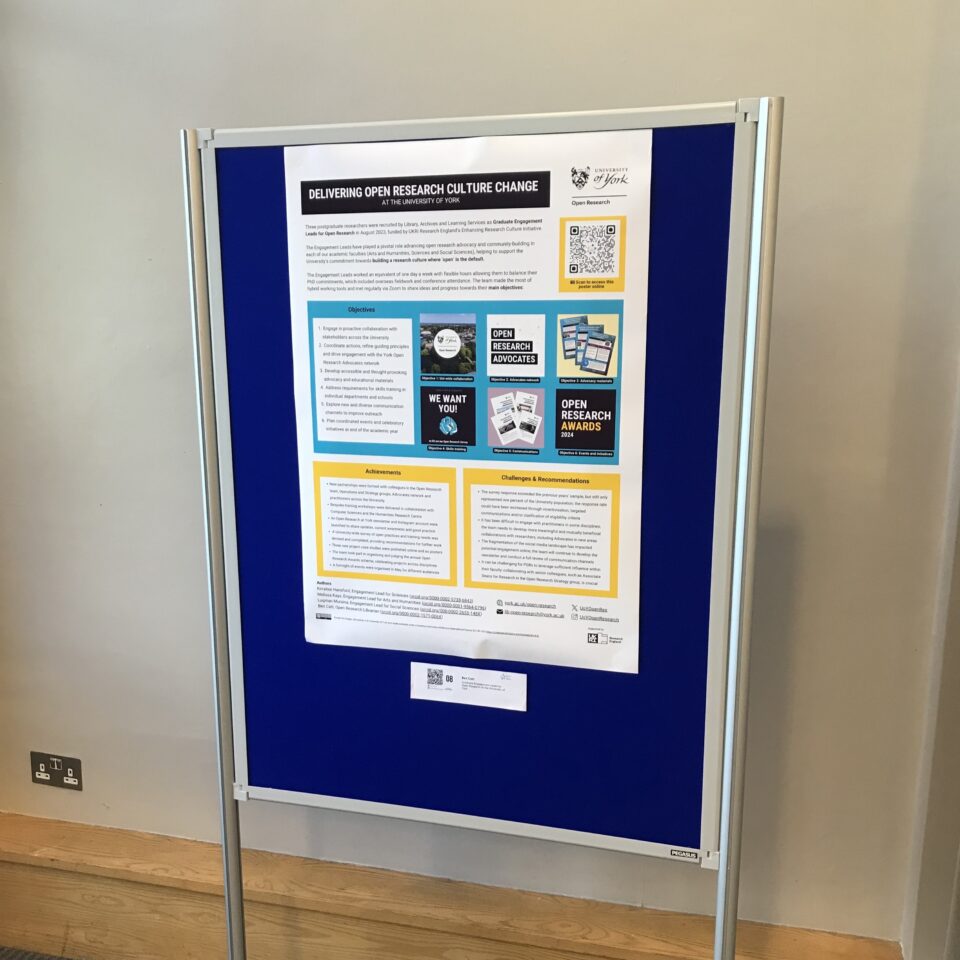
We have taken the opportunity to communicate our Engagement Leads’ achievements amongst other library professionals and open research enthusiasts with a poster on delivering open research culture change, delivered at this year’s Edinburgh Open Research Conference. Kirralise also attended the Oxford/Berlin School on Open and Responsible Research and Melissa participated in the British School at Athens Communicating Archaeology course, both of which provided opportunities to network and further their knowledge of open research-aligned practices in their disciplines. We hope to find more opportunities to share our successes and recommendations with the wider sector through conferences and publications next academic year.
The Engagement Leads have continued to work closely with our Open Research Advocates network, aiming to increase engagement through consultations, occasional meetings and a revised set of guiding principles to set out the mission, benefits and expectations of membership. We have also strengthened our connections with other grassroots networks across the University including the ReproducibiliTea journal club and colleagues involved in the Enhancing Research Culture Workshops in Biology, recognising the essential role these groups play in the development of a practitioner-led, positive research culture at York. We would have liked to have done more in collaboration with practitioner-led groups this year, but we recognise that their efforts are often voluntary and everyone’s time is limited. Coordination of the Advocates network will remain a key objective going into next academic year, and we hope to involve them in a planned series of open research-aligned discussion seminars which Luqman has taken a key role in developing. We look forward to sharing further news of these events very soon!
It has also been a year for reflection, as some activities were not as effective as we would have hoped. There was little engagement with a series of drop-in enquiry clinics we offered during Open Access Week, and mixed levels of interest in the Open Research at York events fortnight we organised in May. The discussions were nevertheless appreciated by those who attended and produced a useful set of recordings and resources on diverse areas such as open research in archaeology and heritage and writing lay summaries with AI assistance. We will continue to learn from these experiences as we develop the aforementioned seminar series and try to address topics which meet the most urgent needs and interests of our research community.
Delivering Open Research Culture Change poster at the Edinburgh Open Research Conference
The Open Research team is hugely grateful for the work that Kirralise, Luqman and Melissa have contributed this past year, especially in terms of being able to learn from their perspectives and experiences as new ECRs. We are sorry to report that Kirralise and Melissa will be leaving us at the end of the summer as they focus on completing their PhDs, but we wish them all the best in the next stage of their careers and hope that they maintain their enthusiasm for open research in their future roles! Fortunately, Luqman will continue his work with the team and we look forward to building upon our achievements with his focus being on engaging with researchers in Social Sciences.
Here are some final thoughts from our three Engagement Leads:
I have enjoyed my time over the last year working as graduate open research engagement lead for the Faculty of Sciences. This role has really shown me another side to open research focussing on how practices and resources can be implemented at a university level, and the challenges that can be associated with this. I hope that over the next year the work we started can continue to develop in ways which help researchers and students to access as many open research opportunities and practises as they wish to
Kirralise Hansford, Graduate Engagement Lead for Open Research (Sciences)
I take it as a great privilege to be appointed the Graduate Engagement Lead role. It’s personally provided a learning curve for me vis-a-vis the weekly meetings, completing team and individual tasks, in addition to making progress in my PhD research. As I continue in the role, I look forward to the development of the university’s research culture (especially in the Social Sciences), such that open research becomes the default.
Luqman Muraina, Graduate Engagement Lead for Open Research (Social Sciences)
The Open Research team at York is such a valuable asset to the university, and it’s been a great experience to aid in spreading the word about our tools, trainings, and events this year. For the Arts and Humanities faculty, Open Research often looks different from the sciences, and we were able to work together to identify areas of overlap and areas where we can create new opportunities for students. I look forward to seeing how the team continues to create innovative solutions and resources for University of York students in the future
Melissa Kays, Graduate Engagement Lead for Open Research (Arts and Humanities)
The Open Research team works in partnership with staff and postgraduate researchers to help you plan, publish and share your research. Further information about the University’s commitments, governance and support for open research can be found at Open research at York.
My name is Fedor, and I am a postgraduate Public History student at the University of York.
Prior to my MA degree, I completed a BA (HONS) History degree at York, my main research interest being the history of Russia, Russian Empire and the Soviet Union, as well as histories of commemoration and ethnic conflict.
This guide will seek to enrich the collections of the University of York’s library with sources on the Armenian Genocide, as well as the history of Armenians as an ethnic minority in the Ottoman Turkey and beyond, parts of my own family originally coming from Armenia, this is a very personal topic.
About the Armenian Genocide
The Genocide of Armenian People of 1915-1923 is the established culmination of centuries of inequality and oppression of an ethnic minority under Ottoman rule, resulting in deaths of hundreds of thousands of Armenians across the Ottoman Empire and in displacement and deportation of millions. Other ethnicities have also been affected by the massacres and deportations, like Greeks, Assyrians and Kurds. The Genocide resulted in the de-armenisation of Turkish lands, and the destruction of Armenian cultural and spiritual heritage. The Genocide of 1915-1923 is largely considered the first genocide of the modern era and is believed to have the very term ‘genocide’ coined after it. The purpose of my curation will be to expand the University’s collections on the topic of the Armenian Genocide and raise awareness of the how the Genocide is viewed worldwide.
As a minority ethnicity in the broader Ottoman Empire, Armenians were well-integrated into society, despite their unequal treatment – as non-Muslims, they had to pay higher taxes and were not allowed to own weapons. They ran businesses, built churches and had schools that taught in Armenian. Despite the majority (up to 70%) of the Armenian population of the Ottoman empire consisting of poor peasants, the Ottoman stereotype of a greedy, well-off Armenian evading taxes persisted, those Armenians who managed to run a successful business faced hatred and xenophobia. For the brief time of 1908-1909, several Armenian parties were represented in the Ottoman senate.
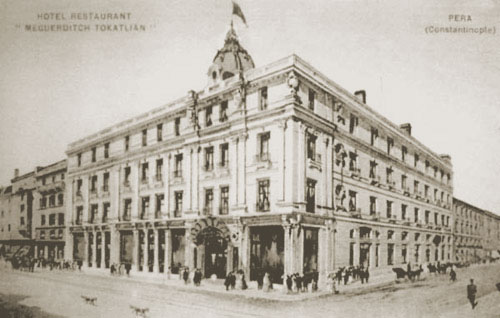
Armenian-owned Tokatlian Hotel in Pera, Constantinople, c. 1900.(Photo 136, R. H. Kevorkian, P.B. Paboudjian, Les Armeniens Dans l’Empire Ottoman a La Veille Du Genocide. Editions d’Art et d’Histoire ARHIS, Paris, 1992)
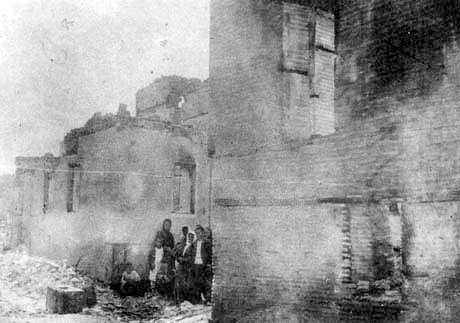
Prior to the Genocide of 1915-1923, several Armenian pogroms took place across the six Vilayets (regions) with Armenian ethnic majority – Van, Erzerum, Sivas, Diyarbekir, Bitlis and Kharpout. Particularly notable were the massacres of 1894-96, that gave rise to the Ottoman resettlement of de-Armenised lands with Turks, Circassians and Caucasus muslims.
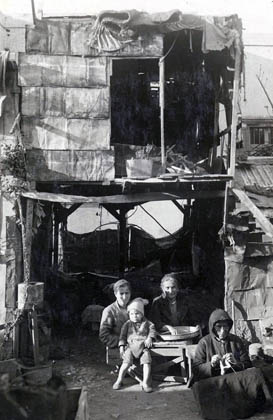
Burned ruins of Armenian quarter in Adana, following the 1909 pogrom.(Archive of the German Assistance Association, Public Domain Image)
Reactions, Trials, Justice?
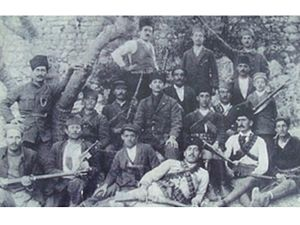
Armenians formed resistance groups and parties to defend their villages and settlements from genocidal Turkish forces and auxiliaries. While not always successful at stopping the better-equipped soldiers, this resistance saved many lives during the genocide. Particularly notable is the forty-days long defence of Musa Dagh mountain in 1915, that saved the population of neighbouring villages from being massacred. Thanks to the heroism of the resistance fighters, the village of Vakוflו stands to this day as the last remaining Armenian village in Turkey.
Armenian resistance fighters (Fidayiner) in Musa-Dagh, 1915, Public Domain Image
I think it may be said, without the least fear of exaggeration, that no more horrible crime has been committed in the history of the world…. this is a premeditative crime determined on long ago…. it was a long-considered, deliberate policy to destroy and wipe out of existence the Armenians in Turkey. It was systematically carried out. it was ordered from above…
Lord Robert Cecil, the Under-Secretary of State for foreign Affairs. House Of Commons, Hansard (5th Series), Vol. LXXV, 16 November 1915, Cols. 1770-1776.
Britain, France and the United States knew of the genocide, and condemned it, offering little assistance to Armenians on the ground, but helping refugees and survivors of the deportations after the First World War. War crime tribunals were set up for the leaders of the Young Turks directly responsible for the massacres and deportations. However, by the time of the start of the hearings, some of the architects of the Genocide, including Talaat-pasha, Grand Vezir of the Ottoman Empire in 1917-1919 and the minister of internal affairs in 1913-1917 managed to escape Turkey and avoid the tribunal. In absentia, the escaped Young Turks were sentenced to death.
The Armenian Revolutionary Federation (Dashnaktsutyun) party, not satisfied with the escape of the leaders of the Young Turks from the tribunal, ordered their assassination. The order was carried out by Armenian freedom fighters who lost their families in the genocide. Talaat-Pasha, the architect of the genocide was shot in the street in Berlin in 1921 by Soghomon Tehleryan, who surrendered himself to authorities minutes after the assassination and was acquitted by the court. While Dashnaktsutyun claimed that the purpose of these assassinations was not terror or eradication of the Turkish population, but rather carrying out the sentence of the military tribunal, this revenge operation remains a morally questionable act.
The Genocide today
The Genocide remains relevant for Armenians all around the world to this day. The Genocide Memorial day, April 24th, sees mass manifestations in Armenia and across the global Armenian Diaspora,from the United States to Lebanon, urging people not to forget the horrors of 1915-1923.
The events of 1915-1923 have been a staple part of the Armenian culture, resurging particularly around the centenary of the genocide, with songs, films and book dedicated to the Genocide frequently published, and a pushing a revived interest in family history and pilgrimages to the former sites of genocide.
In diversifying the University of York’s library collections, I am hoping to raise awareness of the Genocide, and provide resources for scholarly research of the Genocide at the University of York.
Hi! I’m Rachel, a third-year English and Related Literature student. I’m particularly interested in migrant literature and decolonial practice within academic spaces. Today, I am excited to announce that I will be working with the University Library to curate a collection titled In/visible Lives: On South Asian Residents in the Gulf. Through this curation I hope to cultivate the diversity of the University Library collections while creating a space which foregrounds the experiences of the various South Asian communities in the region.
Why South Asian-Gulf Migration?
Most literature and scholarship around South Asian diasporas tends to be oriented around South-North migration. While incredibly important in their own right, I found that these accounts were quite different from and rarely captured the particular transience of growing up as an immigrant in the Gulf—a place I would never legally belong to. The Gulf’s citizenship laws which prevent naturalisation, produce longstanding migrant communities, often three or four generations old, who remain unrecognised as citizens and who must return to their home countries upon retirement.
As a third-generation migrant myself, while I’ve lived my whole life in the UAE, I remain an Indian citizen. Resultantly, after coming to the UK, I often found myself struggling with introductions. When asked where I was from, I was careful to distinguish that I only grew up in the UAE, never feeling like I could claim the country as my own. Deepak Unnikishnan, award winning author of Temporary People, incisively articulates the feeling in his piece with The Common:
“I started putting Abu Dhabi in my bio in the early aughts. It was an act of resistance, which nobody, except me, cared about. I needed people to know I had roots in the Arabian Peninsula. That people like me—children of the transient diaspora the Gulf cultivated—nonchalant about allegiance and flags, counted and existed”.
It is these complexities around citizenship, migration, and identity that felt both personal and wider-reaching, that are in some ways unique to the Gulf and in others reflective of a process of neoliberal globalisation that produces and unevenly disadvantages a global working class, that fostered my interest in curating around South Asian residents in the Gulf.
South Asian Migration to the Gulf: A Brief Background
Often referred to as the Gulf countries, the Gulf Cooperation Council (GCC) comprises 6 countries, Bahrain, Kuwait, Oman, Qatar, Saudi Arabia, and the United Arab Emirates. The population of most Gulf countries tend to be heavily skewed towards expatriates who outnumber the national population in 4 out of the 6 GCC countries. South Asian migrants in particular form the largest expatriate population in the Gulf, with the South Asian-Gulf migration corridor being one of the largest in the world.
Most popular accounts of South Asian migration to the Gulf tend to focus on low wage male migrant labourers, particularly looking at the construction workers behind the skyscrapers, luxury malls and theme parks that cemented the global renown of modern metropolises like Dubai and Doha. However this belies the diversity of the South Asian resident communities in the Gulf; from low wage and domestic workers, to middle class doctors, lawyers and various white collar workers and wealthy upper class business executives, South Asian residents occupy a range of professions. Additionally, although migration to the Gulf is often understood within the context of the 1970’s oil boom that attracted an enormous influx of migrant labour from South Asian countries, South Asian-Gulf migration has an extensive pre-oil history and can be traced to pre-Islamic eras as far back as the 7th century, when Indo-Arab trade was flourishing.
Maritime Museum of Kuwait. Azhar Munir Din, 2021, Unsplash (https://unsplash.com/photos/grayscale-photo-of-boat-on-dock-EfcB5iAKV5M).
What are the Aims of my Curation?
As an international student in the UK I’ve noticed how people’s reactions towards the Gulf tend to reflect very different conceptions about the place than my own. More often than not, reactions followed one of two narratives: the first conjured up an image of immense wealth and consumerism as seen in the likes of Dubai Bling—a glimmering mirage of a city often condemned as a tourist trap, superficial and inauthentic—while the second was based on humanitarian reports about gendered and sexual or migrant labour rights violations, like the recent 2022 Qatar World Cup controversy. The extremes of the wealthy and exploitative that these narratives swivel between create what Neha Vora calls “a place of fantasy”(1). Often, they reflect orientalizing and exceptionalist conceptions of Gulf societies as illiberal and backwards—in comparison with their supposedly liberal and progressive Western counterparts (2) . In both instances, South Asian residents are made selectively visible, occupying the unseen peripheries of the glamorous city, or understood only as passive victims.
In light of this, my aims for the curation are threefold. Firstly, it is my intention that this curation will move beyond such reductive narratives, by illustrating the richness and diversity of the experiences of South Asian resident communities in the Gulf—who, as Nadeen Dakkak has observed, often simultaneously occupy positions of marginality and power (3).
Secondly, drawing on a range of economic, historical, sociological, literary and artistic materials this curation will strive to be attentive to how mutually constitutive networks of migration, gender, sexuality, race and class shape migrant experiences, including the often underrepresented experiences of queer and female South Asian residents.
Thirdly, through the curation I aim to both highlight the structural disadvantages endured by South Asian resident communities while also celebrating their too often unrecognised impact on their various countries of residence in the Gulf. In particular, the scholarly and artistic works within the collection unveil alternative modes of citizenship and belonging that are enacted by South Asian resident communities on the ground even while they are refused legal citizenship.
In a recent article in the Guardian Jhumpa Lahiri suggests that “our global ‘obsession” with what is original or authentic is ‘very problematic’ and is partly responsible for ‘the fallout we’re seeing now’ in Gaza and in the three countries she has connections with: India, Italy and the US”. In light of ongoing issues around migration where laws around citizenship and national borders dictate who gets to belong to or reside in a place, often at great cost to human life, I hope that this curation will resonate with global matters of migration, citizenship and belonging while also filling in gaps in understanding about the Gulf and the South Asian diasporic communities it has long been home to.
Neha Vora, Impossible Citizens.
Vora and Koch, Everyday Inclusions.
Nadeen Dakkak, Contesting Narratives of Victimization in Migration to the Arab Gulf States: A Reading of Mia Alvar’s ‘In the Country’.
This blog was updated with a change terminology from ‘immigrant(s)’ to ‘resident(s)’ (July 2024)