Hi 🐕🦺🖤 My name is Kaori, and I am currently pursuing a PhD at the Centre for Women’s Studies (CWS) at the University of York. My research sits at the intersection of English literature, feminism, and queer theory, with a particular focus on writers such as Virginia Woolf. Before coming to York, I completed both my bachelor’s and master’s degrees in English literature in Tokyo.
Since starting this new chapter in York, I’ve genuinely enjoyed life here. Before moving here, however, I found it difficult to imagine what life would actually be like as an international PhD student in the humanities. So, as I sit here writing this at my desk, I hope this post helps bridge that gap for prospective students who may be wondering the same thing.
How Do I Move My Research Forward?
Yes, the most important part!
As a literature student, I usually move my research forward through regular supervision meetings with my supervisors. Before each meeting, I submit a piece of writing, and our discussions are based on their comments, feedback, and any questions that arise from my draft.
I also like to prepare in advance a list of questions or challenges that have emerged during the writing process. These questions range from practical concerns—such as how to identify relevant scholarship on a particular topic—to more literary ones, such as how to interpret an inexpressible yet intriguing moment in a literary text. Having these questions ready helps me make the most of each supervision meeting and allows me to make steady progress with my research.
Surviving the Three-Week Cycle as a PhD Student in York
Supervisions usually take place on a three-week cycle, and each time I submit between 3,000 and 5,000 words that will eventually form the foundation of my doctoral dissertation. This is where one challenge arises: balancing input and output within such a short interval. On the one hand, I need to identify relevant scholarship, locate the most useful discussions, and continue developing my knowledge. On the other, I need to organise all these messy ideas into something coherent and produce a piece of writing that I can share with my supervisors.
Sometimes, I become so absorbed in reading and digging into a particular topic (which is always fun) that I suddenly realise I have only three days left before the deadline to start writing. While I’m still struggling to find the perfect balance, I feel that I’m gradually getting used to this cycle and have developed a rhythm that works for me.
Writing in a Room of My Own
I know many people love studying outside, whether in a library (and we do have beautiful ones in York) or in a café. Personally, though, I prefer writing and studying in my room. Virginia Woolf would probably approve — after all, she famously wrote that “a woman must have money and a room of her own if she is to write fiction” (A Room of One’s Own).
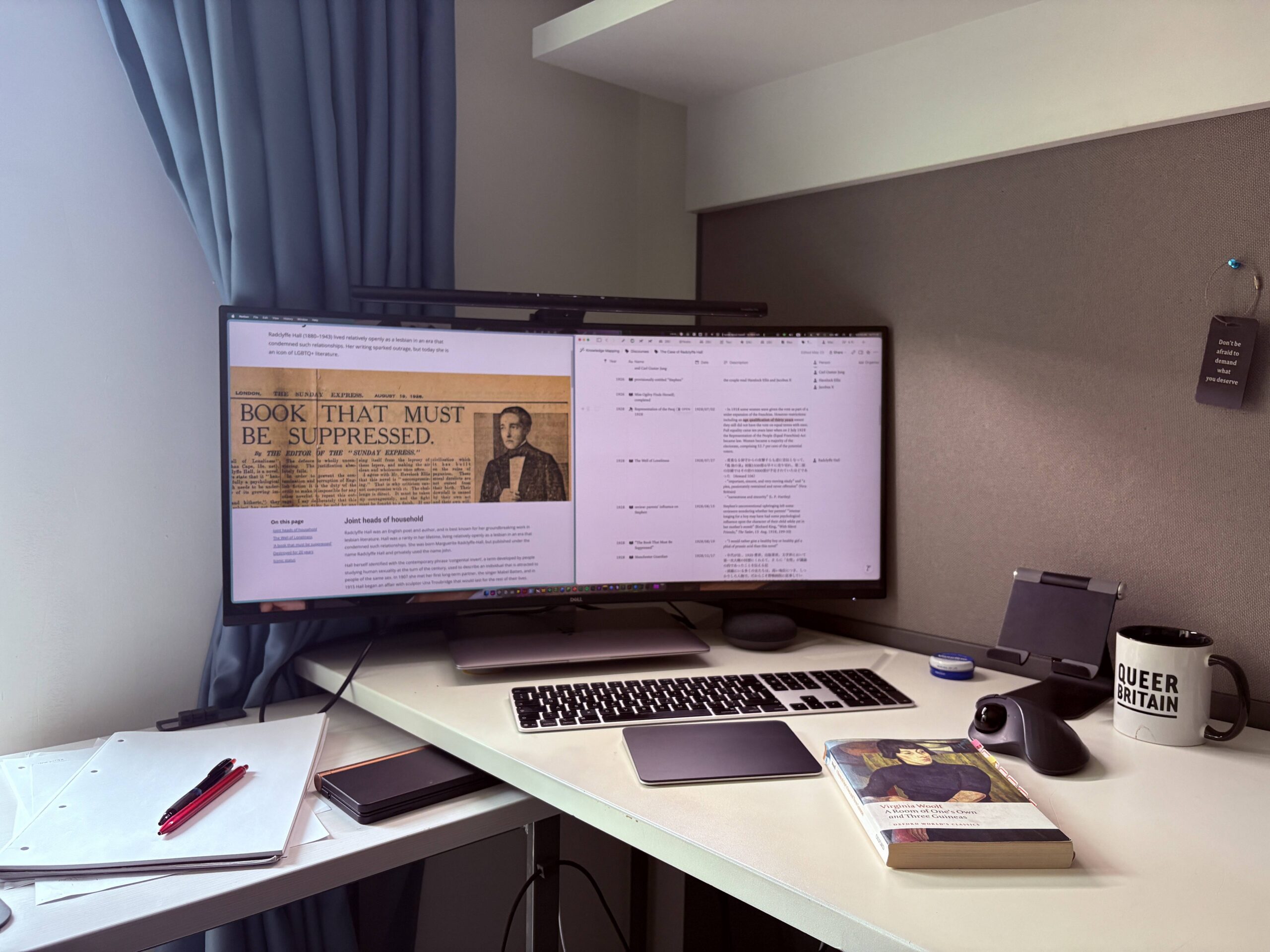
There are practical reasons for this preference, too. I can concentrate much better in my room than in a busy public space. I don’t have to spend time getting ready or putting on makeup, and I can cook for myself, which helps me save money on meals. Most importantly, I can create a quiet and comfortable environment that is entirely my own. My ideal workspace consists of a 34-inch monitor, an L-shaped desk, a count-up timer, a dictionary, plenty of A4 paper, and my favourite Jetstream pen. It may not look particularly glamorous, but it’s where most of my research and writing happens.

When I need a break, I often take a walk into the city centre. One thing I love about York is that it’s compact enough that you often run into friends while you’re out and about. After spending hours reading and writing alone, those unexpected encounters can be a lovely part of the day.
Back in the Classroom
I am often asked whether PhD students take classes as part of their degree. At least in the CWS, research students are not required to take taught modules for credit. (Of course, this may vary between departments and programmes.) That said, during my first year, I audited one module in each semester. I decided to do so partly on the advice of my supervisor and partly out of curiosity. I was eager to see what classes were actually like and how students discussed topics such as feminism in the classroom.
Modules typically run for two hours each week. For me, they have also provided a valuable opportunity to see friends and spend time with other students—especially as someone who spends much of the week writing independently at home.
One thing I particularly appreciated was the atmosphere of the discussions. Students often brought their own lived experiences, including their perspectives on gender and sexuality, into conversations about theory. As someone coming from a different academic culture, I found this refreshing and, honestly, a pleasant surprise. Of course, this may not be true of every module or every department. Nevertheless, I have found the classroom environment welcoming and supportive, and the experience of attending modules has enriched my research in unexpected ways.
If you are curious about the teaching offered by a department, I’d definitely recommend having a look at the Module Catalogue.
* * *
If you’re considering studying abroad, it’s completely normal not to know exactly what your future life will look like. That’s exactly why services like Chat to a Student exist. If you have any questions about studying at York, feel free to reach out—I occasionally work on the platform, so you might find yourself chatting with me!


Leave a Reply