Last September I started my year in industry at the Earlham Institute on the Norwich Research park and, somehow, September has almost come around again already. With my time here nearly at an end, I’ve been reflecting on how transformative my year has been. The skills and confidence this placement offered have been incredibly valuable to my growth as an early-career biologist.
Proteins, Yeast and Robots
So, what have I been doing this year? My project has been a collaboration between the computationally focussed Haerty group and the Earlham Biofoundry, which is equipped with a suite of laboratory robotics platforms. Across the UK there are only a handful of biofoundries: labs that specialise in automation, engineering biology and high-throughput experimentation. This made working in the Earlham Biofoundry team a truly unique and exciting opportunity. Between these two groups I’ve been developing a semi-automated, high-throughput pipeline for screening protein-protein interactions, with the aim of experimentally validating computationally predicted interactions between alternatively spliced isoforms.
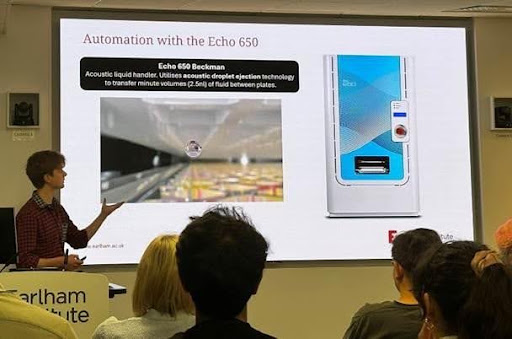
Through generation of experimental data on these isoform-level interactions, the project lays the groundwork for advancements in our understanding of the role alternative splicing plays in protein complex formation. To develop this pipeline, I’ve had the opportunity to get hands on with the laboratory robots in the Earlham Biofoundry. Of these, the main piece of equipment I’ve used throughout my project is the Echo650, an acoustic liquid handler. The echo generates ultrasonic acoustic energy to transfer tiny volumes fluid between source and destination plates. I’ve been using this machine to increase the scalability of the manual yeast two-hybrid assay for protein-protein interaction screening.
As well as the Echo, I’ve been trying my hand at automating the process of yeast co-transformation with the Opentron Flex liquid handler. Working in the Biofoundry can feel quite surreal at times, with all the cutting-edge robots making it feel like the set of a sci-fi movie. If you’d like more details on this project and my experience in interdisciplinary research, I wrote an additional blog post on the Earlham Institute website that delves deeper: Automation, engineering and computational biology: My Year in Industry | Earlham Institute
Outside the Lab
Beyond the lab, my year on the research park has brought along a bunch of unique opportunities to engage with the world of biological research. For example, in January I attended the Festival of Genomics in London, a huge bioscience event. Attending talks and panels from researchers across the field of genomics made it a hugely inspiring few days.
I also had plenty of chances to practice my science communication skills. Back in February the Norwich Science Festival rolled around, where I volunteered as part of the Microbe Zoo, an interactive exhibit aimed at introducing young audiences to the world of microbial research. I spent a good few days during the festival in a giant soil tunnel, introducing a whole new generation to bioscience through crochet microbes and glowing roots. The zoo was such a fun event to be a part of and a great chance at practicing public engagement.
As well as demonstrating to the public, I had a lot of opportunities to communicate my research to a scientific audience. In March I had the privilege of being selected as a speaker for the Norwich Engineering Biology Day. On top of sharing my work with others, learning about the breadth of research in engineering biology and how it’s being used to tackle pressing global challenges made the event super uplifting and invigorating. In addition, I took on a slightly surreal teaching role at Biofoundry’s Engineering plant and microbial systems workshop, demonstrating the capabilities of the Echo 650 to visiting researchers from across the country. As a final capstone for my year in industry, I’ll be speaking again at the Norwich & Cambridge Student Symposium (NoCaSS). I hope this demonstrates just how much is on offer during a year in industry on the Norwich research park. My biggest piece of advice for incoming students would be to engage with every opportunity they’re able to. Almost all of these events were optional and/or required an application yet add so much to a research placement; the more you put in, the more you get out.

As I mentioned in my last blog, the atmosphere at the Earlham Institute has been extremely welcoming right from the get-go. Throughout the year there’s been loads of opportunities to engage in the institute and park’s community, from spring and summer parties, student events like our pottery session, and even just grabbing a drink after work on a Friday. I’ve been made to feel at home this year and the encouragement from everyone in the institute has been a great motivator throughout my project. After getting so engrossed in my project and the research community here, it feels pretty strange to be leaving!
Looking Ahead
As I return to York for my final year, I know the skills I’ve gained throughout my placement will be a valuable help. Overall, one of the biggest takeaways has been getting to grips with troubleshooting after experiments don’t go the way I anticipated. When working on a novel project, unexpected results or problems don’t always have a clear answer; unlike in a lab practical, you can’t just ask a lecturer why it didn’t work. Delving deeper into the problem, reaching out to scientists from other fields and institutes and thinking critically about my experiments have not only led to several “EUREKA” moments throughout the year, but have helped structure my mindset when approaching research and reinforce my passion for biology. Every “failure” in the lab is another opportunity to learn something new and expand your understanding, making research one of the most exciting paths to pursue.
From the community to the cutting-edge science to the opportunities for gaining new skills, I can’t recommend the Earlham Institute’s year in industry program enough. If you’re interested in pursuing a career in research after graduation, a year in industry is an amazing way of paving your path.
Leave a Reply