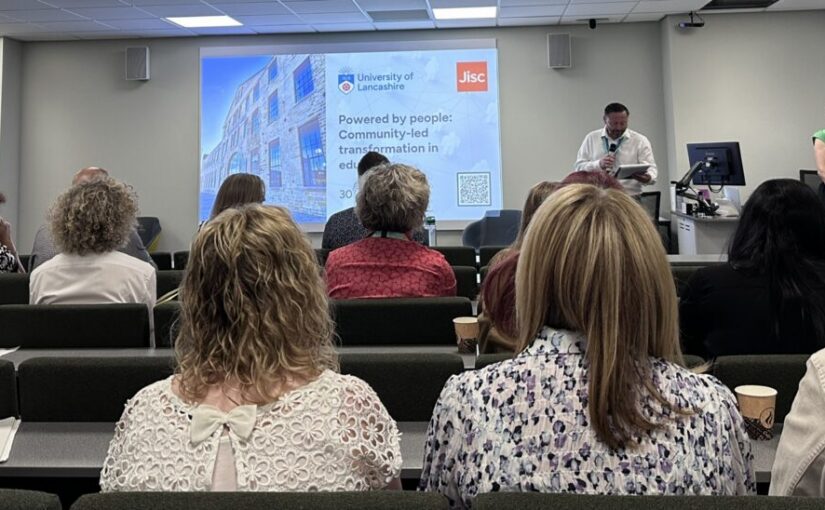

The Powered by People event on 30 June 2026 was organised by Jisc and University of Lancashire’s Chris Melia on “how to develop digital capability using a community-led approach that embeds staff recognition and peer support.” It was an opportunity to reflect on how to sustain communities, what gives a community life and how to make it sustainable without reliance on just one person.
What a fun day! I basically got the head space to think about what community is, why it might work, what can make it work better and how to ensure a community thrives. When it comes to promoting digital accessibility, this isn’t often a method that gets talked about a lot. Having the opportunity to intersect two areas I’m very involved in was very welcome.
I came to be on a panel and fly the flag for Future Teacher (FT). I came away with lots of ideas to consider for our next two years of the FT community to share with my fellow organisers and to implement at the university.
Ideas we’re already thinking of:
- more student input – what do students want from x technology? How does y practice help them? We’ve already tested out this format with our Teaching students with vision impairment webinar on 25 June. We often ask presenters to bring along any students who can explain how the practice or technology has helped them and our webinar series is peppered with these student insights. We believe it’s what makes our webinar series unique.
- creating a student panel to help us decide the topics to run – what do students want their lecturers to be more aware of or to have more skills in?
Ideas for us to consider:
- Can we intersect with other communities to create a multiplier effect across them?
- Can we help presenters to tell stories , not just present facts?
- Is there anything from the Jisc community resources that we could adopt?
I particularly enjoyed the workshops on community building and storytelling. I learned
- Prompt cards are very effective ways of stimulating conversations
- Stories can be elicited through the creation of artefacts like crafts
- Stories can be powerful as they are memorable and communities are strongest when they have a shared memory of what they are doing together.
Even during the panel session with other people talking about our communities, I was struck by how much more effective answers to questions were when they were backed up by a story! Thanks to fellow panellists for that illustration of story-telling in action and to Jisc’s Chris Thomson for his storytelling inspiration!
I am motivated to
- create a community around accessibility at the university, allowing people to have conversations and create events
- Create a community around DigAcc maybe called DigAcctions?
- Explore further Jisc’s guide on community-led digital skills.
Having a day to reflect on the effectiveness of our approaches to supporting communities is an absolute luxury and I’d like to thank Natasha Veenendaal, Chris Melia and Carolina Barnes for leading this space. I made connections with people who I intend to invite to speak at the Future Teacher webinar series and to tap for further inspiration.
Since the event happened in June, I’ve already put some things in practice:
- I help to run a community called The Distractibles at the University of York. At the start of the year, when we have larger groups of students attending, it’s often hard to stimulate sharing and conversations between them. I created a set of prompt cards as conversation starters to help these conversations along. We can also use them in our online sessions as these can sometimes wander far and wide without a theme to ground them!
- I’ve started a community at the university around online learning development. Many staff and the Student Union prepare materials to engage the public or to deliver online training to others. It’s often a lonely job with one person creating materials on a specific topic. Creating the community has helped us to see areas we can all develop together and provide encouragement and feedback for each other, “turning isolated effort into collective strength”. We’ve run one meeting so far and we’re starting a group chat.
- I’ve helped establish a committee to organise our University Accessibility Awareness week (19-23 April 2027, watch this space!), drawing on many interested staff who are not currently in the structured working groups but do champion accessibility. It’s an opportunity for us to bond over the creation of this event and to share our passion for creating a more accessible culture at the university.
- I help to run a learning technologists sub-group for the Jisc Accessible Maths working group. This group comes together each month to discuss questions from academics we support, or to dissect the language or technicalities discussed at the main working group meeting. Together we develop deeper shared knowledge of what it takes to make maths accessible through a shared document and unpick the ever-moving parts of the maths eco-systems. We also share ideas for working with colleagues and provide much needed encouragement for each other. By running the community, I get to practice explaining my own evolving knowledge, I find out what staff development techniques might provide traction, I have knowledge of other universities’ approach to accessible maths which can prove useful in conversations with my own colleagues. I gain a sense of belonging with other ‘accessible maths nerds’ as we tend to be the only ones in our organisations. I also gain a sense of satisfaction from mentoring others. Witnessing the growing confidence of the group in ‘talking accessible maths’ fulfils my own aims of inspiring people in this area. At the DigAcc26 conference in June, we discuss why we run the group in our session called ‘Finding the Common Denominator‘.
- I’ve started a Braille club with some students! I need some support to progress to UEB module 2 so selfishly, I now have some learning buddies to invent games with and to learn together.
I’ll reflect on how these things are going in a future blog post. Writing this post has already motivated me to follow up on some ideas I captured at the event in June. It demonstrates the power of reflection – I can have these ideas in the moment, but making things happen often requires revisiting intentions and planning in the tasks. I can be more purposeful and achieve better outcomes if I implement the cycle of learn, do, reflect and repeat. And I need to think about the stories that will help make it all come alive!