

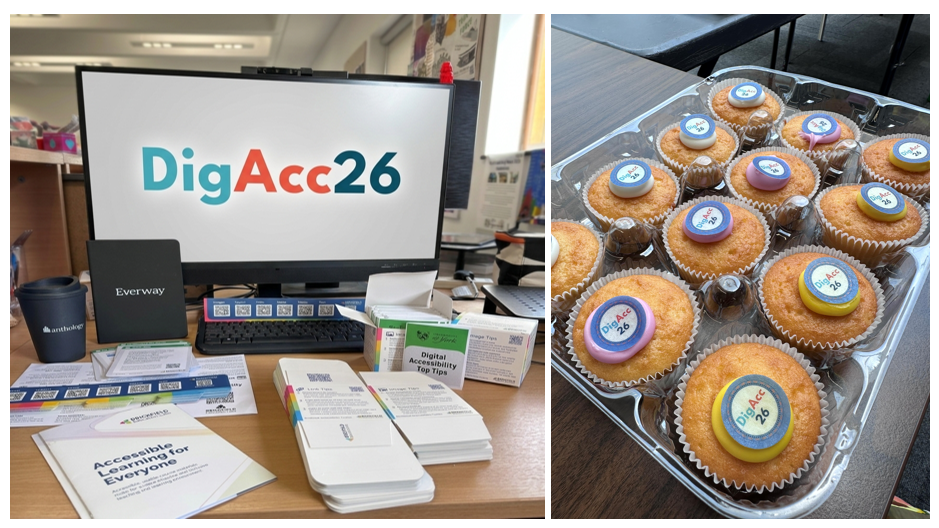
We prepped for the annual Digital Accessibility conference headed up by the University of Nottingham as always by lining up freebies and cake.
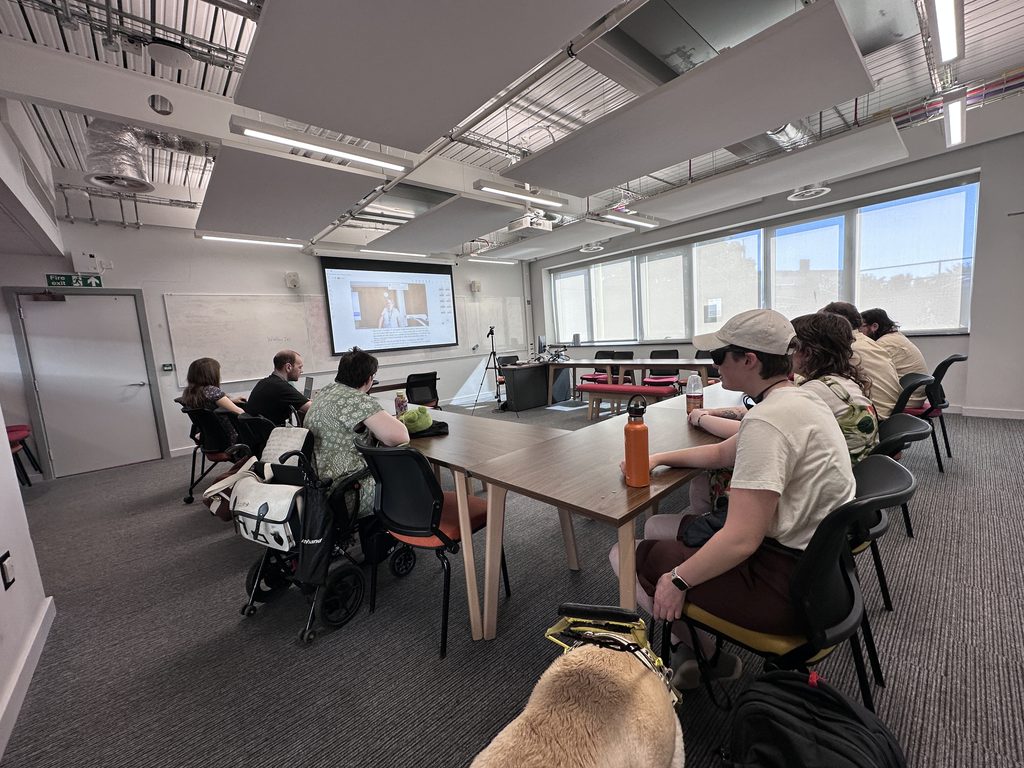
As we did in previous years, we streamed the sessions from each parallel session in three rooms, and booked a pod to allow staff who were presenting to have somewhere quiet to deliver their sessions. Having organised this in previous years, it was a small job to work through the checklist and organise for each room to have a host to sign in to the right sessions. Although we opened up registrations to anyone from other HEI, we didn’t get any attendees from elsewhere in the end.
DigAcc26 was not just an opportunity to highlight digital accessibility across the university; it was also an opportunity for staff or students to do some professional development by submitting talks. This year we had:
- Jess Bull from our Library Alternative Formats team co-delivered her session with Ros Walker, University of St Andrews and Bec Oliva, University of Glasgow, on Alt Formats in HE (recording). They highlighted how disabled students get access to their alternative formats from the reading lists and the challenges of the workflow which greatly requires cooperation from tutors and publishers to happen. They discussed the large range of assistive adaptations offered by various publisher platforms that adds additional workload for students, the complication of digital rights management and challenging things to make accessible for students.
- Lilian Joy, Digital Accessibility Manager and Accessible Maths enthusiast, co-delivered a session with Josh Lim, University of Bath and Faye Brockwell, University of Sussex, on supporting a community of learning technologists who teach Digital Accessibility to academics in STEM (recording). A sub-group of the Jisc Accessible Maths working group, their premise is that many learning technologists support digital accessibility in disciplines they are not familiar with and Maths has an added technical difficulty that makes it more complex. Coming together helps the group to figure out the technicalities and the most effective ways of supporting colleagues, “turning isolated effort into collective strength” as discussed in another blog post on community-led skills development.
With 3 parallel sessions running, it was sometimes hard to pick the right session to view on the day. Another challenge we reflected on during our lunchtime discussion was that progress and service structures are so variable across institutions it can be hard to translate their practice into our own environment. However, we felt that the presentations often prompted valuable discussions in the room which is why we like this hybrid format so much. And despite it being online, colleagues felt it gave them the opportunity to look for people to connect with in other universities.
With the recordings on the DigAcc26 site, it’s so easy to go back through and review the ones that feel more relevant. I actually post a video from the conference each month into our Digital Accessibility Slack Channel as a way to extend the value from these recorded sessions through the year. It’s easy to say we’ll catch up with the recordings, but it can be hard to find time to do so. My monthly ‘dig through’ helps to give me a reason to review them and also to surface things I feel are relevant to my colleagues.
As always the lunchtime discussion was a great opportunity to catchup with others on digital accessibility across the university and perceptions from different areas. We discussed:
- Staff turnover means the work of communicating the basics is never done. We are lucky we have our mandatory Digital Accessibility Tutorial that helps to get the point across to all staff. We just need more opportunities for the kind of conversations we find ourselves having once a year at the DigAcc conference!
- Our students talked about how quickly they could adopt accessible practice if they are introduced to it as part of their learning, including how to make events more digitally accessible. One noted the gap between novices and experts when it comes to learning coding, especially for screen reader users. It can be hard to find materials at the right level of learning that intersect with having the right screen reader settings. Another student said that people focus more on their visible disabilities and forget to put equal weighting on how digital accessibility can help them with fatigue, dyslexia and ADHD.
- Our software developers want more opportunities for collaboration and end user testing as they try to integrate accessibility in their software creation process. They wished software vendors had an ‘Accessibility Passport’ to make procuring accessible systems less of a challenge. An additional challenge is trying to retrofit accessibility into older applications that are not being replaced.
Two presentations that evaluate the messy nature of trying to procure accessible systems, even if you follow guidance:
It was heartening to know people want the opportunity to collaborate on digital accessibility a bit more. The question is how to keep the conversations going throughout the year at our University? We have
- mandatory training that introduces the language of digital accessibility to everyone, making it easier to have conversations with others on this.
- accessible document meetups and specific training sessions on accessible documents, presentations, social media and web-based platforms.
- a Digital Accessibility Slack Channel for those quick discussions.
- an annual Accessibility Awareness Day (or week in 2027!).
The challenge now is to find a format for a more informal catch up on Digital Accessibility throughout the year that helps people to feel involved in the conversation and supported in their accessibility work. One idea I can implement is to run meetups on Accessibility Audits and Statements and grow that area of skill and expertise across more teams.
Thanks again to our volunteers on the day, to the students who attended and to Brickfield for supplying accessibility-related goodies for all to take away. We also managed to hang on to some swag from previous events for the day. A big thank you as well to ALT for sponsoring a light lunch for all attendees and of course, a very big thank you to Julian Tenney at University of Nottingham and his team and organising committee for their hard work in organising the conference.
Links: