
In the first of a short series of posts marking International Open Access Week 2025 (20–26 October) we help publicise the University of York’s commitments towards sustainable scholarly publishing, and share a recap of an event hosted on behalf of the N8 Research Partnership this summer.

Speaking directly to the theme of this year’s Open Access Week, ‘Who Owns Our Knowledge?‘, the recent N8 Statement on Sustainable Scholarly Publishing calls on publishers to shift away from operating in a manner that no longer serves the interests of academic communities.
The statement, developed collaboratively by senior leaders across the N8 universities including Library Directors, Pro-Vice-Chancellors for Research, and Vice-Chancellors, sets out five key commitments:
- Exploring shared infrastructure and supporting enhanced green open access proactively through institutional repositories
- Investing in non-profit tools and platforms that support open research and transparent publishing
- Engaging researchers in conversations about the impact of their publishing choices
- Sharing best practices with the wider library and research sector
- Championing a positive research culture through open access, responsible metrics, and inclusive infrastructure
Alongside the publication of the statement in June, Professor Charlie Jeffery, University of York Vice-Chancellor and President and previous Chair of the N8 Research Partnership, commented:
For too long, we’ve seen the consolidation of scholarly publishing into the hands of a few major commercial players whose priorities are increasingly divorced from the academic communities they were meant to serve.
Our researchers are delivering work that will help improve the world around us. They then review and edit this work – often without compensation – and yet institutions are charged both to publish and to access this knowledge. The balance has tipped too far, and we hope this statement represents a first step towards the N8 working with publishers to develop a different approach that will benefit all parties.
Launch event

On 12 June 2025 we welcomed colleagues from across and beyond the N8 to the York Law School and Department of Sociology for Pathways to sustainable scholarly publishing. The event was opened by Professor Sarah Thompson, Pro-Vice Chancellor for Research, who declared that the launch of the new statement represented a moment to be proud of the N8 and an opportunity to celebrate the collaborations that enable the collective’s libraries to be pro-active and forward thinking.
Sarah outlined that an active conversation with publishers is particularly critical at this moment in time due to the acute financial challenges universities are facing. She described the statement as an extremely welcome intervention from the N8, affirming as it does its members’ commitment to collaborating and influencing the future of sustainable scholarly publishing.
Further context to the launch of the statement was then provided by Kirsty Lingstadt, Director of Library, Learning, Archives and Wellbeing:
Following the N8’s Rights Retention activity in 2023, we looked at what we could do next. Scholarly publishing was in a difficult place, and there were certain challenges thrown into sharp relief by the financial situation facing the sector. Scholarly publishing is a core part of the research, infrastructure and eco-system that we find ourselves in but we’re increasingly having to make difficult choices due to rising costs. As such, making open access available to all has become harder and harder as we’ve moved along.
Professor Christopher Pressler, John Rylands University Librarian at the University of Manchester and chair of the N8 Library Directors’ Group, delivered a succinct summary of what the N8’s statement hopes to achieve before the event’s first panel discussion, chaired by Anna Clements, Director of Library Services and University Librarian at the University of Sheffield. Participants were Anna Vernon, Head of Research Licensing at Jisc and Sara Ball, Strategy Lead for Open Science, UK Research and Innovation (UKRI), who shared insights on the national approaches being taken to drive efficiency and deliver value for money in scholarly publishing.

The second panel session was chaired by Sarah Thompson, Associate Director of Libraries, Archives and Learning Services. This session featured presentations from three scholarly publishers who have already made strategic commitments to supporting open science and introducing sustainable open access business models, reflecting the missions of their parent organisations and societies. The panel were Dr Caroline Edwards, Executive Director, Open Library of Humanities, and Senior Lecturer in Modern and Contemporary Literature, Birkbeck, University of London, Clare Curtis, Director of Content and Engagement at the Biochemical Society/Portland Press, and Chris Bennett, Global Commercial Director at Cambridge University Press & Assessment.
Dr Caroline Edwards reflected on the work of the Open Library of Humanities and recently-announced Open Journals Collective:
We’re not reinventing the wheel – we are just consolidating what already exists. We are asking for libraries to consider our journals as part of their collections budgets, rather than as marginal within library budgets. More than this, we are asking librarians to help us craft the future of scholarly journals publishing. We’re going to build a better alternative to transformative agreements because, as discussed today, they are fundamentally inequitable.

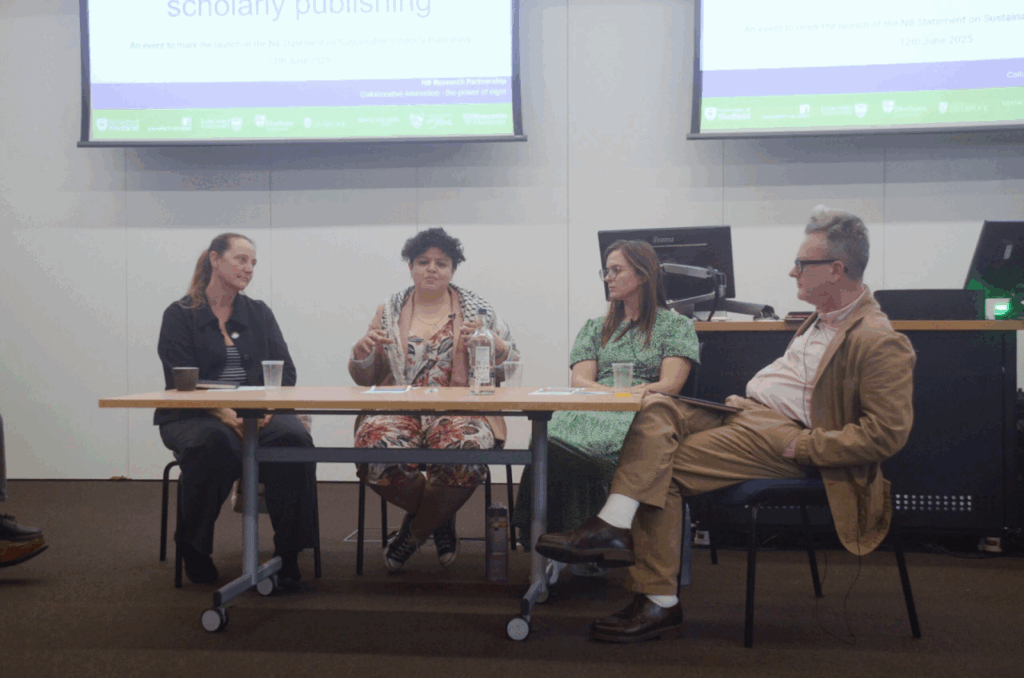
The event wrapped up with a final panel session on research communication and civic engagement, chaired by Andrew Barker, Director of Library Services & Learning Development at Lancaster University. Before beginning the session, Andrew paid a warm tribute to his colleague and friend Elaine Sykes, Head of Open Research at Lancaster University, whose sudden and unexpected death was confirmed earlier that week.
The subsequent discussion centered around the efforts and challenges of creating a more inclusive, accessible, and representative research culture within academia. It featured contributions by Dr Emma Yhnell, Reader and Associate Dean for Equality, Diversity and Inclusion, College of Biomedical and Life Sciences at Cardiff University, and two researchers from York, Dr Clau Nader, Research Associate in the Department of Health Sciences, and Dr Kate Lancaster, Lecturer in the School of Physics, Engineering and Technology.
The panel discussed the systemic barriers in academia, especially the pressure to conform to outdated metrics such as publishing in high-impact journals. In a fitting end to the day, our final panelists agreed that change often starts with a few brave voices, encouraging collective momentum toward a more just and inclusive research and publishing environment.
N8 collated the following conclusions in their recap of the event:
- Growing consensus across stakeholders – Speakers from academia, libraries, funders and publishers all expressed support for more transparent, cost-effective, and inclusive publishing models. This cross-sector agreement reflects momentum toward systemic change.
- Challenges with commercial publishers and metrics – Multiple speakers pointed to ongoing issues: rising costs, reliance on prestige metrics, and publisher opacity around pricing. These challenges disproportionately affect underfunded institutions and researchers, reflecting the importance of the N8’s intervention.
- Emerging alternatives and transition models – Promising alternatives are being implemented, such as The Open Journals Collective, that aim to shift the cost burden away from individual researchers and toward community-supported, nonprofit-driven systems.
Credits
Text and images excerpted from ‘Pathways to scholarly publishing – an event to mark the launch of the N8 Statement on Sustainable Scholarly Publishing’ by N8 Research Partnership, licensed and redistributed here under a Creative Commons Attribution-NonCommercial-ShareAlike Licence.