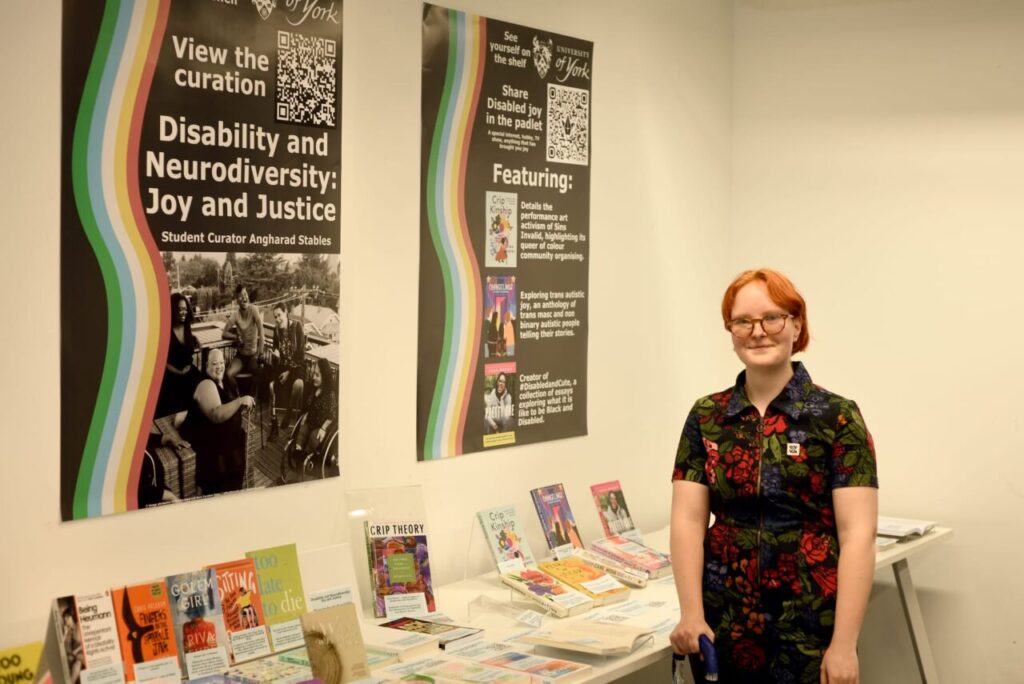


I am feeling incredibly bittersweet about my time as a Student Curator coming to an end. I have loved working on this curation, and it has felt incredibly gratifying to pull it all together with the digital Libguide and physical display in the library. I feel as though I have had this curation brewing in the back of my mind for a while, and being given the resources to actually create it has been incredible. I finally got to put my incredibly niche goodreads shelving system to good use!
However, my issue is I really do not want to stop working on this curation. Disability and neurodiversity are quite key to my self identity, and so I consume a lot of content in all forms around it. It is really hard to now turn off my curation brain when I see something on youtube or my for you page, thinking ‘let me just add this’! I hope that this curation keeps living on, with people adding to the curation padlet and sharing their own Disabled joy as well as that featured in the curation.
Setting up the physical display was incredibly fun, and it was great getting to organise it spatially to reflect how my research was carried out. If you visit it in person, you’ll see that there are books, but also little signs with QR codes to videos, art, articles, and ebooks. Lots of these are put in a spot deliberately; such as Alice Wong’s interview QR code going next to her memoir. I really hope that this makes the physical display fun to explore. I have also included a QR code to the Hannah Gadsby standup on my libguide, but don’t blame me if you are laughing next to the Burton.
I have aimed to make the physical display as easy and accessible to peruse as possible. There are ebook versions of physical books/standalone ebooks where possible to allow for reading aloud and changing formats, I have included a wide range of text difficulty, and included social media accounts for low effort perusing. I wanted to make sure there were materials for all spoon levels!

I also wanted to make the physical display and online libguide as similar experiences as possible, so you won’t be disadvantaged if you can’t physically get to the library to view the curation. All the videos and artwork you can view at the physical display are on the libguide. The only thing you need to be in the library for is to borrow the physical books.
On the actual content of the curation, it has definitely shifted from my initial thoughts. I definitely did not expect to find as much incredible poetry as I did, and was incredibly excited by how much Disabled, anti capitalist, political thought I found. I did expect to find many memoirs, and initially I was quite set against not including them. My perception was that Disabled people are often only published in memoirs, as a way to package up Disability and sell it to an abled audience as inspiration. However (from scouring many Goodreads reviews) I believe all the memoirs selected for this curation are incredibly valuable and we can definitely get joy from them too. I really liked the wording of Judith Heumann’s; ‘the unrepentant memoir of a Disability Rights Activist’, and Harriet McBryde Johnson’s ‘Too Late to Die Young’ seems to really stem from a joy for living life being Disabled. Rebekkah Taussig’s memoir ‘Sitting Pretty’ aims to directly refute the media’s one dimensional portrayal of Disability. I therefore thought it would be a disservice to exclude these authors simply for their genre.

Overall, I have strived to include diverse perspectives in the curation. Disability and Neurodiversity are incredibly broad topics themselves, and it was especially necessary to curate an intersectional reading list as experience of Disability is undeniably shaped by race, gender, sexuality, and background. Queer of colour organising is, and has always been, at the heart of the Disability Rights and later Disability Joy movement. I hope I have managed to capture that in my curation.
When purchasing books for my curation, I sometimes struggled with the question ‘is this joyful enough?’. This was particularly true for some books detailing traumatic events, such as Leah Lakshmi Piepzna-Samarasinha’s poetry collection Tonguebreaker. I generally ended up including them, as it would feel dishonest to completely ignore any mention of hardship. Tonguebreaker details surviving hatecrime and other traumatic events, and in the midst of it all finding love. I think that encapsulates the theme for me; our resilience and joy in community.
While setting up the physical display, someone came over to talk about her son’s potential ADHD, and whether I had any recommendations. We had a really lovely conversation and it really proved to me the importance of Disabled and neurodivergent spaces and visibility.

Finally, I could not have done this curation without help from a brilliant team of people. Thank you to Antonio, Ilka, Dave, and Kirsty for your help and support. Thank you to Ned for posting my many instagram stories, and Ben for answering my many questions about copyright. Steph and Siobhan were incredibly helpful in all things libguides and HTML coding. And thank you to Jessica for setting us up with reading lists!