
This year’s International Open Access Week theme asks ‘Who owns our knowledge?’, challenging us to reflect on not only who has access to the research we produce, but on how knowledge is created and shared. Significant progress has been made in some areas towards putting ‘Community over Commercialization’, the theme of OA Week in 2023 and 2024), but new concerns and risks have emerged:
The rush to scrape academic knowledge to train artificial intelligence models and to integrate AI into academic processes—often without proper consultation or author consent—threatens to undermine our knowledge systems. Surveillance that would be unthinkable in a physical library setting now happens routinely through some publisher platforms. Nevertheless, the community-owned, community-led, and non-commercial approaches to knowledge sharing called for by the UNESCO Recommendation on Open Science and Toluca-Cape Town Declaration offer pathways away from these risks toward a future where individuals and communities own and benefit from their own knowledge.
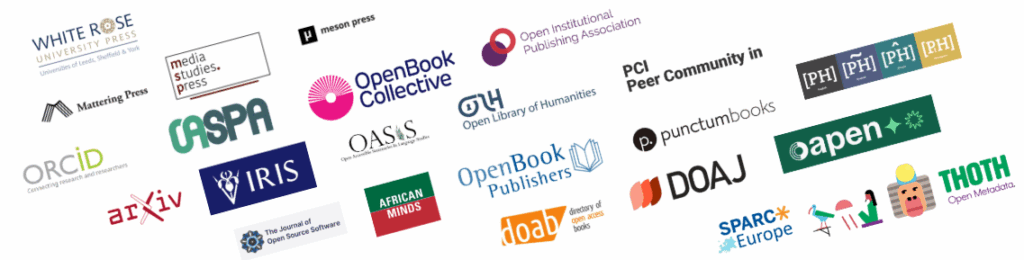
The University of York Library has a longstanding commitment to Supporting the wider open research ecosystem, in line with many other UK universities and pledges made in the recent N8 Statement on Sustainable Scholarly Publishing (see our previous post, Pathways to sustainable scholarly publishing). Despite a backdrop of financial challenges across the sector, we have continued to support a range of initiatives, tools and infrastructure services that help facilitate open research practice. Most of the organisations we support can be described as community-led, and one of our key principles for support is that initiatives should operate on a not-for-profit basis or should be affiliated with a research or educational institution.
Approaches for supporting external initiatives are varied, ranging from small one-off donations to multiple-year subscriptions and formal memberships. We engage with collective and consortia-based approaches such as the Global Sustainability Coalition for Open Science Services (SCOSS), now in its sixth funding cycle, and Jisc Open Access Community Framework (OACF), which is currently under review with the intention of opening up for a new round of applications in 2026. Recommendations and decisions are made by the Content and Open Research team, in consultation with the Collections Community group and in response to suggestions from our academic colleagues including members of the Open Research Advocates network.
Our institutional open access press, White Rose University Press, and research repositories, White Rose Research Online and White Rose eTheses Online (both powered by the open source EPrints 3 platform), are also a key part of our commitment towards community-owned infrastructure. Kate Petherbridge, Press Manager of White Rose University Press, previously wrote about the growth of a publishing community and foundation of the Open Institutional Publishing Association (OIPA) in an Open Access Week 2023 blog post.
Here, we highlight a selection of initiatives we have supported over the years:
Open Book Collective (OBC)
OBC is a charity bringing together publishers and libraries to secure the diversity and financial futures of open access book production and dissemination. They are a registered UK charity, with a governance structure that is community-led at its core. As a supporting member institution, the University Library collectively participates in decision-making relative to the OBC’s management, membership policies, and long-term strategic planning.
Through OBC we have the opportunity to directly support independent publishers across a range of disciplines, which include African Minds, Mattering Press, mediastudies.press, Meson Press and White Horse Press. We also support and utilise the open source metadata management and dissemination platform Thoth, which helps publishers get open access works into the book supply chain to ensure their long-term sustainability and accessibility. OBC also manages a Collective Development Fund, a grant giving programme for emergent open access book initiatives, which recently completed its second round.
Kevin Sanders, Open Access Engagement Lead at OBC, introduced the Collective and contributed to our discussion on The realities, challenges and future of open access publishing back in January.
Peer Community In (PCI)
PCI is a researcher-led organisation which provides an evaluation and recommendation service for scientific preprints. Authors can deposit their preprint along with data, script and code, in any open repository, then submit the article to a thematic PCI (community of researchers) where it undergoes rigorous open peer review by researchers in the field. Following evaluation, the paper may receive recommendation from the PCI, a form of validation which makes them complete, reliable and citable articles.
Authors can choose to publish their paper formally (without charge) in the Peer Community Journal, or submit it to a PCI-friendly journal which has committed to accepting PCI-recommended articles without need for further peer review. Another recent development is PCI Registered Reports, a community dedicated to reviewing and evaluating study proposals, thereby addressing certain publication and reporting biases that may be embedded in ‘traditional’ journals.
Back in May, Professor Christopher Chambers, PCI Publication Director, introduced PCI Registered Reports and contributed to a discussion on Registered Reports and the future of peer review with researchers from Psychology and Education.
OAPEN
The OAPEN Foundation is an open access advocacy organisation based in the Netherlands, which counts the University Library amongst its supporting members. They work to promote and support the global transition to open access for academic books through infrastructure services for publishers, libraries and funders. Their services includes the OAPEN Library, which recently marked its 15th anniversary and the Directory of Open Access Books (DOAB), a searchable discovery tool which indexes almost 100,000 open access titles including our own White Rose University Press publications. DOAB results are also integrated into YorSearch and Reading Lists.
Another key resource is the OAPEN Open Access Books Toolkit, which aims to help book authors to better understand open access book publishing and to increase trust in open access books. It provides quick and brief introductions to specific topics, mapped to an eight-stage research lifecycle. The Library has integrated and signposted some of this guidance in our own Open Access Publishing Practical Guide.
Programming Historian
Programming Historian delivers openly-licensed peer reviewed tutorials which help arts and humanities researchers discover new digital tools, techniques and workflows. They encourage practitioners to use their lessons for learning new technical skills and teach about new methods in classes or workshops. The lesson index is organised by stages of the research process and includes over one hundred tutorials on topics including coding, data analysis and visualisation, which we refer to in our Digital Skills guides.
The project is international, volunteer-driven and not-for-profit, supported by individual donations and a broad institutional membership including the University Library. Their publishing model adheres to the ‘diamond’ form of open access with no charges placed on authors or readers of their tutorials, and they are recognised by the Directory of Open Access Journals (DOAJ) – another key piece of open access infrastructure we support!
If you are interested in contributing to Programming Historian you can write a lesson, join their team of reviewers or provide feedback. We are also interested to hear from anyone at the University who has used this resource in their learning, teaching or research as example cases: lib-open-research@york.ac.uk