


As we passed around objects during our student salon workshops I was reminded of a 2013 decorative arts pedagogical video called “This is Not a Chair,” where Harvard researchers from a variety of disciplines gave new identities to several seventeenth and eighteenth century chairs. Responses in the short film ranged from “this is not a chair, this is a sculpture” from an art historian, to “this is not a chair, this is a document of enslavement” said by an historian to describe a chair made by enslaved labour. Objects in our cabinet told their stories likewise, this is not just a sugar bowl, this is a document of enslavement; this is not just a map of Asia, this is a worldview. By letting material objects tell their own stories, as we handle them and reflect upon their design and usage, our cabinet is actually in keeping with eighteenth century imaginative approaches to objects. It-narratives of that century come to mind, where thimbles in their “own” words tell us they were “inclosed within the narrow limits of a small traveling box…for the purposes of traffic among the opulent in the neighborhood.” The objects in our cabinet require a more critical approach than just travelling about to the “opulent of the neighborhood.” So, the student salon cabinet allowed us the chance to unravel and expose the objects’ colonial ties, while offering them to a variety of students for careful and creative study.
In taking the time to handle objects, and contemplating them, our workshop participants had the chance to re-assess the meanings of the objects and the reality of the salon as a place for exchange and experience of familiar and unfamiliar objects. After all, to quote the famous line from L.P. Hartley’s The Go-Between, “The past is a foreign country; they do things differently there.” By asking questions of the objects in their hands, students were confronted with an opportunity to ponder what biases or judgements we all bring to our understanding of the past, in a similar way to how past peoples in actual salons showed their biases and prejudices through their handling, mishandling, and consumption of objects from countries other than their own.
Feedback from our participants, including the title of this post, are teaching us the continued importance of hands-on, contemplative, object study for early career students in fields like history, literature, archaeology. Suggestions for how the cabinet might best be used in the future emphasized a desire by and for students to “touch history,” within modules that focused on the same historical periods as the items.
One participant even described how our cabinet’s fabrics and prints reminded them of studying Daniel Defoe’s Roxana: The Fortunate Mistress (1724), and suggested the cabinet’s use in future seminars on the novel. Dancing in her salon-like drawing room, Roxana masquerades as a ‘Turkish princess’ wearing garments of ‘fine Persian or Indian damask.’ Originally belonging to a Turkish woman who was captured and enslaved, Roxana bought the garments as a ‘curiosity’ in Italy at the same time her lover ‘bought me a Turkish slave’. She mentions, to prove the authenticity of the performance and the garments, that the ‘little Turk’ often helped her dress in it. While Roxana is keen to convey how much the dress is worth, our attention is drawn to the life of the other woman the cloth reveals, and the child who knew the garment better than Roxana herself.

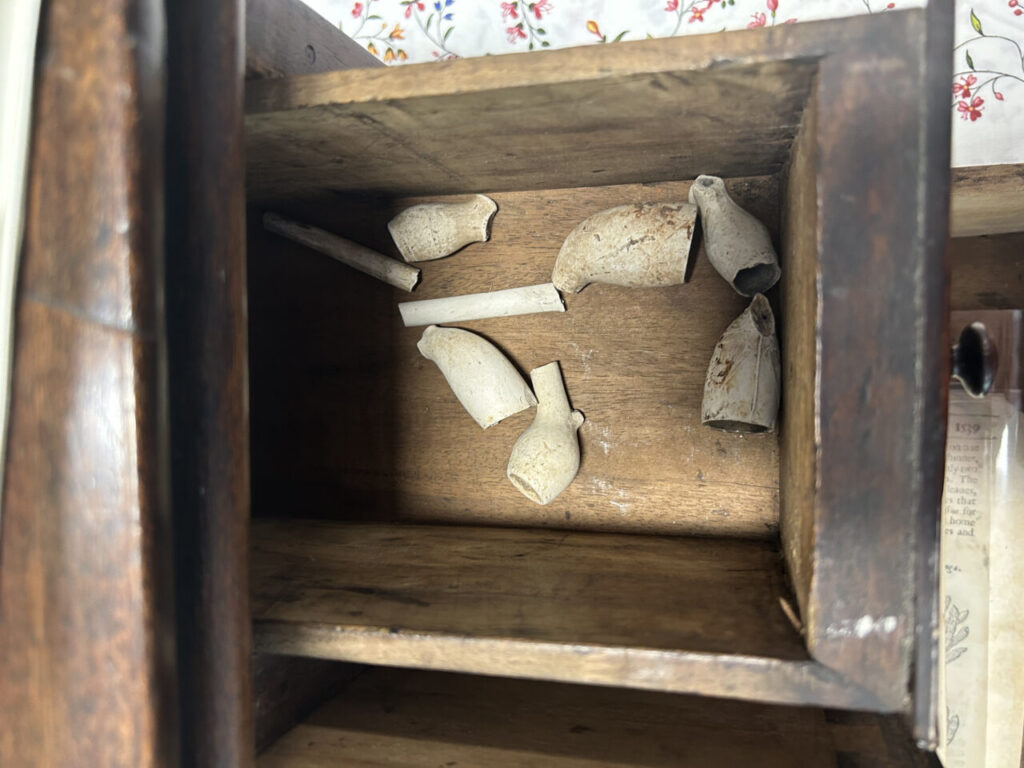
Several participants noted the feel of fabric, the texture of porcelain, or the smell of the spices included in the cabinet, all which are sensory experiences that are both memorable and enhancing to the descriptions in the literature read for modules. I can even remember the first time I studied a hand sewn gown or held a broken seventeenth century pipe stem straight from the dirt of an archaeological dig. I suddenly felt the weight of real, complex people of the past by holding their objects. This process of realisation, that objects have stories to tell, and are a vital path for learning about the past, was evident in the questions, feedback, and even facial expressions of our workshop participants. Objects of the past, after all, aren’t just for looking.
Rachel Hogue is an MA student in Eighteenth Century Studies at the University of York.