

Insects are among the world’s wondrous flora and fauna that inspired the rich visual and material cultures of salons across Europe. In the 17th and 18th centuries, these gatherings in glittering rooms occupied an interesting position in British society, being social and domestic spaces that were also part of the scientific studies of botany and entomology – studies intricately interwoven with colonialism. Bugs such as the cochineal, native to Central and South America, became another important part of British trade, used for pink and red dyes in cloth and paint throughout the period. In competing with the Spanish in this trade the British would then transport these insects to India to produce their own demand, using them for such goods to acquire the kinds of coveted textiles that graced the bodies of salon ladies. Bugs were also collector items; wealthy collectors such as Sir Hans Sloane would amass great collections of insects, still housed and studied in London’s Natural History Museum today. Bugs were also important to medicine, and profit in the maintenance of plantations and in the transport of slaves across the Atlantic. Insects were simultaneously living things, objects of curiosity, pests and natural resources to be exploited. Tucked away in the Student Salon cabinet, with shells and seeds, the Blue Milkweed Beetle (whom I have affectionately named Ignatius Solomon Terry) reflects investment in the natural world and profit throughout this period.

European bug history has been enriched by several women, elite and otherwise, despite the long term male dominance with figures like the biologist and physician Carl Linneus. Women such as Maria Sibylla Merian contributed to the documentation of nature through her watercolour illustrations of the nature of South America in the 1700s, which depicted insects in their own environments, such as her illustration of a pineapple surrounded by cockroaches. Her prints undoubtedly influenced subsequent botanists travelling abroad, notably Marianne North’s illustrations of Indian flora and fauna in the 1800s. Artists would craft exquisite, detailed visual representations of nature that would be evoked in the homes of the elite, particularly through their fabrics and wallpapers. These women often travelled for diplomatic and intelligence-gathering purposes. The literature and visual art that women travellers created was inextricably tied to colonialism and the access it granted them to expanding natural worlds. The nature they would capture in print – would then be replicated in England, through botanical gardens such as the garden of Mary Somerset, Duchess of Beaufort, or Kew Gardens in the 18th century. When Behn mentioned the wondrous insects of South America, she also noted that she had donated some of them to antiquaries in London.

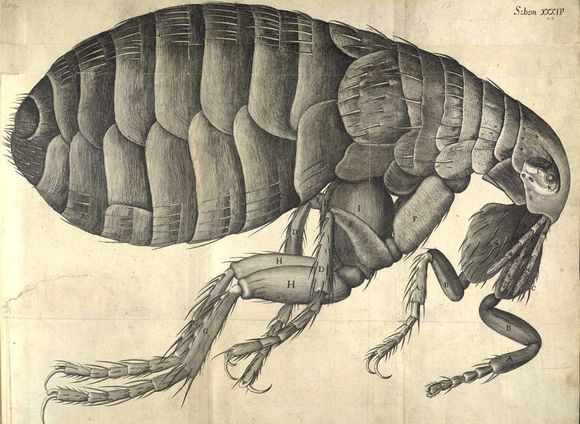
If you were to stare into a 17th-century still life painting with a floral arrangement, chances are that you will also see a fly or beetle resting on a petal. The study of entomology has long been entwined with botany, both fields enhanced by artistic illustration as well as the increasing use of the microscope in the 17th century. Whilst male figures such as Robert Morrison were lecturing on botany at Oxford women did not have the same access to these intellectual spaces. Books such as Robert Hooke’s Micrographia (1665) were points of access to these kinds of knowledge. They were illustrated with depictions of observations, for example the famous flea by architect Christopher Wren. The 17th century was full of both men and women who were trying to reason with the world they existed in. Women did engage with Micrographia, particularly evidenced in Margaret Cavendish’s critique of the text, Observations upon experimental Philosophy (1666). Whilst this text is not exclusively on bugs it does lean into the springs of independent female thought surrounding natural philosophy. Her argument centered around the “truth” of nature through microscopic “eyes”, opposed to her own natural philosophy’s adherence to speculative reason. Cavendish’s novel The Blazing World, published in the same year, catapults a woman into a parallel universe where she tries to make sense of various things including its natural world. These texts did spark interest as Cavendish was the first woman to attend meetings at the Royal Society in 1667 following these publications. Women were very engaged in disseminating theories and ideas on the ever expanding natural world. A blue milkweed beetle may not be a remarkable discovery now, but if a 17th century woman were visiting a colony in North America, this jewel-like bug may have seemed otherworldly.
Furthermore, the study of insects beyond these circles of knowledge, was also bound in trade, profit and control. Trade of commodities across the globe led to the transportation of pests, be it back to Europe or to other destinations, and knowledge of a broader nature was crucial to the production at plantations controlled by the East India and Royal Africa companies to maintain profits. It was also important for the control over people, both subjugated and enslaved. Notably, in the passage of black enslaved people on ships bound to the Americas and Caribbean, as they were kept in horrendous conditions often with animals, which would lead to pests such as cockroaches infesting the ship hold and other areas. This impacted the health of all the people onboard these ships and later on land, as bugs, such as the American cockroach, would be transported across the sea. In the prioritisation of maintaining profit, entomology was a crucial part of colonialism through medical and environmental sciences.
All this lay behind my initial insistence that a bug belonged in our cabinet. Bugs were an integral part of science, trade and collections in 17th and 18th century England, and Europe more broadly. They were considered worthy of the fashionable literature of the salon – in the 1570s, in France, a flea threw salon attendees into a poetic frenzy after being caught climbing down the breast of Catherine des Roches, one of the salon hosts. Insects also offer an avenue for thinking about the place of women within early modern science, art, travel, and collecting Within the realms of natural science and philosophy, women played valuable roles in the study of entomology and botany, from scientific illustration to the study of, and debates around the functioning of the living world. Our bug, Ignatius Soloman Terry, is a small yet mighty part of our cabinet in this way.

Mumia Douse-Bah is a recent English Literature and History of Art graduate of the University of York.