


Susannah Lyon-Whaley is a Marie Sklodowska-Curie Actions (UKRI-guaranteed) fellow at the University of York.
What do a civet cat, a whale, a deer, and a vanilla orchid have in common? This was one question that York’s pioneering historian of smell, Dr. William Tullett, posed on an early June evening, in the parlour of a 14th-century York hall. Will and I were running a workshop on sensory history in the 17th century during which we discussed the global connections of commodities such as vanilla and chocolate, and what insights discovering history through the senses could offer.


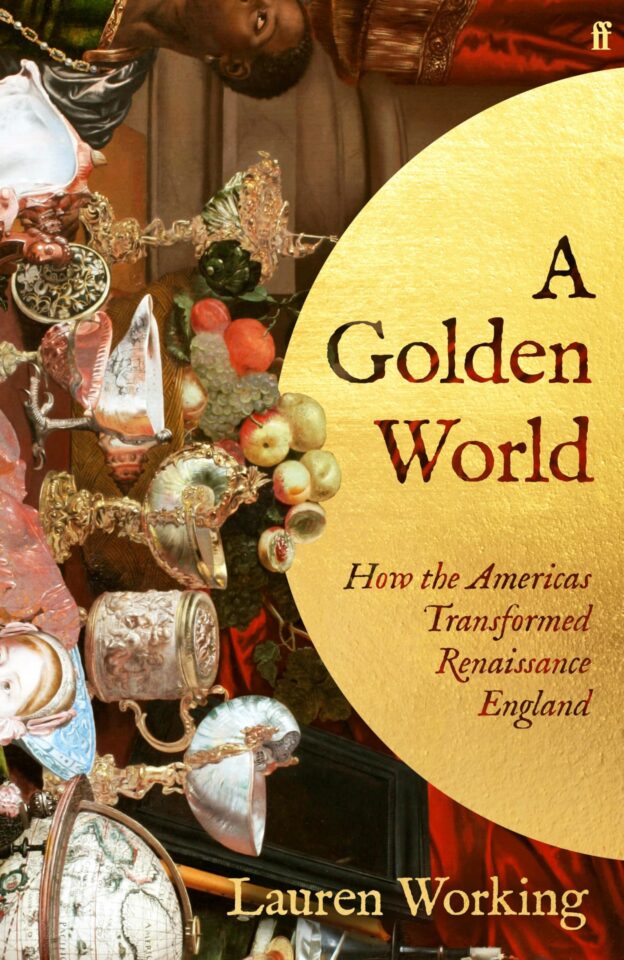
The Student Salon cabinet inspired and shaped the event. The Dutch oak table cabinet sitting in the room was filled with fabrics, fine porcelain, shells, maps, trade beads, and other objects, all of which spoke in their own ways to how women and men in Britain encountered places on the other side of oceans. These encounters are a focus of my postdoctoral fellowship project at the University of York on royal women. The Student Salon, which I co-founded during this project with my supervisor Dr. Lauren Working, was inspired by literary salons. These were high society events that often took place at the royal court. The cabinet’s function is to help us think about history through things from the past we can touch and hold. Lauren’s interests in how Indigenous American practices and knowledge shaped social experiences in England were written all over our evening’s explorations. We were celebrating, too, the publication of her exciting new book A Golden World: How the Americas Transformed Renaissance England. Fittingly, our workshop took place in a building that had served in the 17th century as the meeting place of the Merchant Adventurers, a company of traders and investors who backed ventures to places as far away as the Americas.

The answer to the parlour game question – what do a civet cat, a whale, a deer, and a vanilla orchid have in common? – is that all produced ingredients for 17th-century chocolate. The first thing people had told me about York’s modern-day chocolate factories when I was newly arrived to the city was that when the wind is right you can smell chocolate in the streets (see another of our blog posts for how smelling cinnamon was said to fuel explorers’ dreams of El Dorado). And chocolate did arrive in York from the Americas, available to wealthy citizens by the end of the 17th century. In the Florentine Codex, a 16th-century ethnographic study of Mesoamerica, the Spanish friar Bernardino de Sahagún described a Mexica (Aztec) ruler served at the end of his meal with:
honeyed chocolate made with ground-up dried flowers – with green vanilla pods; bright red chocolate; orange-colored chocolate; rose-colored chocolate; black chocolate; white chocolate. The chocolate was served in a painted gourd vessel … In a small net were kept the earthen jars, the strainer with which was purified the chocolate, a large, earthen jar for making the chocolate, a large painted gourd vessel in which the hands were washed, richly designed drinking vessels …
Extract from the Florentine Codex, 16th century [Nahuatl to English translation]
In the 1620s and 1630s, the English priest Thomas Gage travelled to Mexico and Guatemala. In his account of his travels, he described the sound of chocolate:
This name Chocolatte is an Indian name, and is compounded from Atte, as some say or as others, Atle, which in the Mexican language signifieth water, & from the sound which the water (wherein is put the Chocolatte) makes, as Choco, Choco, Choco, when it is stirred in a cup by an instrument called a Molinet, or Molinillo, until it bubble and rise unto a froth.
From Thomas Gage, The English-American (1648)
When we hear the word ‘chocolate’ as we stand in line for an ice cream truck (as many of us will this summer), ask for an iced chocolate at the local cafe, or hear our friend call down the supermarket aisle, ‘make sure you get the chocolate!’, we are actually listening to the whoosh whoosh sound of cacao and water running through wood, just as it hit Mesoamerican ears more than four hundred years ago (take a listen in this video). It’s just one example of how our daily lives are built on encounters with and learning from other cultures.
The workshop was an evening about connections, not only between civet cats and vanilla, but between York and Aztec Mexico, the past and the present. When Queen Catherine of Braganza received a present of chocolate and tea (camellia sinensis, a Chinese leaf) from her lord chancellor in 1663, these were still relatively unfamiliar tastes. Drunk from a polished gilt cup or smooth cool china in a London palace, maybe before a mantelpiece decorated with newly fashionable Chinese-inspired Delft tiles like the one in our Student Salon cabinet, it felt like tasting, touching, and smelling another world. Swirling in the queen’s cup and present in the liquid’s velvety texture against her lips was an Aztec world, but also a world of Caribbean plantations worked by enslaved labourers.

Sometimes, there are surprises in learning about the past through the senses. We encountered one in our workshop as we tried to guess between the scent of real and fake vanilla. Vanilla arrived in Britain from Mexico with a taste and smell that is still with us today. But over the centuries, Europeans have discovered it is more efficient to synthetically manufacture the chemical compound creating its fragrance and flavour from wastepaper pulp or petrochemicals, so nine times out of ten, that is what you’re tasting. And it has fooled us spectacularly. Few of us guessed which was the real vanilla and which was synthetic.

Today, we serve hot chocolate in Ikea mugs, not golden goblets. For me, making hot chocolate sounds like the rumble of the kettle on full boil, not the choco choco of a molinillo whisk. But what drives me to that tin holding the Tony’s Chocolonely in my pantry cupboard drove others across oceans. Next time you savour ‘chocolate’, spare a thought for the skills of Mexica people at the heart of the Aztec empire in Tenochtitlan, and every taste, whiff, and sound, we owe them.