

I recently revisited a museum I remember going to as a child with my parents, and was pleasantly surprised to see that it had changed from my memories. Instead of an exhibit on an arduous journey aboard the Mayflower to the “New World” with no mention of the transatlantic slave trade or the attempted genocide of Native Americans I remembered, curators had removed this entire section, and started to reframe it to bring awareness to the colonisation inherent in America’s “creation”.
Historically, the origins of museum and collection artefacts, and the stories we tell about them, have been whitewashed to be more palatable to white audiences and erase or evade trauma caused by the colonial past. However, over the last five to ten years, this has taken a turn for the better. Museums are getting better at acknowledging and highlighting the lives and depictions of marginalised people, often working with descendant communities to bring awareness, centre their own perspectives, and return dignity to them. Similarly, the Student Salon Project, focuses on the global entanglements, colonialism, and material and literary culture in seventeenth and eighteenth century salons through decolonial perspectives. For me, one of the objects in the Student Salon that really embodies this purpose is a seventeenth century trade bead, one that I will discuss alongside Aphra Behn’s Oroonoko (1688) and Jacques Savary des Brûlons’ The Universal Dictionary of Trade and Commerce (1723).

Oroonoko is a tragic love story written by the English royalist playwright Aphra Behn. It centres on the grandson of an African king who falls in love with a beautiful woman, before they are both sold as slaves.
Before the reader is even introduced to the eponymous character Oroonoko, his love of Imoinda, and their enslavement narrative, the narrator establishes the novel’s setting of Surinam. This was a Dutch plantation colony in northern South America from 1667-1954, before becoming the independent Republic of Suriname in 1975 it is today. From the very beginning, the colonial presence of Europeans is inescapable – from the author’s choice of setting, descriptions of Indigenous people, the Africans enslaved there, and, topically, through descriptions of beads.
‘We dealt with ‘em with Beads of all colours…the beads they weave into Aprons about a quarter of an ell long, and of the same breadth; working them very prettily into flowers of several colours of beads…’
Oroonoko, Aphra Behn, 1688, pp. 5-6
‘Those then whom we make use of to work in our plantations of sugar, are ******, black-slaves altogether; which are transported thither in this manner. Those who want slaves, make a bargain with a master, or captain of a ship, and contract to pay him so much a-piece, a matter of twenty pound a head for as many as he agrees for…’
Oroonoko, p. 13
Glass beads in seventeenth and eighteenth century England were imported and used for trade on a global scale. For example, William Davenport & Co, based in Liverpool in the eighteenth century, imported Venetian beads and other commodities for trade with Africa. Blue beads with white stripes similar to ours have been found at Bunce Island’s English slaving fort. As described in a chilling entry in The Universal Dictionary of Trade and Commerce (1723), one person was worth 2.2kg of beads. Oroonoko reveals that in 1688, one person was worth 20 pounds through dehumanising and commercial language, and the reality of a human auction.
‘It is a type of glassware, or small grains of glass of various colours, with which the ****** of the Coasts of Africa and the people of America adorn themselves, and which are given to them in exchange for a quantity of rich merchandise…In a cargo to treat six hundred and twelve Negroes; mainly between the River Sestre and the River Andres, about three thousand pounds of rassade are needed; namely twelve hundred pounds of counter-embroidered, eight hundred pounds of black rassade, and a thousand pounds of all the other colours…’
Jacques Savary des Brûlons, Dictionnaire Universel de Commerce, 1726, p. 653
These beads weren’t only traded with Africa or South America, but North America too, as described in The Universal Dictionary of Trade and Commerce. Indigenous craftspeople used these imported beads and their own domestic beads and beadworking traditions. The Wampanoag, for example, made wampum belts from the quahog clam, sometimes creating adornment that also appropriated and reconceptualised European-made beads into their own cultures.
This wasn’t a one-way trade. Tribal nations gifted beadwork to Europeans using their own beads and materials, for example as gifts to Charles II’s wife, Catherine of Braganza (1638–1705), or to the governor of Pennsylvania, William Penn (1644–1718). ‘Black Indian girdles made of wampum…’ are also found in William Cope’s cabinet of curiosities, one of the first in England, as catalogued in the Musaeum Tradescantianum (1656). These gifts were part of high diplomacy, and can be read as expressions of Indigenous sovereignty, not submission, as highlighted in a speech by Onondaga chief Canassatego in 1744. To quote Mikmaw scholar Robbie Richardson, ‘…the Indigenous appropriation of European goods [was] a political decision and articulation of symbolic power, and not, as Europeans frequently assumed, proof of the inherent superiority of their goods’.
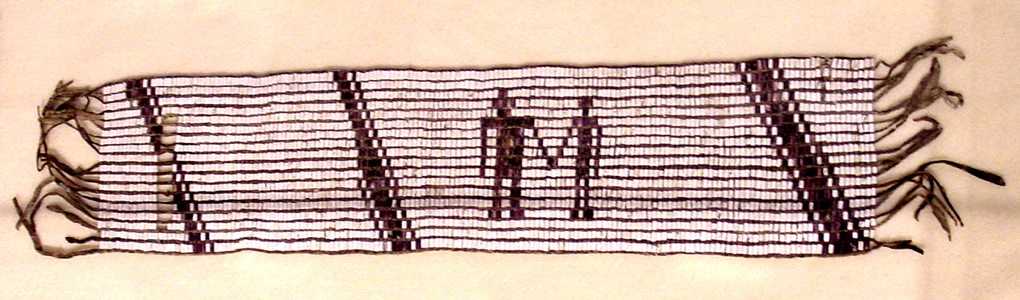
So, just how likely is it that salon attendees and salonnières would have had an awareness of trade beads? Well, we can’t know for sure, but there are connections between the Mancini Salon and Aphra Behn, the author of Oroonoko, and neither woman was ignorant of the global tensions and active colonialism occurring around them, whether in the colonies or the metropole. We don’t know if Aphra Behn attended the Duchess’ salon, but Behn did write about Mancini in her novella The History of the Nun (1689), and translated Bernard le Bovier de Fontenelle’s Entretiens sur la Pluralité des Mondes (1686) into the English A Discovery of New Worlds (1688) shortly after Mancini read it in her salon. So there is a possibility that Oroonoko and its discussions on slavery (and trading beads) could have been read at Mancini’s salon.
Daisy Glassett-King is a third-year student in the English department at the University of York.