The Three Minute Thesis (3MT) competition doesn’t just celebrate great research. It sharpens the skills of our students, helping bring their research to life. Jenny, the 2025 third place winner, stepped up to the challenge, summarising years of complex PhD work into a concise, compelling three-minute pitch.
Jenny, PhD in Environmental Geography, Department of Environment and Geography

Mangrove forests as a defence against tsunamis
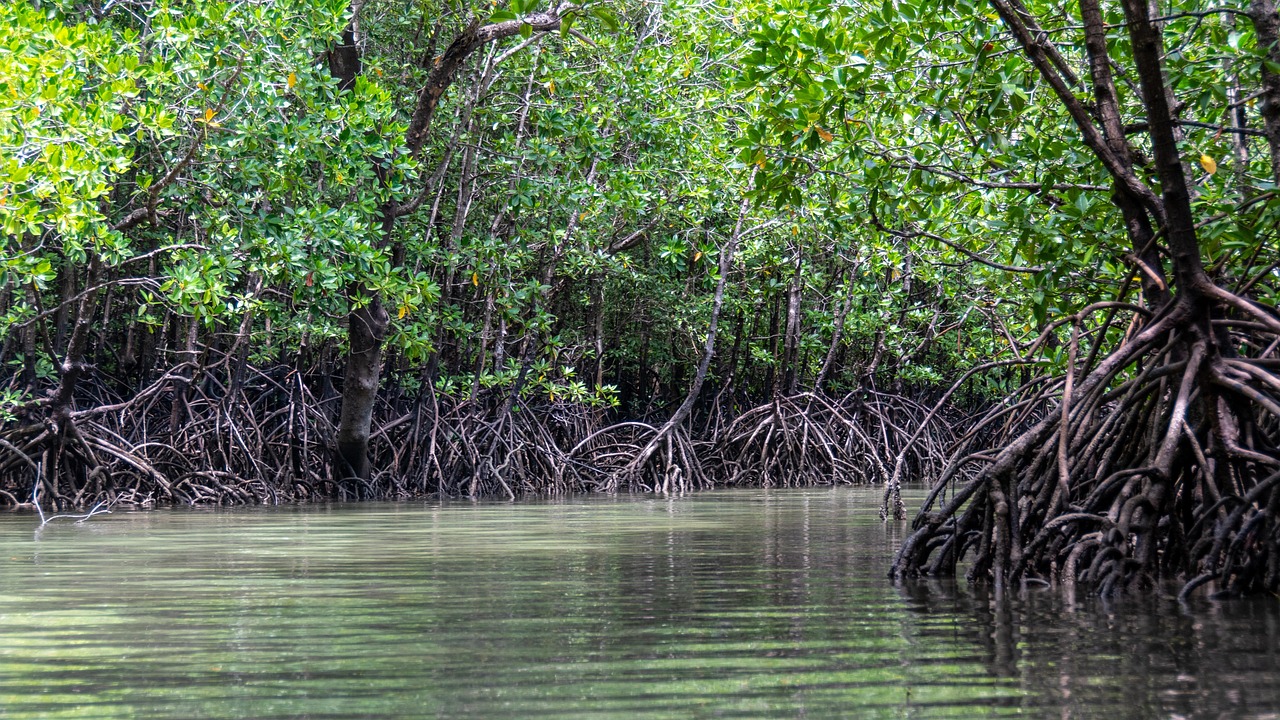
“Mangrove trees are a type of tropical coastal vegetation which have been used by local communities for storm protection for generations. With their dense root systems and tangled branches, these trees may also act as a shield against tsunamis.
“Recent decades have seen an increase in mangrove deforestation for tourism, shrimp farms, and urban land, leaving coastal communities vulnerable. Satellite imagery after the 2004 tsunami shows a distinct increase in damage to settlements where this deforestation had taken place. Many locals stated that the devastation and lives lost from the tsunami could have been avoided if these forests had been protected.
“Mangroves also provide a wide range of benefits for the local communities and ecosystems. They can reduce erosion, stabilise soil, store carbon, and provide nursery grounds for fisheries. More evidence of the protective role that mangroves play against tsunamis would support conservation efforts to reestablish the dwindling numbers of mangroves.”
My research
“My research involves creating numerical models of waves travelling through mangrove forests. This allows me to quantify the level of protection the trees can provide against tsunamis.
“In numerical modelling, you use a computer to bring together equations which describe a physical situation. In the same way you can use an equation to tell you how far a ball will travel if you throw it at a certain speed or angle, I can use equations to describe how far a wave will travel if it has a certain amplitude, or how much it will slow down as it encounters a forest.
“I can then use this model to run experiments, just like you would in a lab. For example, I am currently running experiments where I vary the water depth and the wave height. A tsunami could be 2 or 3 times as high as a mangrove forest. So it’s important to know if these trees are still able to protect communities in the worst-case scenarios.
“I will also be experimenting with different forest layouts. If we want to plant more mangroves to protect people from tsunamis, what is the optimum layout? Should the trees be planted in structured rows, or in a more random, natural configuration? My model will allow me to design a forest which provides the maximum level of protection.”

A growing risk
“Climate change is causing sea levels to rise, making the risk of more deadly tsunamis grow by the day. Recent research examining the relationship between sea-level rise and tsunami impact finds a doubling of distance travelled by the wave, and a rapidly increasing risk to life.
“The results of my research will enable a forest with maximum levels of protection to be designed, whilst accounting for socio-economic factors, including local livelihoods.”
My background
“I joined York as a PhD student in the Department of Environment and Geography. I previously did physics, where I studied topics like electromagnetism and quantum mechanics, so it may seem a bit of a jump to end up researching tsunamis. However, I focus on the physics of tsunamis – how they move and interact with other objects.
“I was able to get into this field as I took courses during my undergraduate degree on fluid dynamics. I learned to use equations to describe the movement of fluids – for example the way gases or liquids mix together, or even how particles form into stars or galaxies.
“During my master’s degree, I had my first experience with numerical modelling. I created simulations of light transport through coral. This helped me to understand how the coral structures allow them to capture enough light to survive in low-light areas.
“Between modelling in my Masters thesis, and taking fluid dynamics courses, I was able to apply my knowledge from physics in a different field.
“I decided to come to York because I was really interested in the research being done here. The campus is in a beautiful area. I enjoy taking a walk around the lake while I take a break from coding, and all of the wildlife.”
The competition
“The Three Minute Thesis was a really fun competition. It’s a great way of looking at your research from a different angle. A PhD is three or four years long, so it’s easy to lose track of the big picture. Having the challenge of summarising it all in 3 minutes really helped me to remember my overall aims.
“It can also help you to understand your own research better. Having to explain it in such a short time, to people who may know nothing about your field, means you have to be confident in what you’re talking about. You learn to be able to take a complex idea and break it down into a much more simple description.
“It was great to be able to meet other people in the competition, and to find out more about the research happening in other departments around the University. It was also invaluable for my presentation skills. I learned how to stand as I present, to look and sound confident, pace my speech, and put emphasis on different words are all things I will take forward into any future presentations.”
Leave a Reply