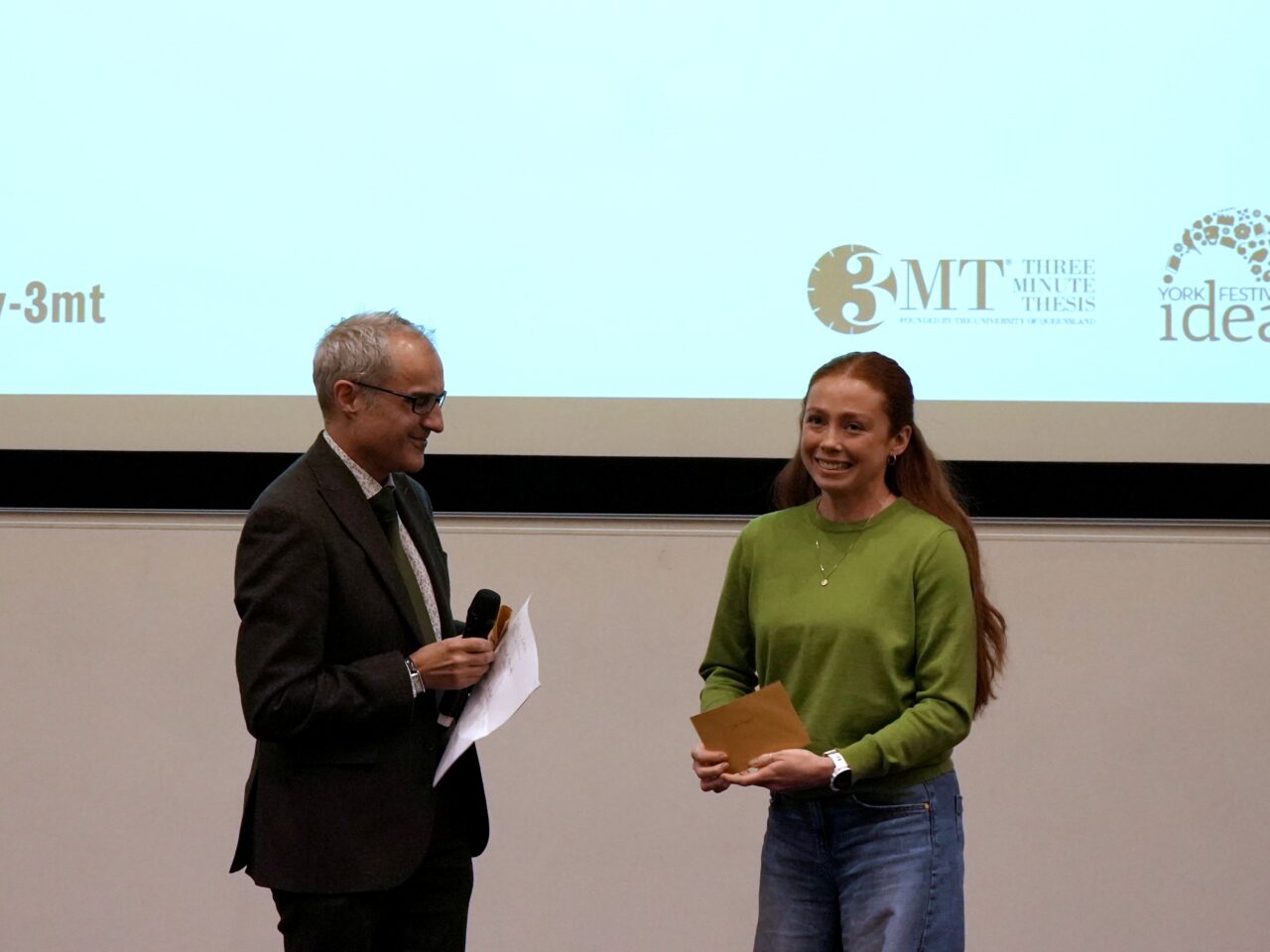
The Three Minute Thesis (3MT) competition doesn’t just celebrate great research; it sharpens the skills of our students, helping bring their research to life. Lily, the 2025 winner, stepped up to the challenge, summarising years of complex PhD work into a concise, compelling three-minute pitch.
Lily, PhD in Psychology, Department of Psychology

“Psychology is the science of the mind. It helps us understand how we think, feel, and behave, from the decisions we make, to the way we see the world. What makes psychology so powerful is its presence in every moment of our lives. I’ve always been drawn to that idea, which led me to pursue a PhD.
“My research is focused on one critical question: why do we believe things that aren’t true? We live in a world where information is everywhere, especially online, but not everything we see is based on facts.
“Misinformation is false or misleading information that is shared as if it’s true, which can have dangerous consequences. In my PhD, I’m investigating how our social identities affect how we judge and share information online.”
Belonging shapes belief
“Social identity is the way we see ourselves and the groups we belong to. Some parts of our social identities are based on our beliefs, like our religion or political views. Other parts are based on our status, like our job or where we live.
“Research has found that belief-based identities are more likely to influence the way we think and feel about things, especially when we’re dealing with people from our own group. This is known as ingroup bias, which means we often trust and agree more with people who share something important in common with us.
“There’s already some evidence that ingroup bias makes people more likely to believe misinformation, but scientists haven’t fully explored how this works with different parts of our identity. My research uses this belief vs status framework to understand how these different parts of our identity affect whether we believe or share false information, and how this might change across countries or communities.”
Reducing the spread of misinformation
“The impact of my research lies in its potential to help us understand and ultimately reduce the spread of misinformation in a way that truly reflects how people behave in the real world.
“While many existing solutions focus on improving people’s thinking skills or fact-checking information, they often overlook the powerful influence of our identity. A one-size-fits-all approach isn’t enough.
“This is especially important for designing interventions that actually work across different communities and countries. If we can build strategies that take identity into account, we can help people make better decisions.
“Beyond academic impact, I hope my work will inform the design of social media platforms, public health campaigns, and educational tools to create a safer and more trustworthy information environment. In a world where misinformation affects us all, this kind of insight is more valuable than ever.”
My background
“I’ve always been one to ask a lot of questions. Even as a child, I was constantly trying to make sense of the world around me. My Year 2 teacher once told my parents I’d grow up to be a scientist! She might have missed the “social” part, but she wasn’t wrong.
“Growing up in Dubai and attending an international school introduced me to people from all over the world. I quickly realised how different people can be, and how much our backgrounds and identities shape the way we think and see the world. That fascination with people and behaviour eventually led me to psychology.”
A different route to university
“Back in the UK, I studied Maths, Biology, Chemistry and Psychology at A-level. Psychology quickly became my favourite subject, but after struggling in exams, I wasn’t sure university was still within reach.
“Not one to give up, I took a different route and completed a distance-learning Access to Higher Education Diploma while working full-time. It was tough, but I gained confidence. I applied to the University of York and was accepted!
“From there, everything changed. I loved my degree: it opened doors to knowledge and resources that meant I went on to graduate with a First.
“Afterwards, I began working for a Tech start-up, where one day my CEO asked me if I’d ever thought about doing a PhD. The rest was history!”
Three Minute Thesis
“Taking part in the Three Minute Thesis (3MT) competition was a big challenge, but one that was so rewarding. The aim of the competition is to explain your PhD research in just three minutes. It sounds simple, but it’s not easy to sum up years of work in such a short time! To take part, I had to think really carefully about what my research was contributing and why it matters.
“The University gave us brilliant training that helped me practice explaining my research in a clear and interesting way. I learned how to keep people’s attention, even if they didn’t know anything about psychology. I did this by focusing on telling my story in a way anyone could understand.
“Taking part in this process improved my public speaking, confidence, and storytelling skills. I also learned how to explain difficult ideas, so anyone could understand them.
“Most importantly, I learned how to connect with people through my research, by focusing on what really matters to them. These are really valuable skills, not just for research, but for any career where communication, empathy, and clarity are key.”
A better tomorrow
“Winning the competition gave me the chance to present my work to lots of different people. Research isn’t just for scientists, it’s something that should be shared with everyone. Especially when it can make a real difference in the world.
“When I applied to York for my undergraduate degree, I wrote in my personal statement that one day I hoped to go on to complete a PhD. I didn’t know how I’d get there, but I never gave up on the idea. And now, here I am, doing research to make a better tomorrow.”

Leave a Reply